
ZATCA E-Invoicing for Salons & Clinics: How to Register for Fatoorah Phase 2 in Saudi Arabia
WAJ Team
August 20, 2026
-1.png&w=1200&q=75)
E-invoicing in Saudi Arabia has quietly become mandatory for almost every business including small and mid-size salons, spas, and clinics. With Wave 24 of ZATCA’s Phase 2, the threshold dropped to just SAR 375,000 in annual VATable revenue, with an integration deadline of 30 June 2026. In practice that means near-universal coverage: if your salon is busy, you are almost certainly in scope. This guide breaks down ZATCA e-invoicing in plain language and walks you through registering for Phase 2 and issuing compliant invoices.
Note: This is a practical overview, not tax or legal advice. ZATCA’s requirements and wave notifications are updated over time; always confirm your specific obligations with ZATCA or a certified provider.
The two phases, explained simply
ZATCA (the Zakat, Tax and Customs Authority) runs Saudi Arabia’s e-invoicing program, known as Fatoorah, in two phases.
Press enter or click to view image in full size
- Phase 1 (Generation) has applied to all VAT-registered businesses since 4 December 2021. It ended handwritten and word-processor invoices: you must issue structured electronic invoices from a compliant system, each with a QR code, and store them properly.
- Phase 2 (Integration) began on 1 January 2023 and is rolling out in waves by turnover. It adds a big step: your invoicing system must connect directly to ZATCA’s Fatoora platform so invoices are validated or reported in real time.
ZATCA notifies each wave at least six months before its integration date. Wave 23 (revenue above SAR 750,000) had a deadline of 31 March 2026, and Wave 24 (revenue above SAR 375,000) the largest wave so far had a deadline of 30 June 2026, when the penalty waiver ended and full enforcement began.
Standard vs simplified invoices which one you issue
This distinction matters because it changes how your invoices are handled:
- Simplified tax invoices (B2C) are what most salons issue day to day a receipt to an individual client. Under Phase 2 these follow a reporting model: you issue the invoice with its QR code and report it to ZATCA within 24 hours.
- Standard tax invoices (B2B/B2G) for example, invoicing a company or a government entity follow a clearance model, where ZATCA validates the invoice before you share it with the buyer.
Every compliant invoice must be in UBL 2.1 XML format (or PDF/A-3 with embedded XML), carry a cryptographic stamp and digital signature, a unique UUID, and a QR code. Plain PDFs, images, and spreadsheet files do not qualify.
What you need before you start
- Active VAT registration with ZATCA and your VAT number.
- Confirmation of whether you have been notified for a wave (Wave 24’s SAR 375,000 threshold captures most active salons).
- A ZATCA-certified e-invoicing solution a POS or system that supports Phase 2 integration, cryptographic stamping, and the Fatoora APIs.
- Access to ZATCA’s Fatoora portal to onboard your solution.
Step-by-step: registering for Phase 2 integration
The technical details sit mostly inside your software, but here is the path every business follows.
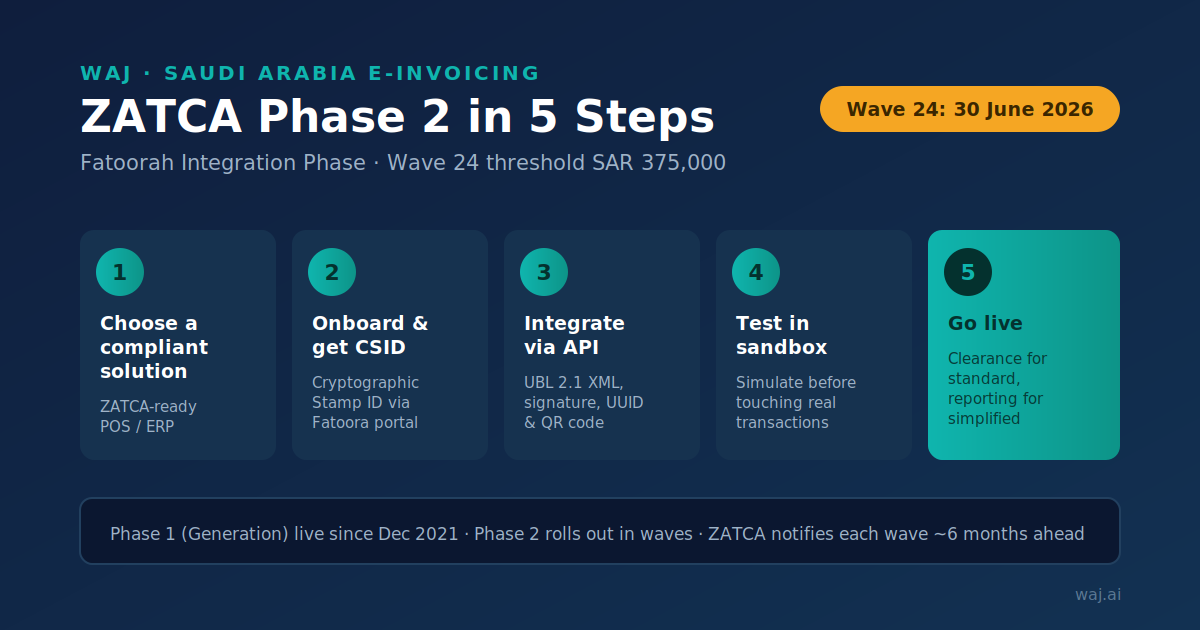
- Choose a compliant solution. Select a POS or invoicing system that is certified for ZATCA Phase 2. This single decision removes most of the technical burden, because a good vendor handles stamping, formatting, and submission for you.
- Onboard and obtain your CSID. Working through the Fatoora portal, your solution requests a Cryptographic Stamp Identifier (CSID) your business’s official digital identity in the e-invoicing system. This is what proves each invoice genuinely came from you.
- Integrate via the Fatoora APIs. Your system connects to ZATCA so it can generate UBL 2.1 XML invoices with the required signature, UUID, and QR code, and submit them for clearance or reporting.
- Test in the sandbox. Before going live, use ZATCA’s testing environment to simulate invoice submission and catch any issues without affecting real transactions.
- Go live. Activate the live integration. From this point, standard invoices are cleared and simplified invoices are reported automatically as you trade.
Common mistakes salons make
A few pitfalls come up again and again:
- Assuming “small means exempt.” Wave 24 dropped the threshold to SAR 375,000 specifically to bring SMEs in. A single busy chair can cross that line.
- Treating a plain PDF as an e-invoice. Only structured XML with the stamp, UUID, and QR counts. A designed receipt is not compliant on its own.
- Leaving it to the last week. Onboarding, getting your CSID, and testing take time. Enforcement and penalties are real once your deadline passes.
- Choosing a non-certified system. If your POS cannot do Phase 2, no amount of manual effort will make your invoices compliant.
-1.png)
Getting compliant without the headache
The realistic path for a salon or clinic is not to build any of this yourself it is to run on a system that is certified for ZATCA Phase 2 so compliance happens automatically at checkout. When you choose your platform, insist on Phase 2 certification, cryptographic stamping, both invoice types, and Arabic-first operation.
WAJ is the all-in-one, Arabic-first operating system for salons, spas, and clinics across the region bookings, POS, and client records in one place and it keeps you covered on compliance in every major market it serves. JoFotara in Jordan and VAT e-invoicing in the UAE are built in, and ZATCA Phase 2 in Saudi Arabia is handled through a certified integration partner. In practice that means your invoices are produced in the right format, stamped, reported or cleared, and returned with their QR code automatically at checkout with nothing extra for your team to do.
Book a free demo or start a free trial, and let’s make compliance the part of your business you never have to think about.
Follow WAJ on Google
Add WAJ as a preferred source to see more of our articles in your Google Search results, marked with a "preferred" badge.