
Salon Management Software ( What Features Actually Matter? )
WAJ Team
June 7, 2026

Introduction: The Hidden Cost of Choosing the Wrong Software
Every year, thousands of salon owners make the same costly mistake: they choose their management software based primarily on price, then spend the next 12 months paying for that decision in ways they never anticipated.
The cheapest booking tool becomes expensive when it cannot send automated appointment reminders and your no-show rate climbs to 18%. The free POS system turns into a liability when its reporting cannot tell you which services are actually profitable. The platform with no WhatsApp integration quietly erodes customer relationships in markets where instant messaging is the default communication channel.
Industry insight: Salon businesses that implement automated appointment reminders report no-show rate reductions of 30-50%. For a salon taking 200 appointments per week at an average service value of $45, that can translate to thousands of dollars recovered each month.
This guide was written for salon owners, barbershop operators, spa managers, and beauty business entrepreneurs who want to make an informed decision before committing to a salon management system. Whether you are opening your first location or standardizing software across a growing chain, the following pages will walk you through the 12 features that genuinely drive business outcomes, the red flags that signal a bad investment, and a practical scorecard to compare solutions objectively.
Salon software categories covered in this guide include: salon booking software, beauty salon software, barbershop management software, salon POS software, salon CRM, and full-suite salon management systems.
Why Salon Management Software Has Become Essential
.png)
The beauty industry has changed faster in the last five years than in the previous two decades. Customer expectations, competitive dynamics, and communication channels have all shifted significantly, making manual operations increasingly difficult to sustain.
Customer Expectations for Instant Booking
Today's salon clients expect to book an appointment at 11pm on a Sunday from their phone, receive a confirmation within seconds, and get a reminder 24 hours before their visit. According to multiple industry surveys, over 60% of beauty service appointments are now booked outside of business hours. A salon that cannot accommodate this expectation loses bookings to competitors who can.
Online booking is no longer a premium feature. It is a baseline requirement for any salon that wants to remain competitive in 2026.
The Rise of WhatsApp and Mobile Communication
In many markets across the Middle East, Europe, Africa, and Asia, WhatsApp has replaced phone calls and SMS as the primary customer communication channel. For salons operating in these regions, a salon management system that lacks WhatsApp integration is effectively missing one of the most important touchpoints in the customer journey.
Booking confirmations, appointment reminders, post-visit follow-ups, and promotional messages all perform significantly better when delivered via the channel the customer actually uses every day.
The Competitive Landscape in the Beauty Industry
Independent salons now compete not just with neighboring businesses but with franchise chains, on-demand beauty services, and well-funded startups with polished digital experiences. The operational efficiency enabled by good salon scheduling software directly impacts a business's ability to serve more clients, retain existing ones, and reduce the administrative overhead that consumes profitable working hours.
The Operational Cost of Manual Scheduling
Manual scheduling creates a predictable set of problems: double bookings, missed reminders, inefficient staff allocation, no visibility into which services or stylists generate the most revenue, and no mechanism for systematically reactivating dormant clients. These are not minor inconveniences. They represent measurable revenue leakage that accumulates over time.
The 12 Features That Actually Matter
Not all features are created equal. The following 12 capabilities consistently separate salon management software that genuinely improves business outcomes from software that merely adds complexity. Each section explains what the feature does, why it matters, and what to look for when evaluating solutions.
1. Online Booking
Online booking is the front door of your salon in 2026. A proper salon booking software solution should allow clients to view real-time availability, select their preferred stylist or service provider, book a specific time slot, receive an instant confirmation, and complete or partially pre-pay if required.
What to look for: A mobile-optimized booking interface that loads quickly, requires minimal steps to complete a reservation, integrates with Google Reserve and similar platforms, and allows configurable booking windows (e.g., no bookings less than 2 hours in advance). The system should also support buffer times between appointments to allow for preparation and cleanup.
• Mobile-optimized booking page with fast load times
• Google Calendar and Apple Calendar sync
• Configurable booking windows and buffer times
• Multi-service booking in a single transaction
• Deposit and prepayment capabilities
2. WhatsApp Integration
For salons serving customers in WhatsApp-heavy markets, this single feature can have more impact on client satisfaction and retention than almost any other. A robust WhatsApp integration should handle booking confirmations sent automatically after each reservation, appointment reminders dispatched 24-48 hours in advance, follow-up messages after visits requesting reviews or re-bookings, and outbound marketing campaigns for promotions or seasonal offers.
What to look for: Native WhatsApp Business API integration rather than third-party workarounds, two-way messaging capability, template-based messaging that complies with WhatsApp's policies, and automation triggers that operate without manual intervention.
Platform note: WAJ is one example of a salon management platform built with WhatsApp communication as a core feature rather than an afterthought, enabling salons in messaging-first markets to maintain consistent, automated contact with their clients throughout the customer lifecycle.
3. Automated Appointment Reminders
Appointment no-shows are one of the most significant sources of revenue loss for beauty businesses. A well-configured reminder sequence, typically combining a 48-hour reminder and a same-day reminder, can reduce no-shows by 30-50%.
What to look for: Multi-channel reminders (WhatsApp, SMS, email), configurable timing, two-way confirmation that allows clients to confirm or cancel via a reply, automatic waitlist filling when a cancellation is received, and analytics showing reminder effectiveness over time.
4. Staff Scheduling
Staff scheduling in a salon environment is more complex than it might appear. A system must account for individual stylist availability, vacation and time-off requests, service-specific qualification requirements (not every stylist offers every service), room or equipment constraints in spa environments, and booking capacity by time of day.
What to look for: Visual scheduling interface, individual staff calendars with availability rules, break and lunch management, vacation and time-off approval workflows, and capacity planning tools that help managers prevent both overbooking and underutilization.
5. Customer CRM
A salon CRM is the memory of your business. It records every client's visit history, preferred services and products, stylist preferences, allergy or sensitivity notes, birthday and anniversary dates, and contact information. This data is the foundation of effective personalization, retention campaigns, and client relationship management.
What to look for: Complete client profiles with visit history and notes, customizable fields for salon-specific information, client segmentation by spend, frequency, or service type, birthday automation, and the ability to export client data. Never purchase software that locks your customer data in a proprietary format with no export option.
6. Point of Sale (POS)
The checkout experience is the last impression a client has before leaving your salon. A good salon POS software solution should handle service payments, retail product sales, gift cards, package and membership redemptions, split payments, and tip management, all within a smooth, fast interface.
What to look for: Integration with major payment processors, support for multiple payment methods including cash, card, and digital wallets, gift card and voucher management, end-of-day reporting, and a checkout process that can be completed in under 60 seconds.
7. Inventory Management
.png)
Salons carry two distinct types of inventory: professional products used during services and retail products sold to clients. Both need tracking. Running out of a professional color product mid-booking is a serious operational failure. Running out of retail inventory means missed sales opportunities.
What to look for: Automatic stock deduction when products are used in a service or sold at checkout, low stock alerts, supplier management, purchase order creation, and reporting on which retail products move fastest and which are sitting on shelves.
8. Reporting and Analytics
Reporting is the feature that separates successful salon owners from ones who run their business on instinct alone. A comprehensive salon management system should provide daily, weekly, and monthly revenue breakdowns, performance by service category and individual service, staff performance metrics including revenue per stylist and average service time, booking source analysis, client retention rates and churn indicators, and retail-to-service revenue ratios.
What to look for: Pre-built reports that cover standard beauty business KPIs, customizable date ranges, exportable data in CSV or Excel format, and dashboards that can be accessed from mobile devices.
Key metric: Salon businesses that actively use reporting dashboards are significantly more likely to identify and act on underperforming services, overstaffed time slots, and declining client retention before these become critical business problems.
9. Multi-Location Management
For salon brands operating or planning to operate across multiple locations, software scalability is non-negotiable. A multi-location salon management system must allow centralized control of branding, pricing, and service menus while supporting location-specific customization where necessary.
What to look for: Centralized reporting across all locations, the ability to transfer client records between branches, staff management that reflects each location's team, location-specific pricing and availability rules, and a single login with appropriate permission levels for owners, managers, and front desk staff.
10. Marketing Automation
Marketing automation turns your client database into a revenue engine. Rather than sending manual promotional messages, a well-configured marketing module sends the right message to the right client at the right time, including win-back campaigns for clients who have not returned in 60 or 90 days, birthday messages with a special offer, follow-up messages requesting a review after a positive visit, and loyalty program updates.
What to look for: Automated campaign triggers based on client behavior (last visit date, spend threshold, service type), segmentation capabilities, campaign performance reporting, and WhatsApp or SMS delivery rather than email-only.
11. Mobile Access
Salon owners and managers are rarely sitting at a desk. A mobile-accessible management platform allows you to review tomorrow's bookings while commuting, check revenue figures from anywhere, manage staff schedules when you receive a last-minute sick call, and respond to client inquiries in real time.
What to look for: A responsive web interface or a native mobile app, full booking and schedule management on mobile, access to core reports from a smartphone, and push notification support for important alerts.
12. AI and Automation Features
Artificial intelligence is entering the salon software category in meaningful ways. The most practical current applications include AI-powered booking assistants that can handle inbound booking requests via chat, predictive scheduling that suggests optimal staffing based on historical demand patterns, automated service recommendations based on a client's history, and AI-generated performance insights that highlight anomalies in revenue or booking data.
What to look for: Be pragmatic here. Prioritize AI features that solve specific operational problems over those that sound impressive in a product demo. An AI booking chatbot that actually reduces front-desk call volume is valuable. An AI feature that simply re-labels existing functionality is not.
Features That Are Overrated
The salon software market is not immune to feature bloat. Several capabilities appear frequently in marketing materials but deliver limited practical value for most beauty businesses.
• Augmented reality hair and makeup try-on features are technically impressive but have poor completion and conversion rates in real-world salon environments. Most clients do not use them. Virtual try-on tools:
• Highly complex tiered loyalty programs with multiple earning rules are difficult for staff to explain and for clients to understand. Simple, transparent loyalty structures consistently outperform complicated ones. Complex loyalty point systems:
• Bundled social media tools rarely match the capabilities of dedicated platforms like Later or Buffer. They add interface complexity without delivering meaningful marketing value. Social media scheduling:
• Generic website builders included in salon software tend to produce low-quality, poorly optimized websites. A dedicated website is almost always a better investment. Built-in website builders:
• Fingerprint or facial recognition check-in sounds futuristic but adds minimal value over a simple name confirmation for most salon environments. Biometric check-in:
Red Flags When Choosing Salon Software
Knowing what to avoid is as important as knowing what to look for. The following warning signs frequently indicate a poor long-term investment.
1. Hidden fees that emerge after the initial contract is signed, including charges for additional staff accounts, SMS or WhatsApp messages, reporting features, or customer support tiers.
2. Long-term contracts requiring 12 or 24-month commitments with significant cancellation penalties. Reputable software providers are confident enough in their product to offer monthly billing.
3. Poor customer support with no phone or live chat option, response times measured in days rather than hours, and support teams that cannot speak the language of your market.
4. Weak integrations that do not connect with payment processors, accounting software like QuickBooks or Xero, or communication platforms you already rely on.
5. Data ownership restrictions that prevent you from exporting your full client database at any time. This is a fundamental right, and any software that restricts it should be disqualified immediately.
6. Limited or locked reporting where key metrics require an upgraded plan, exports are restricted, or dashboards cannot be customized to reflect your specific KPIs.
7. No free trial or demo period. Any legitimate platform should allow you to test its features before committing to a paid subscription.
8. Onboarding that requires a specialized consultant and carries an additional setup fee. Good salon scheduling software should be intuitive enough to be configured by the business owner.
Questions Every Salon Owner Should Ask Before Buying
Use this checklist when evaluating any salon management system. Request written answers where necessary.
9. What is the total monthly cost at my staff size, including all add-ons and messaging fees?
10. Is there a per-SMS or per-WhatsApp message charge, and what are the rate limits?
11. Can I export my complete client database in a standard format (CSV, Excel) at any time without restriction?
12. What payment processors does the POS integrate with, and what are the transaction fees?
13. Does the online booking page work on mobile without requiring clients to download an app?
14. How is customer support delivered (phone, chat, email), and what are the guaranteed response times?
15. Is WhatsApp Business API integration included, or is it a paid add-on?
16. What are the multi-location pricing and management capabilities?
17. Can I set different permission levels for owners, managers, and front desk staff?
18. What does the onboarding process involve, and how long does initial setup typically take?
19. Is there a minimum contract period, and what are the cancellation terms?
20. How is data backed up, and what is the recovery process in case of a system outage?
21. Does the reporting module cover staff performance, service profitability, and client retention?
22. What integrations are available with accounting software, Google Calendar, and social platforms?
23. Has the platform been used by businesses of my size and type, and can I speak to a reference customer?
Comparison Framework: Salon Software Scorecard
Use the scorecard below to evaluate salon software solutions objectively. Score each category out of 5 based on your direct assessment during demos and trials. Multiply each score by the category weight to calculate a weighted total.
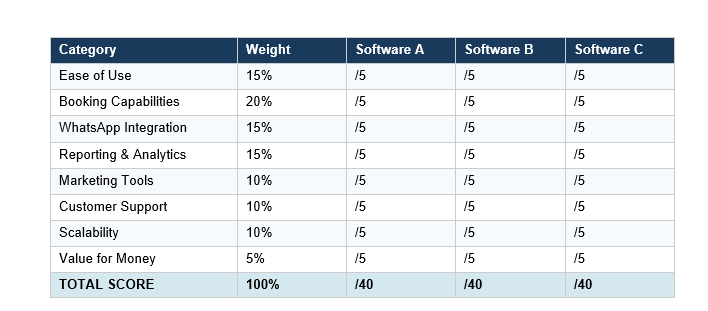
Instructions: Score each solution from 1 (poor) to 5 (excellent) in each category. Multiply the score by the weight percentage to get the weighted contribution, then sum all contributions for a total out of 5. The solution with the highest weighted score is the strongest fit based on these priorities. Adjust category weights to reflect what matters most for your specific business.
Future Trends in Salon Technology
The salon software market is evolving rapidly. Understanding where the industry is heading helps you choose a platform built for the future rather than one that will require replacement in two years.
AI Booking Assistants
Conversational AI is moving from novelty to utility. AI booking assistants integrated into WhatsApp, website chat widgets, or Instagram DMs can handle inbound appointment requests 24/7, qualify client preferences, present available time slots, and confirm bookings without any human involvement. For high-volume salons, this can meaningfully reduce front-desk workload.
Conversational Booking
The next evolution beyond online booking forms is conversational booking, where clients describe what they want in natural language and the system interprets the request, matches it to appropriate services and availability, and completes the booking in a messaging thread. Several platforms are already piloting this capability.
Customer Retention Automation
Retention automation is moving beyond basic win-back campaigns. Predictive models can now identify clients who show early signs of churning based on changes in visit frequency, service value, or engagement with communications, and trigger targeted interventions before the client fully disengages.
Predictive Scheduling
Machine learning models trained on historical booking data can help salon managers anticipate demand fluctuations, optimize staff scheduling to match expected client volumes, and reduce both understaffing and costly overstaffing during slower periods.
Personalized Marketing at Scale
As client data becomes richer and AI tools become more accessible, personalized marketing is moving from a luxury reserved for large chains to a capability available to independent salons. Dynamic messaging that references a client's last service, recommends a complementary treatment, or offers a personalized promotion based on their purchase history drives significantly higher engagement than generic broadcast messages.
Conclusion: The Right Software Is an Investment, Not a Cost
The best salon management software is not necessarily the cheapest. It is the one that saves your team meaningful time, reduces revenue lost to no-shows and poor scheduling, improves the client experience at every touchpoint, provides the reporting intelligence to make better business decisions, and scales with your business as it grows.
Platforms vary enormously in their practical utility. Some offer an impressive feature list in a demo environment but prove difficult to use in daily operations. Others are straightforward and well-supported but lack the automation capabilities needed to compete effectively in a digital-first marketplace.
When evaluating salon booking software, beauty salon software, or full-suite salon management systems, hold every candidate to the standard of this question: does this software make my business meaningfully better? If the answer is not clearly yes, keep looking.
Several modern platforms have emerged that attempt to combine the full range of capabilities discussed in this guide into a single, cohesive system. WAJ is one such platform: a salon management system designed specifically for modern beauty businesses, integrating online booking, WhatsApp-based customer communication, automated reminders, point-of-sale functionality, staff scheduling, and business reporting in a single interface. Whether WAJ or another solution fits your specific needs, the framework in this guide will help you evaluate your options with clarity.
Take the time to properly evaluate your options, involve your front desk staff in the decision, run a genuine trial period, and choose software that your whole team will actually use. That discipline in the selection process will pay dividends for years.
Frequently Asked Questions
What is salon management software?
Salon management software is a business platform that combines online booking, appointment scheduling, staff management, client records (CRM), point-of-sale transactions, inventory tracking, and reporting tools into a single system designed specifically for beauty businesses including salons, barbershops, spas, and nail studios.
How much does salon management software typically cost?
Pricing ranges widely depending on features and business size. Entry-level tools start around $25-50/month. Mid-range full-suite platforms with automation and WhatsApp integration typically range from $75-200/month. Enterprise or multi-location solutions can exceed $300/month. Always calculate total cost including per-message fees, add-ons, and payment processing charges.
What is the most important feature in salon booking software?
For most salons, automated appointment reminders have the highest ROI of any single feature because they directly reduce no-shows, which represent significant lost revenue. Online booking is equally critical for capturing bookings outside business hours, which now represent the majority of booking activity.
Does my salon really need WhatsApp integration?
In markets where WhatsApp is the dominant communication channel (Middle East, Africa, South Asia, Southern Europe, Latin America), WhatsApp integration is not optional - it is essential. Booking confirmations, reminders, and follow-ups delivered via WhatsApp consistently outperform email and SMS in open and response rates in these regions.
What is the difference between salon scheduling software and a full salon management system?
Salon scheduling software typically focuses on appointment booking and calendar management. A full salon management system adds POS, CRM, inventory management, staff scheduling, reporting, and marketing automation. Most growing salons benefit from a full management system rather than a standalone scheduling tool.
Can barbershops use the same software as hair salons?
Yes, most modern salon management systems are suitable for barbershops with minor configuration adjustments. Look for barbershop management software that supports walk-in queue management in addition to appointments, as many barbershops operate on a hybrid model.
What should I look for in salon POS software?
A good salon POS should handle service payments, retail product sales, gift cards, memberships, tips, and split payments. It should integrate with your existing payment processor and produce end-of-day reconciliation reports. Checkout should be completable in under 60 seconds.
How do I migrate my client data to a new salon software platform?
Most reputable platforms offer data import tools that accept CSV or Excel files. Request a migration consultation during your evaluation process, ask about historical data preservation, and ensure your current platform allows a complete export before you cancel your subscription.
Is cloud-based salon software better than desktop software?
For most salons, yes. Cloud-based salon management systems provide mobile access, automatic updates, no local hardware dependency, multi-device access for managers and staff, and typically better ongoing support. Desktop software can have faster performance in some scenarios but lacks the flexibility of modern cloud platforms.
How long does it take to set up salon management software?
A well-designed platform can be operational within 1-3 days for a single-location salon. This includes configuring services, staff profiles, pricing, online booking settings, and initial data import. More complex setups with multiple locations, custom integrations, or large client databases may take 1-2 weeks.
What reporting should salon management software provide?
At minimum: daily, weekly, and monthly revenue; revenue by service and service category; staff performance including revenue per stylist; client retention and new client rates; booking source analysis; and retail product performance. More advanced platforms add predictive analytics, trend analysis, and client lifetime value calculations.
Can salon management software help with marketing?
Yes. A good salon CRM combined with marketing automation enables targeted campaigns to specific client segments, automated win-back campaigns for lapsed clients, birthday and anniversary promotions, post-visit review requests, and loyalty program management - all without requiring manual outreach for each message.
Follow WAJ on Google
Add WAJ as a preferred source to see more of our articles in your Google Search results, marked with a "preferred" badge.