
Spa Sauna Maintenance: Sauna, Steam Room and Jacuzzi Safety for Gulf Spas
WAJ Team
July 7, 2026
Good spa sauna maintenance comes down to three habits: screen and brief every guest before they use the heat, run a written daily, weekly and monthly checklist for each wet area, and test the jacuzzi water exactly as the equipment maker and your local health authority require. Do that every day and slippery floors, cloudy water and fainting guests become rare.
The wet area is often the most photographed part of a spa and the least managed. Treatment rooms have therapists in them all day. The sauna, steam room and jacuzzi have nobody, until something goes wrong.
Why the wet area needs its own system
A guest in a massage room is with a trained therapist. A guest in the steam room is alone, in heat, often after a long flight into Dubai or a full working day in Riyadh. Different risk, different process.
There is a money side too. If wet-area access is part of a package or membership (see our guide to the spa membership model in the Gulf), a closed sauna is a broken promise to people who have already paid. Skipped maintenance costs you twice: in repairs and in goodwill.
Guest safety: what to ask, tell and post
Health screening questions at booking or check-in
Reception should never give medical advice. Their job is to ask a few plain questions and point people in the right direction:
- Do you have any heart condition, high or low blood pressure, or diabetes?
- Are you pregnant or think you might be?
- Have you had alcohol, a heavy meal or any medication that makes you drowsy today?
- Have you had a cosmetic or medical treatment in the last few days, such as a peel, laser or injectables?
- Do you have any skin infection, open wound or contagious condition?
If the answer to any of these is yes, the reply is polite and simple: please check with your doctor before using the heat, and we can book you a treatment without it meanwhile. Do not argue or decide for them. Note it on their client profile.
Time limits and hydration
Post a time limit outside each room, based on your equipment maker's recommendation and presented as general guidance, not a medical rule. Tell guests to leave earlier if they feel dizzy or unwell. A sand timer on the wall helps; people really do lose track of time in the heat.
Make hydration visible: a water station right outside the wet area, and staff offering water as guests come out. In a Gulf summer, many arrive already dehydrated.
Signage that people actually read
Keep signs short, in Arabic and English, at eye level. One per room:
- Recommended time limit, as general guidance
- Leave immediately if you feel unwell, and call staff
- Guests with health conditions or who are pregnant should check with their doctor first
- Shower before entering
- No glass, no alcohol, no oils or scrubs in the jacuzzi
- Emergency call button location
Six lines get read. A laminated wall of rules does not.
Daily, weekly and monthly maintenance
Use this as a starting template and adjust it to your equipment manuals. A built-in jacuzzi and a portable one, for example, will not need the same care.
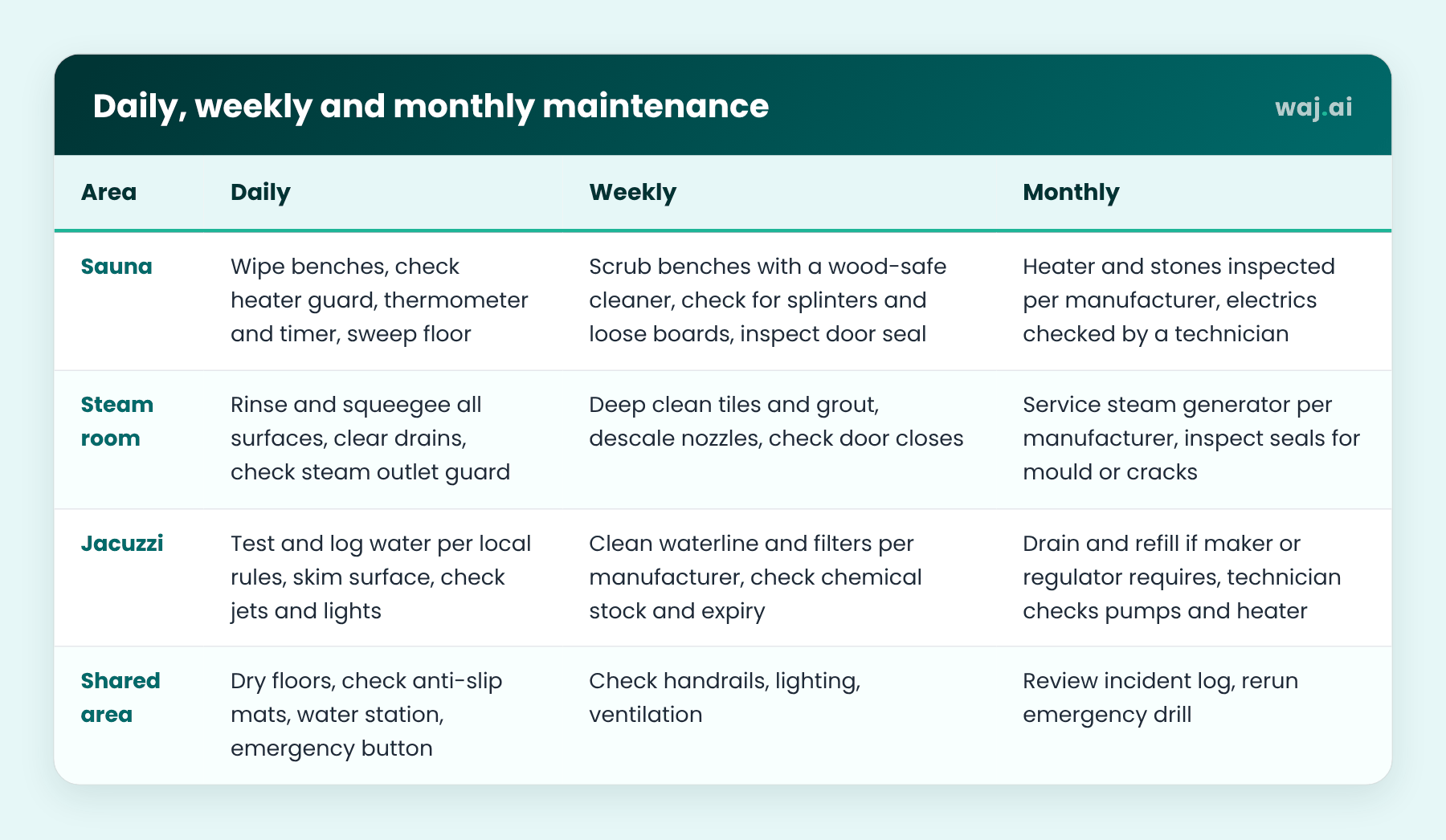
- Sauna
Daily: Wipe benches, check heater guard, thermometer and timer, sweep floor
Weekly: Scrub benches with a wood-safe cleaner, check for splinters and loose boards, inspect door seal
Monthly: Heater and stones inspected per manufacturer, electrics checked by a technician - Steam room
Daily: Rinse and squeegee all surfaces, clear drains, check steam outlet guard
Weekly: Deep clean tiles and grout, descale nozzles, check door closes
Monthly: Service steam generator per manufacturer, inspect seals for mould or cracks - Jacuzzi
Daily: Test and log water per local rules, skim surface, check jets and lights
Weekly: Clean waterline and filters per manufacturer, check chemical stock and expiry
Monthly: Drain and refill if maker or regulator requires, technician checks pumps and heater - Shared area
Daily: Dry floors, check anti-slip mats, water station, emergency button
Weekly: Check handrails, lighting, ventilation
Monthly: Review incident log, rerun emergency drill

Water treatment and testing: follow the maker and the regulator
Do not copy numbers from the internet. Chemical levels, testing frequency and drain-and-refill intervals depend on your equipment, your bather load and your local rules. Across the region, health departments and municipalities set requirements for spa water, and inspectors will ask for your records.
A sound process:
- Keep the jacuzzi manual's water-care section and your local authority's current requirements, in writing, at the wet-area station.
- Use a proper test kit or meter, calibrated as the maker says.
- Test at opening, at the intervals your rules require, and whenever the water looks or smells off.
- Log every reading with the time and the tester's name. To an inspector, an unlogged reading never happened.
- If a reading is out of range, close the jacuzzi, correct it per the maker's instructions, retest, and reopen only when it is back in range.
- Store chemicals locked and labelled, away from the wet area, as the labels and your regulator specify.
When in doubt, ask your municipality, health authority or the supplier's technician.
Cleaning that guests notice
Guests judge hygiene with their feet and noses. Hair in a drain reaches your Google reviews faster than any praise for your therapists. What works:
- Clean between peak waves, not only at closing. If ladies' hours end at 4pm and men's start at 5pm, that hour is your reset window.
- Colour-code cloths and mops per wet area, and never use them in toilets.
- Pin a checklist inside the store-room door for staff to tick and initial.
- Use only cleaning products your equipment maker approves. The wrong chemical can damage seals and void warranties.
Staff checks and who owns what
Name one wet-area lead per shift. They walk the sauna, steam room and jacuzzi on a set schedule, check temperatures, timers and guests, and sign the log. Rotate the role, but someone always holds it.
Everyone on the team should know where the emergency button, first-aid kit and power isolators are, and what to do if a guest faints. Run a short drill monthly, and in each new hire's first week.
Incident logs: write it down the same day
If a guest feels unwell, slips, gets a burn or complains about the water, log it the same day: date, time, area, what happened, who responded, what was done and whether the guest was advised to see a doctor. Keep it factual and private. It protects the guest, your staff and your licence.
Review the log monthly. Three minor slips by the steam room door in one month is a flooring problem, not bad luck.
Booking time slots to avoid overcrowding
A steam room built for six with ten inside is hotter and harder to supervise, and a packed jacuzzi strains the water treatment. Overcrowding is a safety issue.
Treat wet-area access like any bookable service: set capacity per slot, sell timed sessions, and attach wet-area time to treatments, say 30 minutes before a massage. You also get the bather numbers you need for planning water testing.
In WAJ, wet-area sessions can be bookable services with their own capacity, included in memberships and packages, with a WhatsApp reminder that carries your house rules ("please arrive 10 minutes early, shower before entering, and check with your doctor first if you are pregnant or have a health condition"). Reminders also reduce no-shows, which hurt more when slots are capped (more in our guide on how to cut no-shows). Client notes keep screening answers on file between visits.
Still at the build stage? Our guide on how to open a beauty salon or spa in Qatar covers licensing. Plan for wet-area approvals early.
Rules differ by country and emirate. Confirm them with your municipality, the DHA, DOH, MOH or local health authority, or a lawyer.
FAQ
How often should a spa sauna be cleaned?
Wipe benches and sweep daily, deep clean the wood weekly with an approved product, and have the heater inspected as the manual says.
How often should jacuzzi water be tested in a spa?
As often as your local health authority or municipality requires, and at least at opening. Test again whenever the water looks or smells wrong, and log every reading.
Can pregnant guests use the sauna or steam room?
Your team should not decide that. Ask at booking, advise pregnant guests and anyone with a health condition to check with their doctor first, and offer a treatment without heat meanwhile.
What should a spa incident log include?
Date, time, area, what happened, who responded, what was done and whether medical help was advised. Keep it factual, private and reviewed monthly.
How do I stop the steam room getting overcrowded?
Sell wet-area access in timed slots with a set capacity, so you always know how many guests will be inside.
Book a free WAJ demo to see how wet-area slots, memberships and WhatsApp reminders fit together: waj.ai/demo
Follow WAJ on Google
Add WAJ as a preferred source to see more of our articles in your Google Search results, marked with a "preferred" badge.