Salon Insurance in the Gulf: What Cover Salons, Spas and Clinics Should Consider
WAJ Team
May 23, 2026
Salon insurance is a bundle of policies, not one product. Most salons and spas in the Gulf should look at public liability, treatment (professional) liability, property and contents, equipment breakdown, business interruption, and workplace injury, plus employee health insurance, which employers in the UAE and Saudi Arabia must provide under local rules. Aesthetic clinics also need medical malpractice cover, which health regulators often require for licensing. Confirm the current rules and talk to a licensed broker before you buy.
This article is a practical overview from the operator's side, not insurance or legal advice. Policies, wordings and regulations change, and the right cover depends on your services, location and licence.
Why does a salon need insurance? Three everyday scenes
Picture three scenes. A client slips on a wet floor near the basins in a Sharjah salon. A colour service in Riyadh leaves a client with a scalp reaction and photos on social media. A water leak from the flat upstairs floods a spa in Amman a week before Eid. Each is a different kind of claim, needing a different part of your cover.
Public liability insurance for salons
Public liability covers injury to clients, visitors or passers-by, or damage to their property, caused by your premises or business. The wet-floor slip is the classic case. So is a client's handbag ruined by a spilt product.
Malls and landlords often ask for proof of public liability before handing over the keys, sometimes with a minimum limit set in the lease. Read your lease carefully.
Treatment liability and professional indemnity
This is the cover for claims that a service itself caused harm: a burn from a hot tool, an allergic reaction to colour, a skin injury from a peel, hair breakage after a chemical treatment.
Public liability usually doesn't cover this. You need treatment liability (sometimes called professional indemnity or malpractice for beauty businesses). When you speak to a broker, give a full list of every service you offer, including the ones you only do a few times a month. An unlisted service may not be covered.
Medical malpractice insurance for aesthetic clinics
Clinics are a different world. In Dubai, the DHA treats injectables and medical lasers as medical acts, for licensed clinics and qualified practitioners only. Beauty therapists can't perform medical procedures, and a salon that drifts into them is outside its licence and most likely outside its insurance too.
For licensed clinics, medical malpractice insurance for practitioners is often required by health regulators as part of licensing. The rules differ between the DHA, DOH in Abu Dhabi, the MOH and other authorities, so confirm the current requirement with your regulator and broker. Check whether the policy covers the clinic, each practitioner, or both.
Our guide to aesthetic clinic management and automation covers the record-keeping side that supports this.
Property and contents insurance
This covers the fit-out, furniture, stock and equipment against fire, theft, water damage and similar events. In a salon, the fit-out is often the biggest single investment.
Two practical points:
- Value it properly. Insure for what it would cost to replace today, not what you paid three years ago.
- Include stock. Retail products and professional stock add up quickly, especially before a busy season.
Equipment breakdown cover
Laser machines, high-end facial devices, steam rooms and hydrotherapy equipment are expensive and can fail. Equipment breakdown cover pays for repair or replacement after a sudden mechanical or electrical failure. It's often an add-on, so ask for it. Check whether the manufacturer's warranty or service contract already covers some of the risk, and keep service records, because an insurer may ask for them.
Business interruption insurance
If a fire or flood closes you for six weeks, your rent, salaries and loan payments don't stop. Business interruption cover pays for lost income and ongoing costs while you can't trade, usually only after an insured event like fire or flood.
Ask how lost income is calculated. Insurers usually look at your past revenue records, so clean sales data matters. If you've read our guide to the salon summer slow season in the Gulf, you'll know how much revenue swings by month. Make sure the policy accounts for seasonal peaks like Eid; with Eid al-Adha expected around 27 May, a closure this week would cost far more than one in August.
Employee health insurance in the UAE and Saudi Arabia
In the UAE and Saudi Arabia, employers must provide health insurance for employees under local rules. The details vary by emirate in the UAE and are set by the relevant insurance regulator, and the requirements can change. Confirm the current rules for your location and staff categories with your broker or the regulator, especially when you hire, renew visas or open a new branch.
Elsewhere in the Gulf and in Jordan, check local rules too.
Workplace injury cover
A cut, a burn or a back injury can keep a therapist off work. Ask your broker how workplace injury is handled where you operate, whether through a separate policy, an extension of another one, or employer obligations under labour law.
Read the exclusions before you sign
The exclusions page is where most surprises live. Look for:
- Chemical treatments: some policies exclude or limit keratin, relaxers, chemical peels or lightening.
- Lasers and energy-based devices: often excluded from salon policies, or covered only for licensed clinics and qualified operators.
- Unlicensed services: anything outside your trade licence is usually not covered.
- Untrained staff: cover may depend on staff holding the right qualifications.
- Missing records: some insurers limit claims where patch tests or consent weren't documented.
If a service on your menu appears in the exclusions, either get it added or stop offering it until you do.
Claims documentation: what to keep
Insurance only works if you can prove what happened. Build these habits now:
- An incident log. Date, time, people involved, what happened, what you did. Write it the same day.
- Signed consent forms for chemical services, peels and clinic treatments.
- Patch test records with dates and results.
- Client notes on allergies, previous reactions and products used.
- Equipment service records and staff training certificates.
- Photos of incidents and damage. Clinics may also keep before-and-after treatment photos, with consent and only where the rules allow.
Keep health information secure. In Saudi Arabia, the PDPL treats health data as sensitive, and it can't be used for marketing. In the UAE, Federal Law No. 2 of 2019 keeps health data inside the country by default. Our guide to aesthetic clinic patient retention touches on handling patient data with care.
In WAJ, client notes and history in the CRM keep allergies, previous services and products in one place against each client, and reports give you clean sales history if you ever need to support a business interruption claim. For clinics, WAJ's clinic product, Nabd, is worth asking about.
Salon insurance cover table
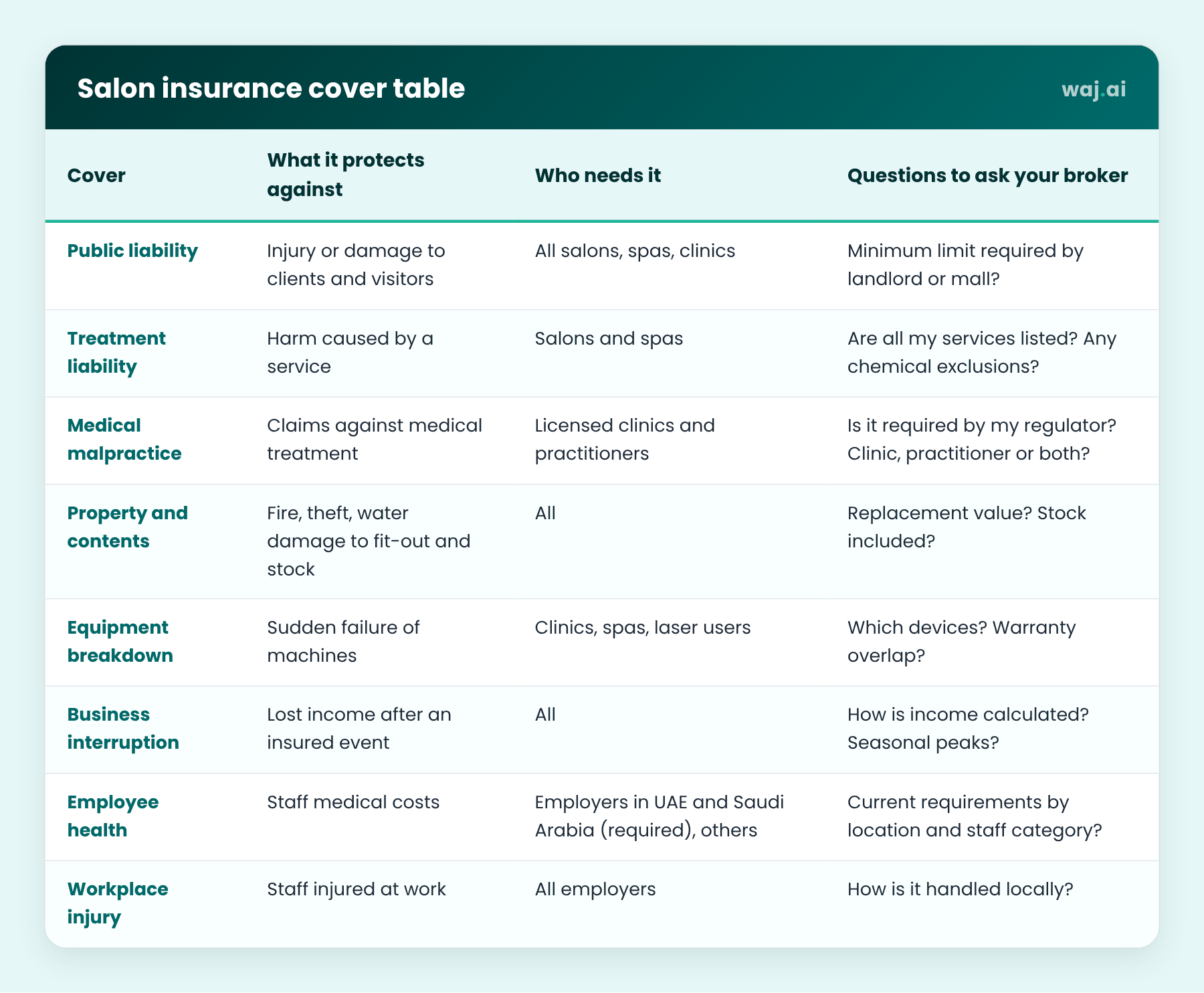
- Public liability
What it protects against: Injury or damage to clients and visitors
Who needs it: All salons, spas, clinics
Questions to ask your broker: Minimum limit required by landlord or mall? - Treatment liability
What it protects against: Harm caused by a service
Who needs it: Salons and spas
Questions to ask your broker: Are all my services listed? Any chemical exclusions? - Medical malpractice
What it protects against: Claims against medical treatment
Who needs it: Licensed clinics and practitioners
Questions to ask your broker: Is it required by my regulator? Clinic, practitioner or both? - Property and contents
What it protects against: Fire, theft, water damage to fit-out and stock
Who needs it: All
Questions to ask your broker: Replacement value? Stock included? - Equipment breakdown
What it protects against: Sudden failure of machines
Who needs it: Clinics, spas, laser users
Questions to ask your broker: Which devices? Warranty overlap? - Business interruption
What it protects against: Lost income after an insured event
Who needs it: All
Questions to ask your broker: How is income calculated? Seasonal peaks? - Employee health
What it protects against: Staff medical costs
Who needs it: Employers in UAE and Saudi Arabia (required), others
Questions to ask your broker: Current requirements by location and staff category? - Workplace injury
What it protects against: Staff injured at work
Who needs it: All employers
Questions to ask your broker: How is it handled locally?
Before you buy, get quotes from more than one licensed broker and compare the wording, not just the price. Confirm regulatory requirements with the DHA, DOH, MOH or your local regulator, and take legal advice where needed.
If you want cleaner records and reports behind your business, book a free WAJ demo: waj.ai/demo
FAQ
Do salons in the UAE need insurance?
Most need several types. Employers must provide employee health insurance, landlords often require public liability, and treatment liability protects against service claims. Confirm current requirements with a licensed broker.
Does salon insurance cover laser treatments?
Often not. Many salon policies exclude lasers and energy-based devices, and in Dubai medical lasers are medical acts for licensed clinics only. Check the exclusions.
Is malpractice insurance required for aesthetic clinics?
Health regulators often require it for licensed practitioners. Confirm with the DHA, DOH, MOH or your local authority.
What documents help with a salon insurance claim?
An incident log, signed consent forms, patch test records, client notes, equipment service records and photos.
Is this article insurance advice?
No. It's a general overview. Speak to a licensed insurance broker and, where needed, a lawyer before choosing cover.
Follow WAJ on Google
Add WAJ as a preferred source to see more of our articles in your Google Search results, marked with a "preferred" badge.