
Salon Price List Design: How to Build a Menu Clients Actually Understand
WAJ Team
May 28, 2026
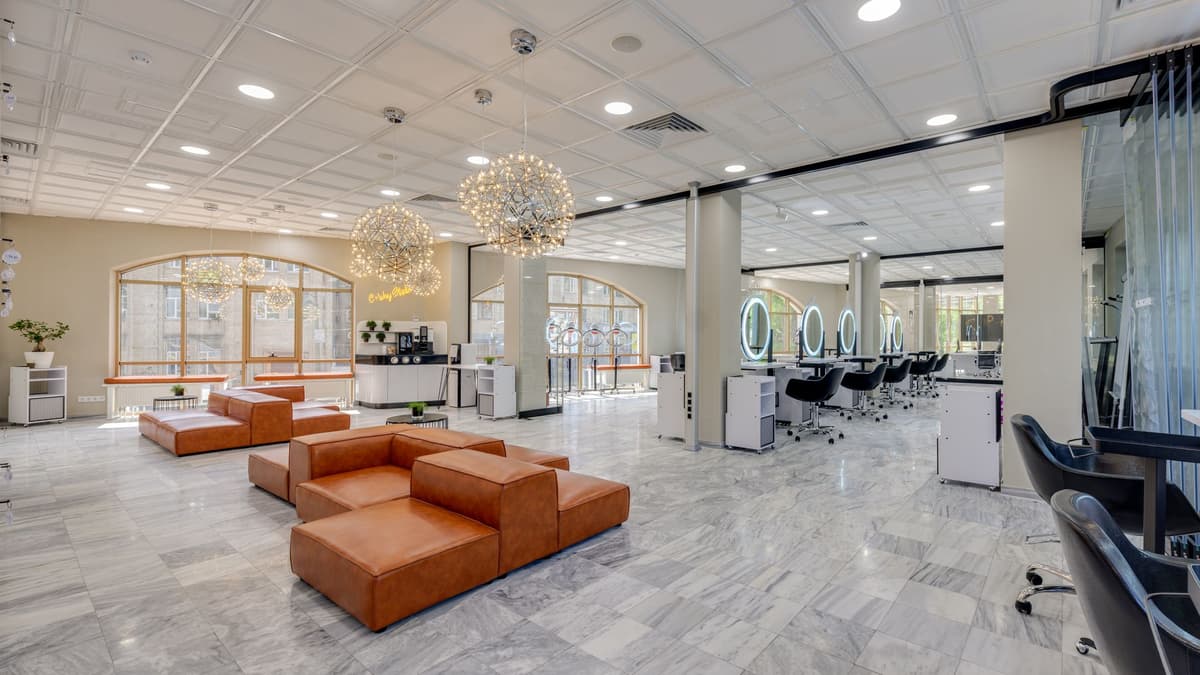
Good salon price list design means a client can find the service they want, understand what it costs, and book it without calling you to ask. In practice that comes down to a few decisions: group services by category, name them clearly in Arabic and English, be honest about "starting from" prices and surcharges, put packages where they're seen, and delete the services nobody books.
Most salon menus in the Gulf grew by accident. A service was added after a supplier visit, a promotion was never removed, and the English and Arabic names were written by different managers. The result is a 70-line menu the receptionist explains out loud to every new client. That is a cost, even if no report shows it.
Why does your price list matter so much?
Your price list does three jobs at once. It sells, because it is often the first thing a client reads before deciding to book. It sets expectations, which decides whether the client leaves happy or argues at the till. And it saves your team time, because every unclear line becomes a WhatsApp question.
A confusing menu also hurts online booking. If a client can't tell the difference between "Blow Dry" and "Styling", she will either pick the wrong one or not book at all.
How should you structure a salon menu?
Group by category, the way clients think
Clients think in terms of what they want done, not how your team is organised. A clear structure for a ladies' salon might be:
- Hair cuts and styling
- Hair colour
- Hair treatments
- Nails
- Brows and lashes
- Waxing and threading
- Facials
- Bridal and occasions
- Packages
Keep categories to about eight or nine. If a category has only one service, merge it into another.
Put the most-booked services first in each category
Inside each category, the order matters. Start with the services that most people book, then the add-ons and specialist services. A client scanning for a blow dry should not have to scroll past three keratin variations first. Your booking reports will tell you which services lead.
How to name services in Arabic and English
Write both names deliberately. Don't translate word by word, and don't leave the Arabic as an afterthought. A few rules that work:
- Use the words clients actually use. In many Gulf salons «سشوار» is clearer to clients than a formal translation of "blow dry".
- Keep the same meaning in both languages. If the English says "includes wash", the Arabic must say it too.
- Avoid internal names. "Signature Ritual 2" means nothing to a new client. Say what it is: "Hydrating facial, 60 minutes".
- Put duration next to the name where it helps, especially for facials, massages and treatments.

Starting-from prices or fixed prices?
Both have a place. Fixed prices build trust and make online booking simple, so use them wherever the work is predictable: a manicure, a brow shape, a men's cut. "Starting from" prices make sense for work that genuinely depends on the client: colour, keratin, extensions, bridal hair.
The problem is the vague "from" with no explanation. A client sees "Colour from AED 250" (example price), books, and is told AED 600 at the end. She feels tricked, even if your stylist was right.
Explain length and thickness surcharges
If price depends on hair length or thickness, show the rule on the menu itself. For example (example prices):
- Short (above the shoulders): base price
- Medium (shoulder to mid-back): base + AED 80
- Long (below mid-back): base + AED 150
- Extra thickness: confirmed at consultation
A small line like "Your stylist will confirm the final price before starting" also helps, as long as your team actually does it.
How to highlight packages on your menu
Packages are where many salons make their best margins, yet they're often hidden at the bottom of the menu. Give them their own clearly labelled category, and also mention them inside the related categories. A client reading the nails section should see "Mani + pedi package" right there.
Seasonal packages work well before occasions. We covered how salons package gifts for occasions in our post on Mother's Day and Eid gift cards, and the same thinking applies to bridal or Eid styling bundles.
Remove dead services
Every few months, pull a report of services that had few or no bookings. If nobody has booked "Gold leaf hand mask" since last year, take it off. Dead services make the menu longer, confuse clients, and clutter your online booking. If a stylist loves a niche service, keep it bookable on request rather than on the main menu.
This is a good job for quieter months. Our guide to the salon summer slow season in the Gulf has other tasks worth doing when bookings dip.
Your menu online and at reception
Your price list now lives in two places, and both must match.
On your booking site, each service needs a clear name, duration and price, plus the surcharge rules where relevant. This is where clients compare and decide, often late at night.
At reception, a printed price list still matters. In some countries it's a legal requirement. Kuwait's Ministry of Health salon guide, issued in August 2025 under Ministerial Resolution No. 194/2025, requires a licensed price list displayed at reception and no services beyond your licensed activity. Rules elsewhere in the Gulf differ, so check with your local authority before you print.
The printed and online versions must show the same prices. A client who sees AED 120 online and AED 140 on the wall will remember the difference far longer than the service.

Before and after: a salon menu example
Here is the hair section of a typical Dubai ladies' salon menu, before and after a redesign. All prices are examples.
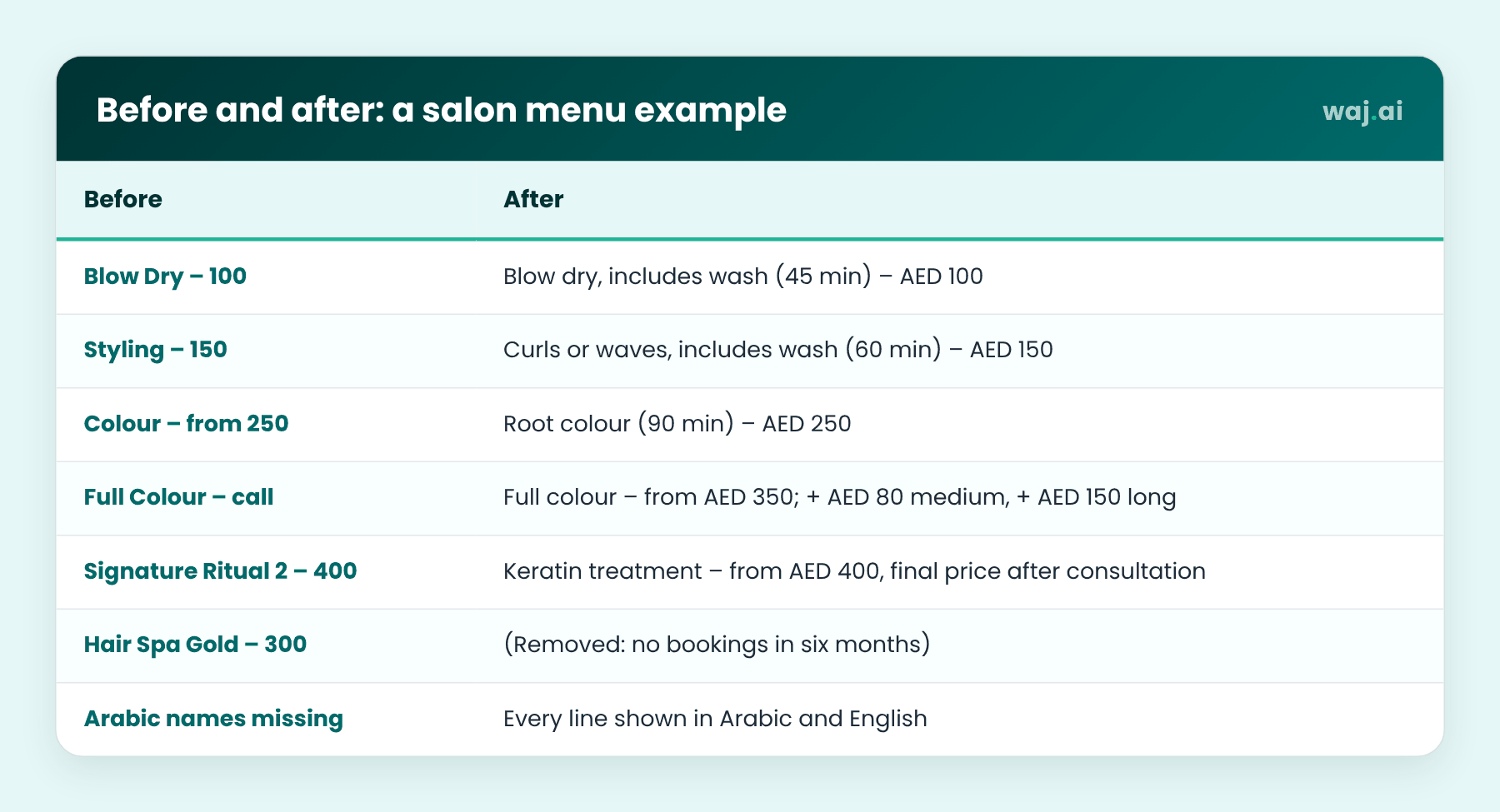
- Blow Dry – 100
After: Blow dry, includes wash (45 min) – AED 100 - Styling – 150
After: Curls or waves, includes wash (60 min) – AED 150 - Colour – from 250
After: Root colour (90 min) – AED 250 - Full Colour – call
After: Full colour – from AED 350; + AED 80 medium, + AED 150 long - Signature Ritual 2 – 400
After: Keratin treatment – from AED 400, final price after consultation - Hair Spa Gold – 300
After: (Removed: no bookings in six months) - Arabic names missing
After: Every line shown in Arabic and English
The "after" menu is shorter, but it answers every question the receptionist used to answer by phone.
A quick redesign checklist
- Export last quarter's bookings by service.
- Remove or hide services with very few bookings.
- Regroup the rest into eight or nine client-friendly categories.
- Rewrite each name in Arabic and English, with durations.
- Decide fixed vs starting-from, and write surcharge rules.
- Add a packages category and cross-mention packages.
- Update the booking site and the printed list on the same day.
Keeping it consistent with your system
The easiest way to keep the online and printed menus in sync is to manage them from one place. In WAJ, services, durations and prices feed the booking site built with the AI website builder, the staff calendar and the POS, so a price change reaches the till and the booking page together. Packages and memberships sit alongside the menu rather than on a separate spreadsheet. For ladies' salons with separate sections and teams, our ladies salon management guide covers how to set that up.
If you want to see how a cleaner menu looks on a live booking site, book a free WAJ demo: waj.ai/demo
FAQ
How many services should a salon menu have?
There's no fixed number, but most clients scan rather than read. Cut services with few bookings and keep each category short enough to see on one phone screen.
Should I show prices on my salon website?
Yes, wherever you can. Clear prices reduce back-and-forth on WhatsApp and help clients book on their own. For variable services, show a starting price and the surcharge rule.
Is a displayed price list mandatory?
In Kuwait, the Ministry of Health salon guide requires a licensed price list at reception. Other Gulf countries have their own rules, so confirm with your municipality or health authority.
How do I explain hair length surcharges without upsetting clients?
Put the rule on the menu, define the lengths simply, and have the stylist confirm the final price before starting. Surprises at the till cause the complaints, not the surcharge itself.
How often should I update my price list?
Review it at least twice a year, and whenever costs change. Update the online and printed versions on the same day so they always match.
Follow WAJ on Google
Add WAJ as a preferred source to see more of our articles in your Google Search results, marked with a "preferred" badge.