
Salon End of Day Report and Daily Cash-Up: A Simple Routine That Stops Leaks
WAJ Team
September 28, 2026
A salon end of day report compares what your system says you sold with what actually landed in the drawer, the card terminal and the bank, then explains every difference before anyone goes home. Done in ten minutes every night, it catches mistakes while staff still remember what happened. Left until month-end, the same gaps turn into arguments nobody can settle.
I have seen salons with full books and healthy prices still lose money quietly at the front desk. Rarely through theft. Usually through a discount nobody approved, a gift card redeemed twice, a tip put in the till, or a bank transfer the client "already sent" that never arrived.
Why do salon tills not match?
Most discrepancies come from a handful of predictable places:
- Cash: wrong change, a float that was never counted in the morning, petty cash taken out for supplies without a note.
- Tips: cash tips mixed into takings, or card tips added on the terminal but not recorded against the stylist.
- Discounts: a "friend price" given at the desk with no record of who approved it.
- Voids and refunds: a sale cancelled after payment, with the money handed back but the void not logged, or the other way round.
- Gift card redemptions: a card used without being marked as redeemed, so the balance stays live.
- Packages and memberships: a session used from a package but checked out as a normal paid visit, or a paid visit marked as a package session.
- Split and mixed payments: half cash, half card, entered as all card.
- Bank transfers: booked as paid on the client's word before the money shows in the account.
None is dramatic alone. Across a month and two or three branches, they add up.
The 10-minute end-of-day routine
Do this at the same time every evening, with the same person responsible. In most salons that is the receptionist, with the manager checking.
- Close all open appointments. Every client who came in should be checked out, and every no-show marked as one. An open ticket makes the totals wrong.
- Print or open the day's sales report by payment method.
- Count the cash drawer. Subtract the opening float. Compare with the cash total in the report.
- Settle the card terminal and compare the batch total with card sales in the system.
- Check bank transfers received today against transfers recorded as paid.
- Review voids, refunds and discounts. Each needs a reason and an approver.
- Check gift card and package redemptions against the clients who actually came in.
- Record tips by staff member, separate from takings.
- Write down any difference and its explanation, even if it is small.
- Bag the cash, sign the sheet, and leave the float for tomorrow.
Done nightly, it takes about ten minutes. Skip a week and it takes an hour.
How to reconcile cash, card and bank transfer payments
Treat each payment method as its own small account.
Cash. Start every day with a fixed float that is counted and signed for. At close, count the drawer, take away the float, and compare with cash sales. Petty cash for milk, towels or a taxi should come out with a receipt and be logged, not "remembered".
Card. Settle the terminal before you close the system. If the terminal total is higher than the system, someone probably took a card payment and recorded it as cash, or charged a tip on the card. If it is lower, look for a payment entered as card that never went through.
Bank transfer. This is the one Gulf salons get caught on most. A client sends a screenshot on WhatsApp, the receptionist marks the visit as paid, and nobody checks the bank. Make it a rule: a transfer is "pending" until the manager sees it in the account. Review pending transfers every morning.

How should salons handle tips?
Tips belong to staff, not to the business, so keep them out of your takings from the start.
- Cash tips go into a separate envelope or box per staff member, never into the till.
- Card tips are recorded against the stylist who earned them, so they show up correctly when you pay out.
- Pay tips out on a fixed schedule and have staff sign for them.
Clear tip handling also stops the quiet resentment of a stylist who believes her tips were "lost".
Voids and discounts: who can approve them?
Set a simple rule and write it down. For example:
- Receptionists can apply only the standard listed offers.
- Any other discount, any void after payment and any refund needs the manager's approval, with a reason recorded.
- Staff cannot discount their own friends or family.
Then check the list every night. You are looking for patterns, not villains, such as the same stylist's clients always getting 20% off. If your discounts are creeping, it may also be a sign your prices need a proper review, which we cover in how to price salon services.
Gift cards and packages: the hidden liability
When a client buys a gift card or a ten-session package, you have taken money for a service you still owe. Every redemption must be recorded against that card or package, or you end up either giving free services or arguing with a client about her balance.
At close, look at today's redemptions and match each one to a real visit. Busy gifting seasons need extra care here, because one rushed afternoon of redemptions can leave balances wrong for months. Packages and memberships follow the same logic, as explained in our guide to the spa membership model.

VAT invoices at the end of the day
If you are VAT-registered, the end-of-day check should include your tax invoices. Every paid sale should have an invoice, voids should be handled properly rather than deleted, and the invoice totals should match the day's sales.
In WAJ, UAE VAT and Jordan's JoFotara e-invoicing are integrated directly, and Saudi ZATCA e-invoicing runs through a certified integration partner. Rules on invoice content and corrections are set by each tax authority, so confirm the details with your tax authority or your accountant.
Multi-branch roll-ups
With more than one branch, the daily routine happens in each location, and the owner looks at a roll-up the next morning:
- Sales by branch and by payment method.
- Cash differences by branch, with explanations.
- Voids, refunds and discounts by branch and by staff member.
- Pending bank transfers.
- Gift card and package redemptions.
The point is not to read every line. It is to spot the branch that is different. If one branch always runs a small cash shortage and the others don't, that is where you spend your time.
This is where a single system pays off. WAJ puts POS, bookings, gift cards, packages, staff commissions and reports for every branch in one place, so the morning roll-up is a report rather than five spreadsheets sent over WhatsApp.
End-of-day checklist
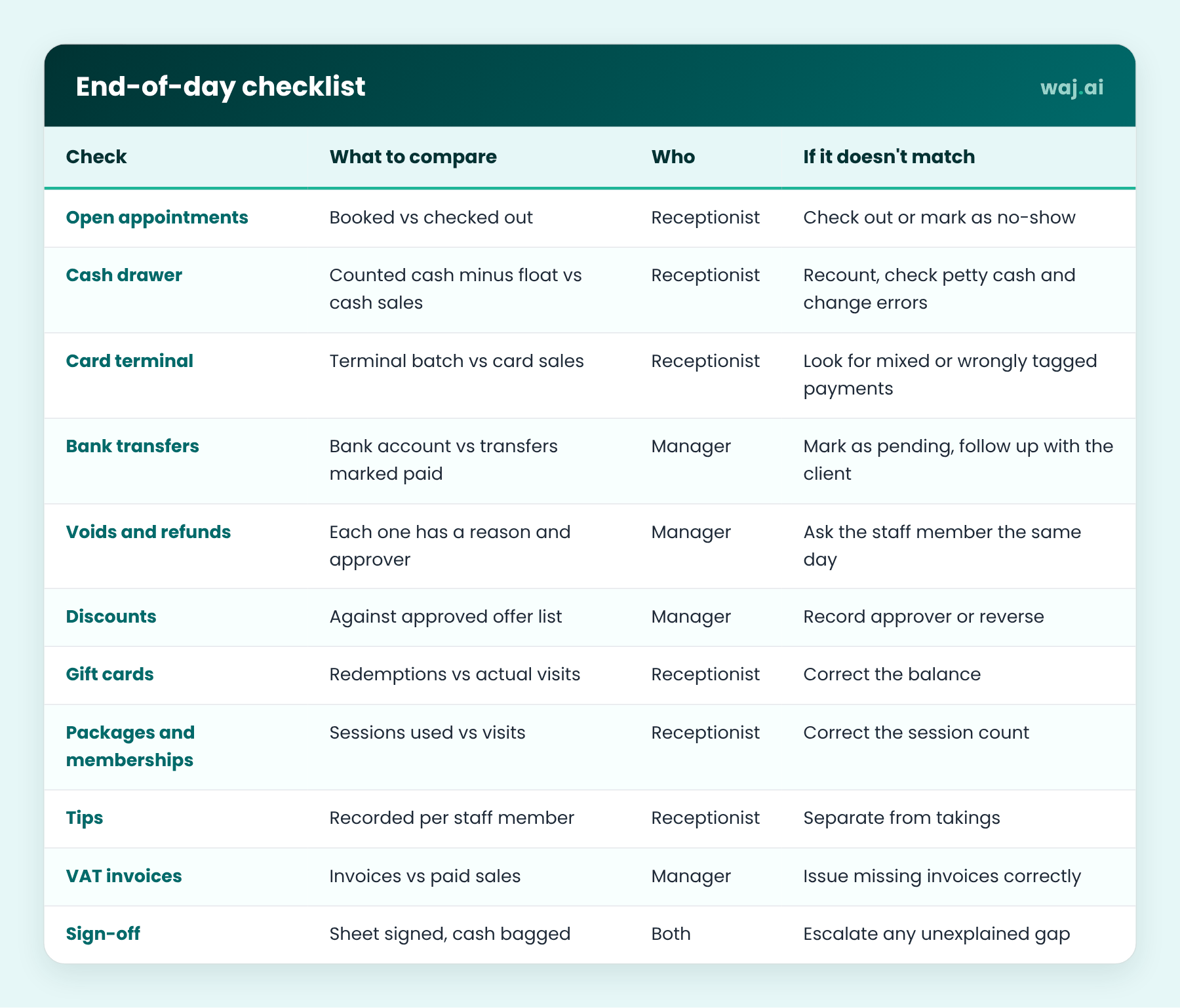
- Open appointments
What to compare: Booked vs checked out
Who: Receptionist
If it doesn't match: Check out or mark as no-show - Cash drawer
What to compare: Counted cash minus float vs cash sales
Who: Receptionist
If it doesn't match: Recount, check petty cash and change errors - Card terminal
What to compare: Terminal batch vs card sales
Who: Receptionist
If it doesn't match: Look for mixed or wrongly tagged payments - Bank transfers
What to compare: Bank account vs transfers marked paid
Who: Manager
If it doesn't match: Mark as pending, follow up with the client - Voids and refunds
What to compare: Each one has a reason and approver
Who: Manager
If it doesn't match: Ask the staff member the same day - Discounts
What to compare: Against approved offer list
Who: Manager
If it doesn't match: Record approver or reverse - Gift cards
What to compare: Redemptions vs actual visits
Who: Receptionist
If it doesn't match: Correct the balance - Packages and memberships
What to compare: Sessions used vs visits
Who: Receptionist
If it doesn't match: Correct the session count - Tips
What to compare: Recorded per staff member
Who: Receptionist
If it doesn't match: Separate from takings - VAT invoices
What to compare: Invoices vs paid sales
Who: Manager
If it doesn't match: Issue missing invoices correctly - Sign-off
What to compare: Sheet signed, cash bagged
Who: Both
If it doesn't match: Escalate any unexplained gap
FAQ
What should a salon end of day report include?
Sales by payment method, cash counted against the float, card terminal totals, bank transfers, voids, refunds, discounts, gift card and package redemptions, tips per staff member, and any difference with its explanation.
How long should a daily cash-up take?
About ten minutes if it is done every night. It gets longer, and less accurate, the more days you leave it.
Should tips go in the till?
No. Keep tips separate from takings and record them per staff member, so your sales figures stay accurate and staff trust the payout.
How do I stop unapproved discounts?
Write a short approval rule, require a reason for every discount outside your listed offers, and review the list every night.
Who should do the cash-up in a salon?
One named person per shift, usually the receptionist, with the manager checking and signing. Shared responsibility means nobody is responsible.
If you'd like to see how daily sales, payments and branch reports look in one system, book a free WAJ demo: waj.ai/demo
Follow WAJ on Google
Add WAJ as a preferred source to see more of our articles in your Google Search results, marked with a "preferred" badge.