
Salon Customer Feedback Survey: Post-Visit Questions, Timing and NPS for Salons and Spas
WAJ Team
September 24, 2026

A good salon customer feedback survey is short, arrives on WhatsApp between 2 and 24 hours after the visit, and asks three to five questions, one of which is the Net Promoter Score (NPS) question: "How likely are you to recommend us to a friend?" Answer every unhappy client privately and quickly, ask every client for a public review, and look at the scores by staff member as well as for the whole business.
Most salon owners I talk to in the Gulf already know when something has gone wrong. A client is quieter than usual at the till, pays, says "thank you, habibti" and doesn't book again. The survey is there to catch that client before she disappears, and to tell you what the quiet ones were thinking.
Why ask for feedback at all?
Because few clients complain to your face. Most unhappy clients just don't come back, and you never learn whether it was the colour, the wait, the price or the receptionist's tone.
A simple post-visit survey gives you:
- An early warning on clients who are about to leave.
- A fair view of each stylist or therapist, based on many clients instead of one loud review.
- A steady number to watch month by month, so you know whether changes you make are working.
- A natural moment to ask for a Google review.
When should you send a post-visit survey?
Send it between 2 and 24 hours after the appointment.
- Too early, while she's still in the car, and she hasn't seen the result in her own mirror or shown it to her sister yet.
- Too late, after two or three days, and the visit has blurred. Answers get vaguer and response rates drop.
A sensible default: send at around 2 to 3 hours after a short service such as a blow-dry or manicure, and the next morning for colour, keratin, facials and longer spa treatments. Don't send late at night, and be careful around prayer times and on the weekend morning.
Which channel? WhatsApp, almost always
In the Gulf and the Levant, WhatsApp is where your clients already talk to you about bookings, so a feedback message there feels like part of the same conversation. Email surveys tend to sit unopened.
Keep it personal: use her first name, the service and the staff member's name. "How was your colour with Maya yesterday?" gets a very different response from "Please rate your recent experience."
A quick note on consent. A feedback message about a service someone just had is part of looking after her. Using her answers or her number for promotions is marketing, and in Saudi Arabia that needs opt-in consent under the PDPL, with an easy way to opt out. If you run a clinic, be more careful still: health data is sensitive under the Saudi PDPL and cannot be used for marketing. Confirm the details with SDAIA or a lawyer.
We wrote more about using WhatsApp across the client journey in our guide to salon software with WhatsApp in MENA.

What questions should a salon feedback survey ask?
Three to five, no more. Every extra question costs you responses. Write them in the language the client booked in, and offer the other.
Salon customer feedback survey template
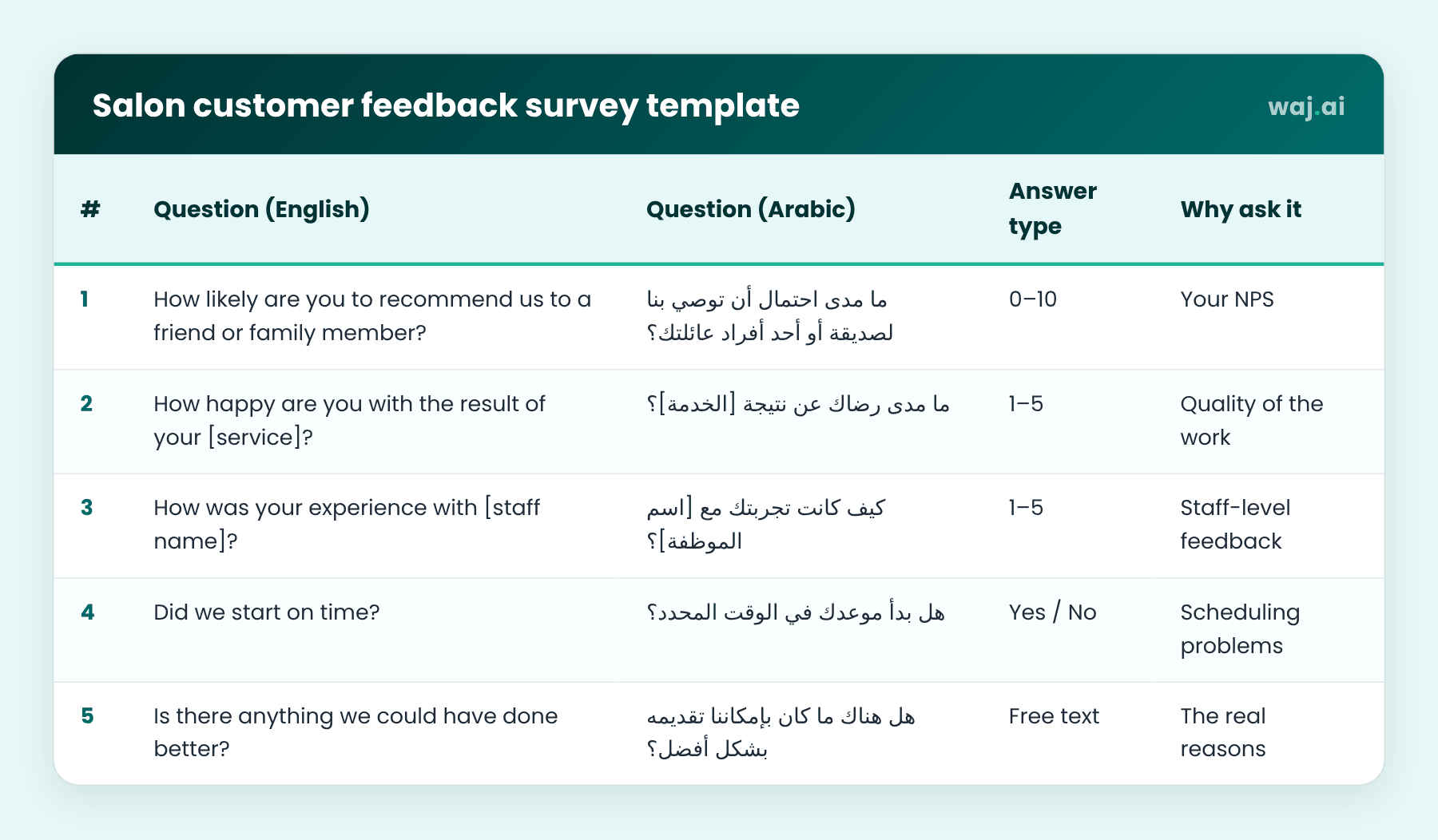
- 1
Question (English): How likely are you to recommend us to a friend or family member?
Question (Arabic): ما مدى احتمال أن توصي بنا لصديقة أو أحد أفراد عائلتك؟
Answer type: 0–10
Why ask it: Your NPS - 2
Question (English): How happy are you with the result of your [service]?
Question (Arabic): ما مدى رضاك عن نتيجة [الخدمة]؟
Answer type: 1–5
Why ask it: Quality of the work - 3
Question (English): How was your experience with [staff name]?
Question (Arabic): كيف كانت تجربتك مع [اسم الموظفة]؟
Answer type: 1–5
Why ask it: Staff-level feedback - 4
Question (English): Did we start on time?
Question (Arabic): هل بدأ موعدك في الوقت المحدد؟
Answer type: Yes / No
Why ask it: Scheduling problems - 5
Question (English): Is there anything we could have done better?
Question (Arabic): هل هناك ما كان بإمكاننا تقديمه بشكل أفضل؟
Answer type: Free text
Why ask it: The real reasons
If you can only ask one thing, ask question 1 and follow it with question 5.
What is NPS and how do you calculate it?
Net Promoter Score comes from one question: "On a scale of 0 to 10, how likely are you to recommend us?" You then group the answers:
- Promoters: 9 or 10. Happy, loyal, likely to send friends.
- Passives: 7 or 8. Satisfied, but would switch for a better offer.
- Detractors: 0 to 6. Unhappy, and at risk of leaving or saying so.
NPS = % of promoters − % of detractors. Passives count in the total but not in either group. The score runs from −100 to +100.
A worked example
These numbers are made up. Say 200 clients answered in September:
- 120 gave 9 or 10. That's 60% promoters.
- 50 gave 7 or 8. That's 25% passives.
- 30 gave 0 to 6. That's 15% detractors.
- NPS = 60 − 15 = 45.
Compare yourself with last month rather than with other businesses, and read what the detractors wrote in question 5. That's where the improvements are.
How to close the loop with unhappy clients
This is the step most salons skip, and it's the one that saves clients.
- Flag every detractor (0 to 6) the same day.
- The manager replies personally, privately, on WhatsApp or by phone. Not the stylist who did the service.
- Listen first. Ask what happened. Don't argue with the score.
- Offer a fix that fits: a free correction appointment, a redo with a senior stylist, or a sincere apology if that's all it needs.
- Write it in her client notes, so the next person who books her knows.
A client whose problem was fixed quickly often trusts you more than one who never had a problem. And a private conversation now is better than a public one-star review later.

How to ask for Google reviews the ethical way
Here's the temptation: send the Google review link only to the people who scored you 9 or 10, and handle everyone else privately. This is called review gating, and you shouldn't do it. It makes your rating look better than the experience really is, it misleads future clients, and it goes against the spirit of review platforms. Check Google's current review policies before you set anything up.
The ethical version is simple:
- Ask every client for a review, whatever score they gave.
- Still follow up privately with detractors, separately from the review request.
- Never offer discounts or gifts in exchange for reviews.
- Reply to every review, good and bad, politely and without client details.
You'll get a few honest three-star reviews. That's fine. For more on building your profile on social channels, see our guide to salon social media marketing in 2026.
Using feedback at staff level
Question 3 is where the survey earns its keep. Look at each staff member's scores monthly, with at least a few dozen responses before you draw conclusions.
- Share good feedback publicly in the team group. Read out a client's words at the morning meeting.
- Discuss weak scores privately, with the actual comments in front of you.
- Look for patterns, not single answers. One harsh score can be a bad day. Ten comments about rushing is a habit.
- Check the system before blaming the person. If one therapist's "on time" score is low, she may simply be booked back to back with no buffers.
Don't tie bonuses to survey scores alone. Staff will start asking clients for high scores, and the data stops meaning anything.
Where WAJ fits
WAJ brings the pieces together: WhatsApp messaging and marketing automations to send messages after a visit, a client CRM where notes and history sit on each client's profile so a follow-up is never lost, and reports by staff member. Win-back audiences help you reach clients who stopped coming, which is often where your detractors end up if nobody calls them. There's no booking commission and no onboarding fee.
If you'd like to see how this would look for your salon or spa, book a free WAJ demo: waj.ai/demo.
FAQ
How many questions should a salon feedback survey have?
Three to five. One NPS question, one or two rating questions about the service and staff, and one open question is enough.
What is a good NPS for a salon?
Any positive score means you have more promoters than detractors. The most useful comparison is your own score month by month, plus the comments behind it.
Should I send the survey after every visit?
For new clients, yes. For weekly regulars, once every few visits is enough so they don't get tired of it.
Can I only send the Google review link to happy clients?
You shouldn't. Ask every client for a review, and follow up privately with unhappy ones as a separate step.
Is a WhatsApp feedback message considered marketing?
A message asking about a service the client just received is part of serving her. Adding promotions, or using her answers for marketing, needs consent. Confirm the rules in your country.
Follow WAJ on Google
Add WAJ as a preferred source to see more of our articles in your Google Search results, marked with a "preferred" badge.