Salon Influencer Marketing in the Gulf: What Works and What's Required
WAJ Team
September 26, 2026
Salon influencer marketing works in the Gulf when you pick creators whose followers live within driving distance, check that they hold the licence their country requires for paid promotion, put the deal in writing, and track every booking they send you. In Saudi Arabia that means a GCAM "Mawthooq" licence, and in the UAE a licence or permit from the UAE Media Council. Skip those basics and you pay for views from people who will never book.
Most owners have tried it once. A creator visits, the video looks lovely, the phone rings twice, and nobody can say whether it was worth it. The problem is usually the setup, not the idea.
Micro or macro influencers: which suits a salon?
For a single-branch salon, local creators almost always beat regional names. A salon in Al Khobar does not need followers in Cairo. It needs women in Dammam and Khobar who trust the person recommending a blow-dry bar.
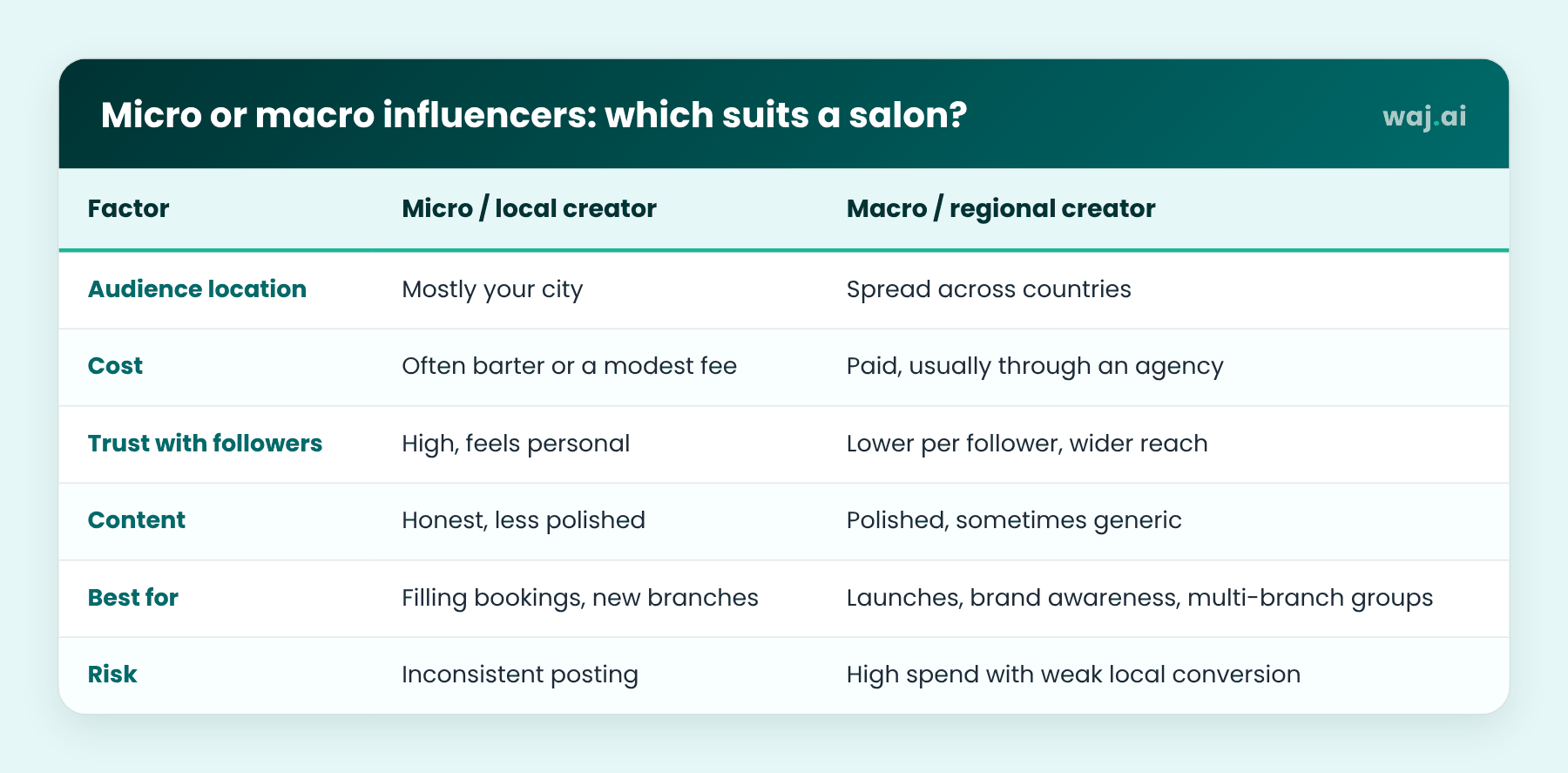
- Audience location
Micro / local creator: Mostly your city
Macro / regional creator: Spread across countries - Cost
Micro / local creator: Often barter or a modest fee
Macro / regional creator: Paid, usually through an agency - Trust with followers
Micro / local creator: High, feels personal
Macro / regional creator: Lower per follower, wider reach - Content
Micro / local creator: Honest, less polished
Macro / regional creator: Polished, sometimes generic - Best for
Micro / local creator: Filling bookings, new branches
Macro / regional creator: Launches, brand awareness, multi-branch groups - Risk
Micro / local creator: Inconsistent posting
Macro / regional creator: High spend with weak local conversion
Four or five local creators over a quarter usually beat one big name for one week.
Do influencers need a licence to promote a salon in Saudi Arabia or the UAE?
Yes, for paid advertising. In Saudi Arabia that is the GCAM "Mawthooq" licence; in the UAE, a licence or permit from the UAE Media Council. These rules change, so check the current requirements with GCAM or the UAE Media Council before you sign anything.
In practice:
- Ask for the licence number before you discuss fees, and verify it on the official channel, not from a screenshot.
- Write it into the agreement.
- Ask whether barter (free services in exchange for content) counts as paid advertising under the current rules. Do not assume it doesn't.
This is general guidance, not legal advice. If you are unsure, confirm with the regulator or a lawyer.
Barter or paid: what kind of deal should you offer?
Barter is the default for most salons: a free service in exchange for agreed content. It is cheap, but you get what you negotiate, and vague barter deals produce one rushed story and nothing else.
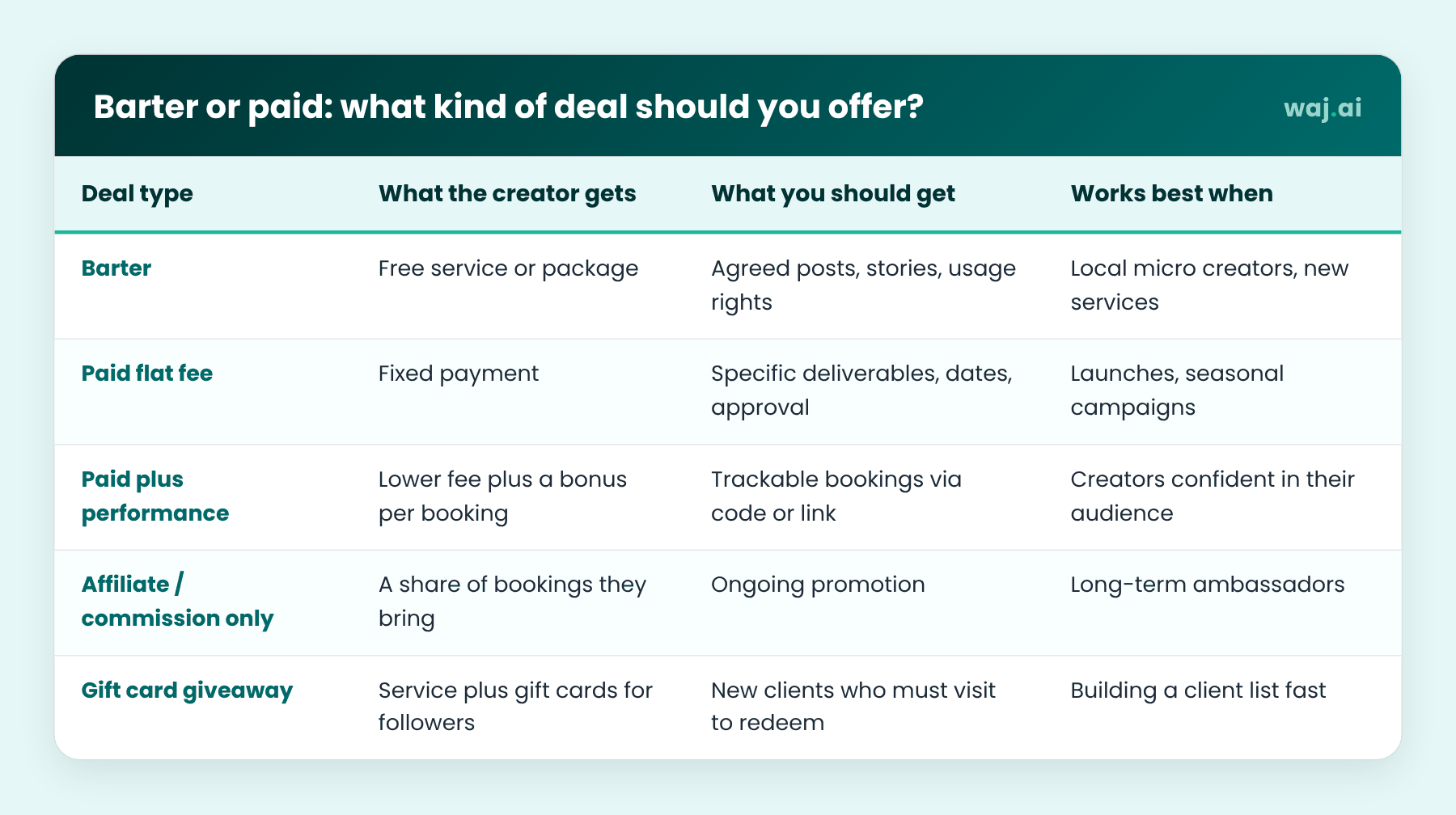
- Barter
What the creator gets: Free service or package
What you should get: Agreed posts, stories, usage rights
Works best when: Local micro creators, new services - Paid flat fee
What the creator gets: Fixed payment
What you should get: Specific deliverables, dates, approval
Works best when: Launches, seasonal campaigns - Paid plus performance
What the creator gets: Lower fee plus a bonus per booking
What you should get: Trackable bookings via code or link
Works best when: Creators confident in their audience - Affiliate / commission only
What the creator gets: A share of bookings they bring
What you should get: Ongoing promotion
Works best when: Long-term ambassadors - Gift card giveaway
What the creator gets: Service plus gift cards for followers
What you should get: New clients who must visit to redeem
Works best when: Building a client list fast
The giveaway model is underrated. A creator who gives away three gift cards to followers sends you three new clients who physically walk in, which is more than most "awareness" posts achieve.
What should an influencer brief include?
Put everything in writing, even for barter. Include:
- Deliverables: number of posts, stories and reels, and the platforms.
- Dates: visit date, posting window, and any blackout days.
- Key messages: the service name, the price or offer, your location, and how to book.
- Booking route: the unique code and the booking link.
- Disclosure: clear labelling of the content as an ad or a collaboration, following current rules where they post.
- Approval: whether you see the content before it goes live.
- Usage rights: whether you can repost the video on your own pages and ads, and for how long.
- What happens if they don't post.
Disclosure matters. A hidden ad that gets called out in the comments damages the creator and the salon, while a clear label costs you nothing.
One more point for ladies' salons: filming inside the salon must never capture other clients. Book the creator at a quiet hour or in a private room, and tell staff in advance. Privacy is part of why women choose a ladies' salon in the first place, as we covered in our ladies' salon management guide.
How do you track bookings from an influencer?
If you cannot tie bookings back to a creator, you are guessing. Use two tracking tools together:
- A unique code per creator. For example, NOURA15. The receptionist enters it at checkout, so even walk-ins and phone bookings are counted.
- A dedicated booking link. A link to your online booking page that you share only with that creator, so you can see who booked from it.
Then, at 30 and 90 days, look past the first visit. A creator who brings ten clients who never return is worth less than one who brings four regulars.
This is where your salon software earns its keep. In WAJ, clients book through your own booking site with no booking commission, and each client's notes and history sit in the CRM, so you can record the source ("came via Noura, Sept 2026") and check reports later for rebookings and spend. WhatsApp reminders and win-back audiences then help turn a one-off visitor into a regular, which is the part influencers cannot do for you.
How to spot fake followers before you pay
Follower counts are easy to fake. Before any deal, spend ten minutes on the profile:
- Comments: are they real sentences from real people, or a stream of emojis and "nice" from accounts with no posts?
- Audience location: ask for a screenshot of audience insights showing cities. If most followers are outside your country, walk away.
- Story views: ask for recent story view counts. They are harder to inflate than followers.
- Growth pattern: sudden jumps of thousands of followers overnight are a warning sign.
Influencer marketing for aesthetic clinics: be extra careful
Clinics should treat influencer content with much more caution than salons. In Dubai, the DHA treats injectables and medical lasers as medical acts that only licensed clinics and qualified practitioners can perform, and promoting medical treatments is generally watched far more closely than promoting a blow-dry. Before any creator films a treatment, check with the DHA, DOH or MOH (or the Saudi health authorities) whether the content needs approval and what claims are allowed.
Some practical rules for clinics:
- Never let a creator promise results or show "guaranteed" outcomes.
- Keep the practitioner's credentials and the clinic's licence visible and accurate.
- Do not use any patient's health information in marketing. In Saudi Arabia, health data is sensitive data under the PDPL and cannot be used for marketing. In the UAE, Federal Law No. 2 of 2019 keeps health data inside the UAE by default.
- Get written consent for anything filmed, including the creator's own treatment.
Our guide to aesthetic clinic patient retention covers the follow-up side.
A simple 6-week influencer plan for a salon
- Week 1: pick one service and the offer, then shortlist eight local creators and check licences and audiences.
- Week 2: sign three or four, each with a brief, a unique code and a booking link.
- Weeks 3–4: visits and posting, staggered so the salon is not overloaded.
- Week 5: repost the best content on your own pages, if the agreement allows it. Our salon social media marketing guide covers how to use it well.
- Week 6 and day 90: compare bookings, spend and rebookings per creator. Keep the best, drop the rest.
Big occasions such as Saudi National Day on 23 September fill good creators' calendars fast, so book early.
FAQ
Do micro-influencers work for salons?
Usually better than large accounts. Their followers are local and trust them, which is what turns a post into a booking.
Is barter legal for influencer posts in Saudi Arabia and the UAE?
Paid advertising requires a Mawthooq licence in Saudi Arabia and a UAE Media Council licence or permit in the UAE. Whether barter counts as paid depends on current rules, so check with the regulator before you agree a deal.
How much should a salon pay an influencer?
There is no standard rate. Start with barter or a small fee plus a per-booking bonus, and pay more only to creators whose codes and links show real bookings.
How do I measure influencer ROI for my salon?
Give each creator a unique code and booking link, then track bookings, total spend and rebookings at 30 and 90 days.
Can an aesthetic clinic use influencers?
Yes, carefully. Check advertising rules with your health regulator, avoid promising results, and never use patient health data in marketing.
If you want to see how bookings, client sources and rebookings come together in one place, book a free WAJ demo: waj.ai/demo
Follow WAJ on Google
Add WAJ as a preferred source to see more of our articles in your Google Search results, marked with a "preferred" badge.