
How to Use a CRM for Real Estate: Turn More Leads into Closings
WAJ Team
September 10, 2026

In real estate, the product is expensive, the decision is slow, and the competition is fierce which means the agent who wins is rarely the one with the most leads. It is the one who follows up best. A property enquiry that gets a reply in five minutes is worth far more than one answered the next day, and a buyer nurtured patiently over months is worth more than ten cold leads that were contacted once and forgotten. This is exactly what a CRM (customer relationship management system) is built for. This guide explains how real estate agencies and agents use a CRM to stop losing leads, shorten the path to a deal, and turn a chaotic pipeline into a predictable one.

Why real estate lives or dies on follow-up
Real estate has a brutal math problem. Leads are expensive you pay for portal listings, ads, and referrals and they arrive constantly from different channels: property portals, your website, phone calls, WhatsApp, walk-ins, and social media. But most of them are not ready to transact today. They are months away. Without a system, the ready buyers get a scramble of attention and the not-yet-ready ones quietly vanish and since those are the majority, most of your marketing spend evaporates. The agencies that win are not generating more leads; they are simply losing fewer of them. A CRM is how you stop the leak.
Step 1: Capture every lead in one place
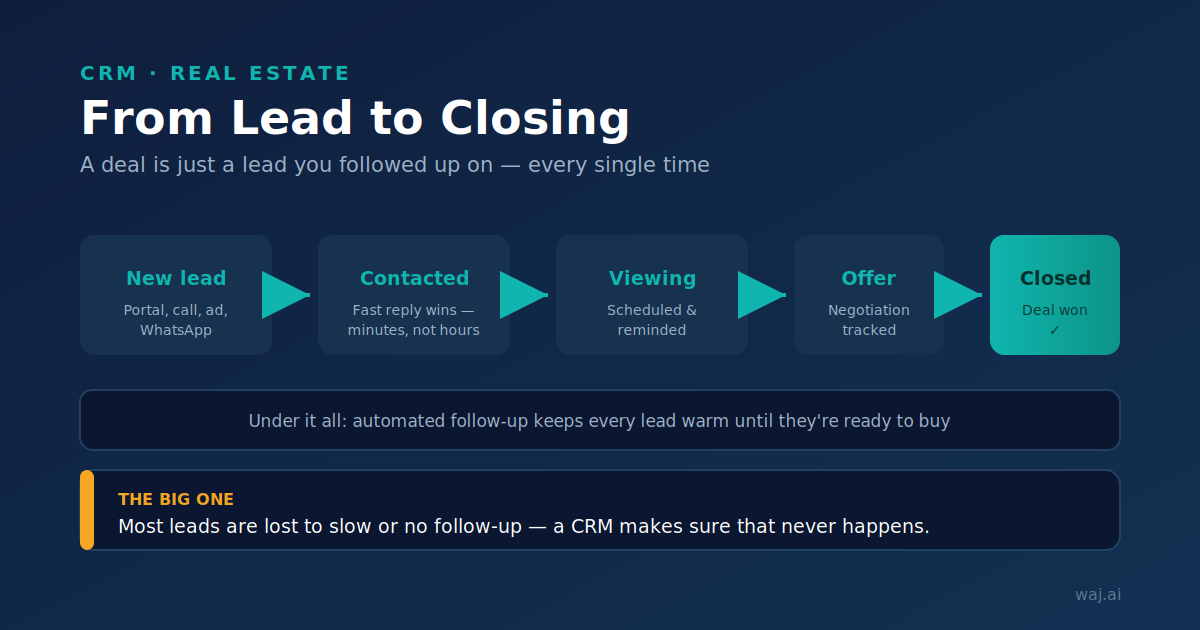
The first job of a CRM is to make sure no enquiry is ever lost. Every lead from every portal, ad, call, and WhatsApp message lands in one organized database with the property they asked about, their budget, and how they came to you. Instead of leads scattered across an inbox, a phone, sticky notes, and three agents' memories, you have a single source of truth. Nothing falls through the cracks, and any agent can see the full picture instantly.
Step 2: Respond fast ; speed is the whole game
In real estate, speed-to-lead is decisive. A buyer enquiring about a property is often messaging several agents at once, and the first to respond credibly usually wins the viewing. A CRM helps you respond in minutes: new leads are assigned to an agent inst
antly, alerts fire so nothing sits unanswered, and instant WhatsApp or auto-replies acknowledge the enquiry the moment it arrives. Simply being the fastest to reply is one of the cheapest competitive advantages in the business and a CRM makes it systematic rather than luck.
Step 3: Manage your pipeline through clear stages
A deal is a journey: new lead → contacted → qualified → viewing → offer → closed. A CRM turns that journey into a visible pipeline where every buyer and seller sits at a known stage. This visibility changes how you work: you can see exactly how many deals are near closing, which leads are stuck and need a push, and where your pipeline is thin so you know when to generate more. For an agency principal, it also means seeing every agent's pipeline at a glance no more guessing who is busy and who is quietly stalling.
Step 4: Nurture the majority who aren't ready yet

Here is where most agents leave money on the table. The buyer who is "looking in six months" gets contacted once and forgotten and in six months they buy through whoever stayed in touch. A CRM lets you nurture these long-cycle leads automatically: scheduled follow-ups, new listings that match their criteria, and the occasional check-in that keeps you top of mind. When they are finally ready, you are the agent they call. Patient, automated follow-up is how you harvest the leads you already paid for instead of buying new ones.
Step 5: Keep every detail and every document
Property deals are detail-heavy and relationship-long. A CRM keeps a complete history for each client every conversation, every property shown, their preferences and requirements so you never repeat yourself and never forget what matters to them. That memory is what makes a client feel understood, and it is what earns the referrals and repeat business that top agents live on. A past buyer becomes a future seller, and a happy client sends their friends.
Step 6: Understand what actually works
Because a CRM records where every lead came from and what happened to it, it answers the questions that decide your marketing budget: which portals and campaigns produce leads that actually close, your conversion rate from enquiry to deal, and which agents convert best. Instead of pouring money into channels on instinct, you invest in what demonstrably produces closings.
The right CRM makes it effortless
A CRM only helps if agents actually use it which means it has to be fast, mobile, and connected to the channels you already work in, especially WhatsApp. It should capture leads automatically, make follow-up easy from a phone between viewings, and show your pipeline at a glance.
WAJ gives you exactly that: one place for every lead, instant assignment and WhatsApp follow-up, a clear visual pipeline, automated nurture, and reporting that shows which sources close all Arabic-first and mobile-ready for agents on the move. Stop losing the leads you already paid for. Start free or book a demo.
Follow WAJ on Google
Add WAJ as a preferred source to see more of our articles in your Google Search results, marked with a "preferred" badge.