
Aesthetic Clinic Aftercare and Follow-Up Check-Ins: A Simple Protocol
WAJ Team
August 20, 2026
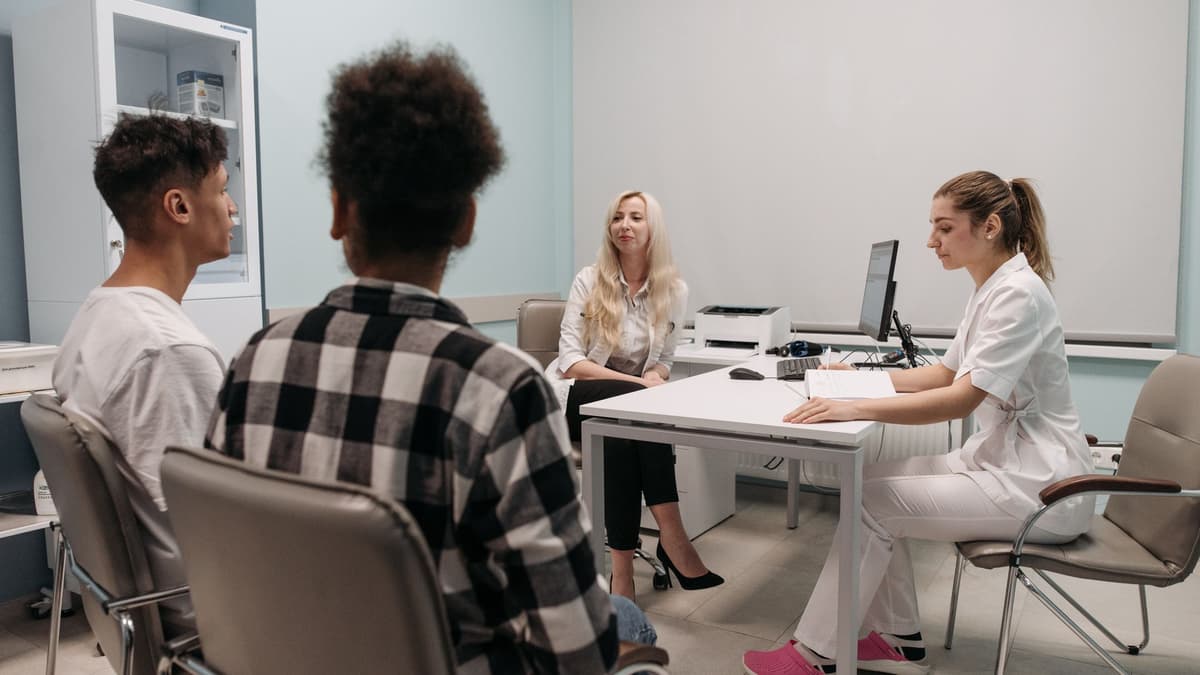
Good aesthetic clinic aftercare comes down to four things: written instructions for each treatment approved by your medical director, sent to the patient in their language, a short series of check-ins (day 1, day 3 and week 2), and a clear route for passing any concern to licensed staff the same day. Record it in the patient file and keep it apart from marketing. Most clinics can have this running within a week.
Designing it takes an afternoon. Doing it for every patient, including the Thursday evening filler appointment that ran late, is where clinics struggle.
Why aftercare decides whether patients come back
Patients judge a clinic on more than the treatment. They judge it on the second night, alone at home, looking in the mirror at some swelling and wondering if it is normal. If nobody from the clinic has been in touch, that worry turns into a late-night search online, or a quiet decision not to come back.
A short, warm message changes that night. "Hi Reem, this is Nour from the clinic. How are you feeling after yesterday? Some swelling is expected. If anything worries you, reply here and our doctor will see it." That is not marketing. That is care, and patients remember it.
Aftercare is the part of aesthetic clinic patient retention that happens in the first two weeks, and it carries more weight than any loyalty offer.
Step 1: Write aftercare instructions for each treatment type
Front desk staff should never improvise aftercare advice. Your medical director decides and signs off every aftercare sheet, and reviews it whenever protocols, products or suppliers change.
- Group your treatments by type: injectables, energy-based and laser treatments, skin treatments such as microneedling.
- For each group, the medical director writes what to avoid and for how long, what is normal, and which signs mean the patient should call straight away.
- Keep each sheet to one phone screen. Long PDFs go unread.
- Add a direct contact number and answering hours, then date each version and note who approved it.
In Dubai, the DHA treats injectables and medical lasers as medical acts for licensed clinics and qualified practitioners only, and beauty therapists cannot carry out medical procedures. Advice follows the same logic: a receptionist sends the approved sheet, and only a licensed clinician interprets symptoms.
Step 2: Send it by WhatsApp in Arabic and English
Paper sheets end up on the car seat. WhatsApp puts the instructions on the phone the patient will be holding at 11 p.m. when the question comes up.
Prepare every sheet in Arabic and English and send the patient's preferred language, recorded at their first visit. A Saudi patient in Riyadh and a British expat in Jumeirah should both read their instructions without effort. A bilingual clinician should check translations, since a small slip in medical wording causes real confusion.
Send them while the patient is still in the recovery chair: "I've just sent your aftercare to WhatsApp. Message us if anything is unclear." Ten seconds, and the patient walks out knowing the clinic is still with them.
Step 3: Follow the day 1, day 3 and week 2 check-in timeline
Three touchpoints cover most treatments. Your medical director may adjust them per procedure.
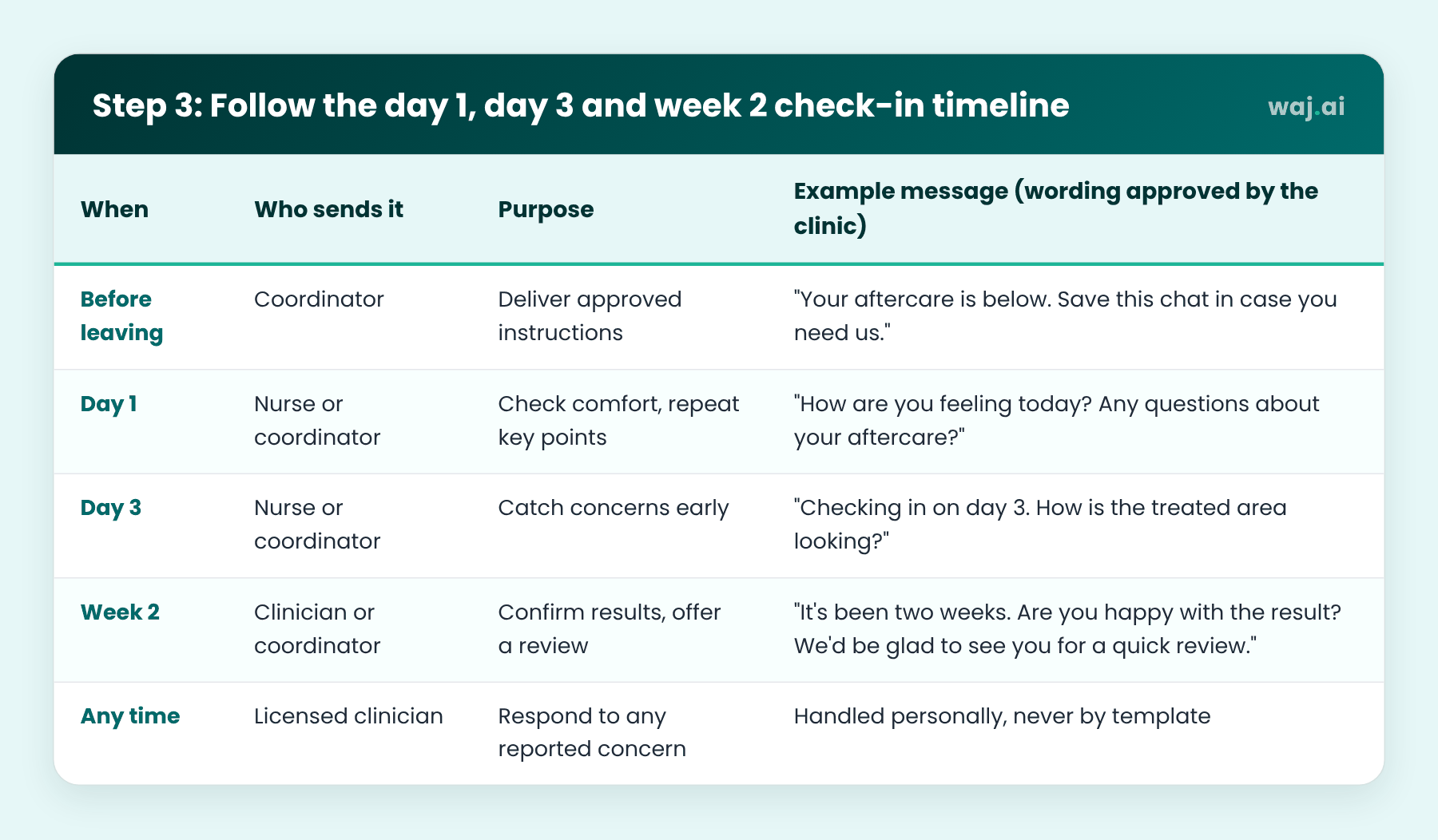
- Before leaving
Who sends it: Coordinator
Purpose: Deliver approved instructions
Example message (wording approved by the clinic): "Your aftercare is below. Save this chat in case you need us." - Day 1
Who sends it: Nurse or coordinator
Purpose: Check comfort, repeat key points
Example message (wording approved by the clinic): "How are you feeling today? Any questions about your aftercare?" - Day 3
Who sends it: Nurse or coordinator
Purpose: Catch concerns early
Example message (wording approved by the clinic): "Checking in on day 3. How is the treated area looking?" - Week 2
Who sends it: Clinician or coordinator
Purpose: Confirm results, offer a review
Example message (wording approved by the clinic): "It's been two weeks. Are you happy with the result? We'd be glad to see you for a quick review." - Any time
Who sends it: Licensed clinician
Purpose: Respond to any reported concern
Example message (wording approved by the clinic): Handled personally, never by template
Use the patient's name and the name of the staff member writing, and ask an open question. Never attach offers or "book your next session" links.
Step 4: Escalate concerns to licensed staff, fast
Sometimes a check-in gets a worrying reply. A photo of unexpected redness. "It's getting more painful, not less." Your protocol must say exactly what happens next:
- The coordinator gives no medical advice, only acknowledges the message and says a clinician will reply shortly.
- The case goes straight to the on-duty licensed clinician through an agreed internal channel.
- The clinician contacts the patient directly, by call if possible, and decides whether to bring them in.
- For out-of-hours worries, the aftercare sheet tells the patient what to do and where to go, in wording the medical director decides.
- Every escalation is logged in the patient file with times and actions.
Agree on a response time and hold your team to it. A patient who sends a photo at 4 p.m. and hears back at 9 p.m. has had five long hours.
Step 5: Offer review visits when they make sense
Some patients simply feel better being seen. The week 2 message is the natural moment to offer a review, booked into the clinician's calendar like any appointment. Review visits are also where results get recorded properly, with notes and, with the patient's consent, photos in the clinical record.
Step 6: Document everything in the patient file
If it is not written down, it did not happen. Each check-in, reply, escalation and review visit belongs in the patient's file, not only in someone's phone. The doctor seeing the patient next month needs the full story, a complaint needs a record, and the coordinator who sent the messages may not be there next year.
In the UAE, Federal Law No. 2 of 2019 keeps health data inside the country by default, so check where your systems store it. Dubai clinics also connect to NABIDH, the emirate's health information exchange. Confirm your obligations with DHA, DOH or MOH, or with a lawyer.

Keep care messages separate from marketing
The day 3 check-in looks like a great moment to mention the new skin booster package. Resist it.
Under Saudi Arabia's PDPL, fully enforceable since 14 September 2024 and regulated by SDAIA, health data is sensitive data and cannot be used for marketing. Direct marketing needs opt-in consent with an easy opt-out. Mix promotions into a flow built on treatment data and you are using health data for marketing. Confirm the details with SDAIA or a lawyer, but the safe rule is simple:
- Aftercare and check-ins go out as care messages, triggered by the treatment, with no offers.
- Promotions go only to patients who have opted in to marketing, through a separate flow.
- Staff know the difference, and your templates make it hard to mix them up.
Patients notice the difference too. A check-in that ends with a discount code reads like a sales message wearing a white coat.
How software keeps the protocol running
A protocol on paper survives about a month in a busy clinic. After that, it depends on the system reminding people. In WAJ, the client record holds notes and visit history, WhatsApp reminders handle the scheduled touchpoints, and the staff calendar holds review visits. Marketing automations sit in their own space, which helps keep care and promotion apart, and WAJ's clinic product, Nabd, is built for clinic workflows like this. For what to automate and what to keep personal, see our guide to aesthetic clinic management and automation and our overview of salon software with WhatsApp in MENA.
Automation sends the routine message. A person reads every reply.
Patient trust is the real outcome
Gulf clinics compete hard on price and on Instagram. Aftercare is one thing a competitor cannot copy by lowering a number. A patient who felt looked after on day 3 tells her sister. A patient who felt ignored tells everyone.
To see check-ins, records and calendars in one place, book a free WAJ demo: waj.ai/demo.
FAQ
What should aesthetic clinic aftercare instructions include?
What to avoid and for how long, what is normal, warning signs that need a call, and contact details, all approved by the medical director for each treatment type.
When should a clinic follow up after an aesthetic treatment?
A common protocol is day 1, day 3 and week 2, plus instructions sent before the patient leaves. The medical director can adjust timing per treatment.
Can a receptionist answer aftercare questions?
They can send approved instructions and acknowledge messages. Any symptom goes straight to a licensed clinician.
Can I include offers in aftercare WhatsApp messages?
No. In Saudi Arabia, health data cannot be used for marketing under the PDPL. Keep care and promotions in separate flows, and confirm with SDAIA or a lawyer.
Where should check-in records be kept?
In the patient's file. In the UAE, also check that storage follows Federal Law No. 2 of 2019.
Follow WAJ on Google
Add WAJ as a preferred source to see more of our articles in your Google Search results, marked with a "preferred" badge.