
What It Takes to Run a Public Demo of an AI Agent Platform
WAJ Team
October 27, 2026

We wanted a demo of our agent platform with no sign-up: click once and you are an admin on a real install, with real models behind it. Anyone can type into it, create agents, upload documents and place voice calls.
That is a public form connected to paid model APIs, with one shared login. This post is the list of things we had to build before it was safe to leave running, and one measurement bug we only found because the demo existed.
The demo is at engine-demo.waj.ai, and WAJ AI Engine is open source under Apache-2.0 at github.com/waj-1/ai-engine. If you are new to the engine, start with why we built it without a canvas.
How do you lock down a public demo?
Demo mode is a single setting, DEMO_MODE=true, on the same code everyone else runs. With it on:
- Everyone shares one account. "Try the demo" signs you in as the demo admin. So everything a visitor types is visible to every other visitor, and a banner says so on every page.
- The dangerous screens are off. Model keys, API keys, users, environment variables, deploys and the admin MCP server are refused. Some screens are read-only: you can read the model list, not change it.
- Tools cannot reach inward. A visitor can connect a tool server, so the engine refuses local and internal addresses. Without that, "add an HTTP tool" is a way to read the host's own network.
- Settings that would loosen any of this are removed from the process at start, so a stray variable in the environment cannot reopen them.

How do you cap the cost of a public AI demo?
Every chat turn, assistant turn and test-judge call is a model call we pay for. These are the caps we set:
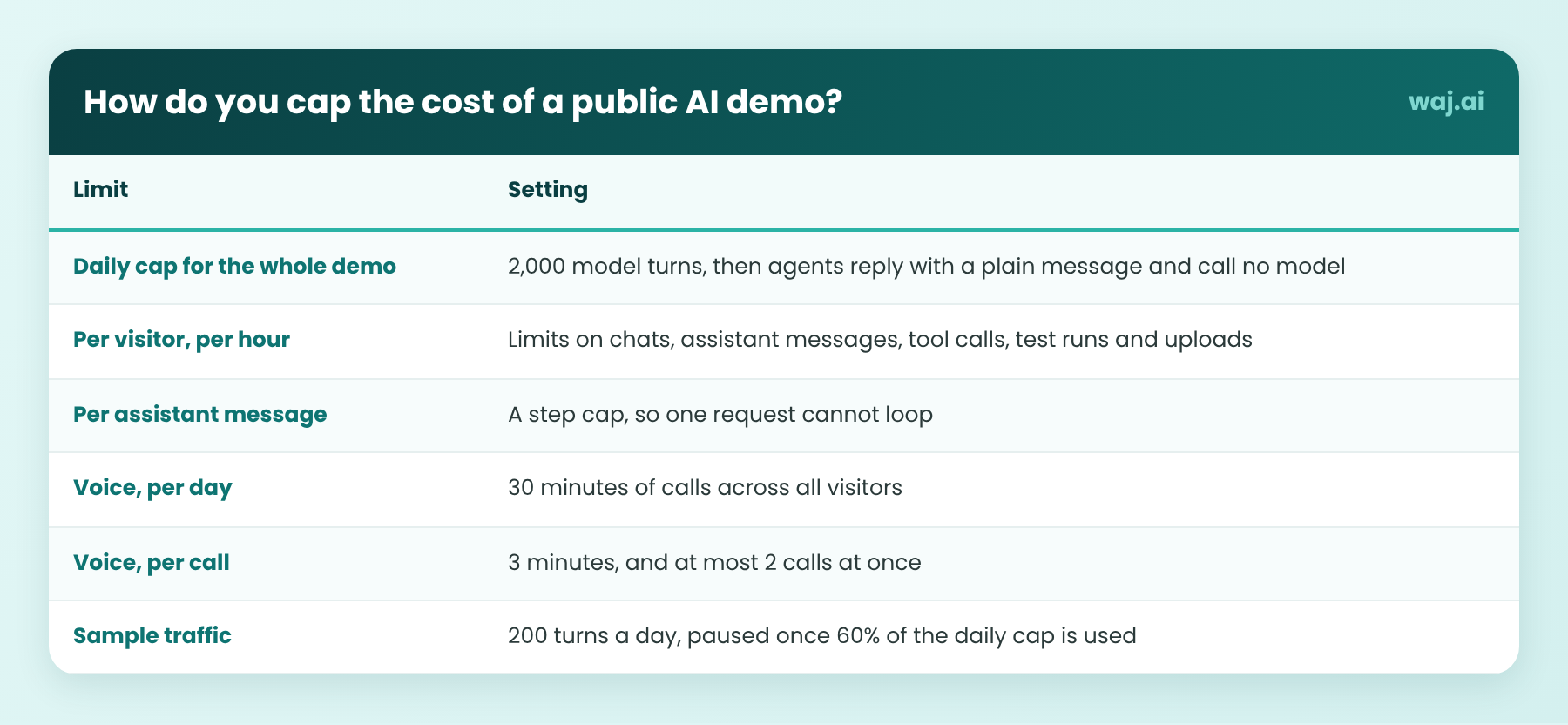
The caps are counted in the database, so two engine processes share them.
Why reset the demo every night?
At 03:00 UTC the engine deletes everything visitors made: agents, instructions, uploads, conversations, test runs, recordings. Then it seeds the demo again: four agents for a made-up internet provider, four knowledge bases, a test suite for each agent.
The reset is the privacy promise. Whatever someone typed is gone by morning.
How do you fill an empty demo without fake data?
After a reset, every report was empty. Overview said "no conversations". Testing said "not run yet". A visitor would have to generate their own data before seeing what the product does with data.
We considered inserting rows. We did not, for a reason that matters more for an observability product than for most: the screens present measurements. Latency, tokens, cost, failure rates. Rows we invented would be made-up numbers under a heading that says they were measured.
So the demo makes its own traffic for real:
- After every start and reset it runs each agent's test suite, and the same suite on a second model, so Testing has real scores and a real model comparison.
- A background task holds real conversations with the agents all day: 41 scripted customer conversations, one or two every 20 to 40 minutes, more in business hours. Each turn goes through the same chat route a website would use and is traced like a visitor's.
- It has a budget of 200 turns a day, and it stops for the day once 60% of the daily cap is used by anyone. Visitors come first.
- It is labelled. The conversations sit under a channel called "Sample traffic", and Overview says most of what you see is the demo's own.
Two tiles stayed at zero: "Failed actions" and "Handed to a person". Nothing in the demo could produce them honestly. We gave the made-up company's tool server a real hand-off action, and made a malformed order number a real refusal from the tool. Now a few scripted conversations hit those paths, and the tiles show what happened.
At list prices the sample traffic costs about six dollars a month.
What was the bug that counted every token twice?
With real traffic on the screens, one number looked wrong. A turn the provider reported as 2,127 input tokens showed as 4,254.
The cause was two layers of instrumentation. The LangChain layer recorded each model call as a span. The OpenAI SDK layer recorded the same call as another span. They are siblings, not parent and child, so "take the outermost" does not work. The per-trace totals added both.
We could not simply turn one off. The LangChain layer also produces every tool span, which is where failed actions and hand-offs come from. The SDK span is the only one that carries the model name and cost on a streamed call.
So the fix is on the read side: when a trace holds two model-call spans from the two layers with the same token counts and overlapping times, count one. The same turn now shows 2,127 in and 145 out, and its cost is exactly tokens times list price. Rows already stored are corrected too, because nothing was rewritten.
If you trace a LangChain app with an SDK-level instrumentor as well, check one turn against the provider's own usage figure. Ours had been double for weeks and nobody had a reason to look.
Can a public demo record voice calls?
Voice calls can be recorded. For a long time the demo forced that off, because all visitors share one login: a recording would be playable by everyone.
We turned it on, with three conditions. The notice on the call page says calls are recorded and that anyone visiting can play them. Only calls from that page are recorded; the two other voice surfaces tell the caller calls are not recorded, so they never are, whatever the setting. And the nightly reset deletes recordings.
The rule we settled on: a surface may only keep what its own notice says it keeps. The voice side of the engine is the same one behind WAJ's AI voice agent.
What does the demo cost to run?
- One container group with eight containers: the engine, Postgres, the REST and auth services, a gateway, and three for tracing. About 175 US dollars a month.
- Model usage under the caps.
- A redeploy takes it down for about seven minutes.
What is still wrong?
- Views longer than a day are thin, because the reset wipes the trace store. Keeping the sample traffic and deleting only visitors' data is the next change.
- On a call, your own words appear only after you stop speaking.
- There is a pause of several seconds before a looked-up answer is spoken.
Frequently asked questions
Do I need to sign up to try WAJ AI Engine?
No. The demo at engine-demo.waj.ai signs you in as a shared demo admin in one click. Everything visitors create is visible to other visitors and deleted every night at 03:00 UTC.
How much does it cost to run a public AI agent demo?
For us, about 175 US dollars a month for the hosting, about six dollars a month for the sample traffic at list prices, plus model usage under the caps.
Why can LangChain tracing double-count tokens?
If you trace with both the LangChain layer and an SDK-level instrumentor, the same model call can be recorded twice as sibling spans, and totals add both. Compare one turn with the provider's own usage figure to check.
Compare notes with us
The code that runs the demo is in the repository under demo_mode/. If you run a public demo of something that costs money per request, we would like to compare notes. And if your team would rather not host the engine yourselves, see WAJ AI Engine: we host it and add voice in Arabic and English.
Follow WAJ on Google
Add WAJ as a preferred source to see more of our articles in your Google Search results, marked with a "preferred" badge.