
"Salon SOPs: How to Write an Operations Manual Your Team Actually Uses"
WAJ Team
July 1, 2026
A salon SOP is a short, written standard for one task, such as opening the salon, confirming bookings or sterilising tools, so every team member does it the same way. Start with the six or seven processes that touch clients and safety every day, keep each one to a single page with photos and a checklist, write it in Arabic and English, and store it where staff actually work. Then train, sign off and review it on a schedule.
Most salon manuals fail the same way. Someone writes forty pages in a burst of energy, prints them into a ring binder, and the binder lives in the manager's drawer. Meanwhile the new receptionist in Al Khobar learns the booking process from whoever is on shift, three different ways in her first week.
Why does a salon need SOPs at all?
Because the owner can't be in every room. With two stylists, standards live in your head. At eight staff across two shifts, the Thursday evening team does things one way, the Saturday morning team another, and clients notice before you do.
SOPs give you consistency (the same consultation and checkout whoever serves the client), faster training, and safer compliance. Sterilisation, product handling and records are what inspectors look at. Kuwait's Ministry of Health salon Health Requirements Guide (Ministerial Resolution No. 194/2025), for example, expects ministry-approved products with expiry dates and opened items labelled with their first-use date. That is far easier to meet when it is written into a daily routine.
Which salon SOPs should you write first?
Don't try to document everything. Start where a mistake costs you a client, money or a fine.
- Opening and closing. Lights, AC, music, stations stocked, till float, tools out of the steriliser, doors locked, alarm set. Two short checklists, one for each end of the day.
- Booking and confirmations. How to take a booking by phone, WhatsApp and online, what details to capture, when the reminder goes out, and what to do if a client doesn't confirm.
- Consultations. The questions to ask before colour, chemical services or a new client's first visit, what to record, and when to recommend a patch or strand test.
- Colour mixing. Reading the formula card, measuring rather than eyeballing, labelling opened tubes and developer with the first-use date, recording the formula on the client's record.
- Sterilisation and hygiene. Cleaning and disinfecting tools between clients, single-use items, towel handling, station wipe-down. Follow the product manufacturer's instructions and your local health authority's rules, and write those requirements into the SOP word for word where possible.
- Checkout. Confirming services and products, applying packages or gift cards, issuing the VAT invoice, rebooking before the client leaves, asking for a review.
- Complaints. Who handles them, what the receptionist says in the first minute, when to offer a redo, and how the complaint is logged.
Then add the next layer: stock receiving, cash-up, laundry, and service-specific SOPs such as keratin or bridal.
What should a salon SOP look like?
One page per process. If it doesn't fit on a page, it is two processes.
Each page should have the same structure:
- Title and purpose. "Colour mixing: so every formula is measured, labelled and recorded."
- Owner. The one person responsible for keeping it accurate.
- When it applies. Every colour service, every opening, every complaint.
- The steps. Numbered, short, written as instructions. "Weigh the colour on the scale." Not "Colour should ideally be weighed."
- Photos. A picture of a correctly set-up station, a labelled tube, a properly loaded steriliser. One photo replaces a paragraph.
- Checklist. Tick boxes for the steps that must never be skipped.
- Version and date. So everyone knows which copy is current.
Photograph the process, the station and the products, never clients. Kuwait's guide explicitly bans photographing or recording customers, and it is good practice everywhere.
Write the way your best senior stylist talks when she trains someone: plain verbs, and the reason behind a step when it matters. "Rebook at the desk, not by message later. Clients who leave without a date often don't come back for weeks."

Should salon SOPs be in Arabic or English?
Both. Most Gulf salons have a mixed team: an Arab manager, Filipino and Lebanese stylists, a Moroccan hammam therapist. If half the team reads the manual in their second language, they will skim it.
Write the two versions side by side, have a fluent team member check each one reads naturally, and keep the step numbers identical so a manager can say "step 4" to anyone.
Where should you store salon SOPs?
Where the work happens, not in an office drawer.
- Laminated checklists at the point of use: opening at reception, mixing at the colour bar, sterilisation next to the steriliser.
- A shared digital folder with current versions only. Old ones go in an archive.
- On staff phones, through a pinned link in the team group, so a stylist can check the bridal prep SOP the night before.
Your salon software carries part of your SOPs too. If reminders go out on WhatsApp automatically, the confirmations SOP gets shorter and harder to skip. With WAJ, reminders, client notes and history, package redemption and VAT invoicing sit in one system, so the written SOP can focus on the human parts: what to say, check and record. Our guide on how to cut no-shows covers the reminder side.
How do you train staff on SOPs and get sign-off?
Reading is not training. Use a simple loop for each SOP:
- Show. The owner of the SOP demonstrates it once, live.
- Do. The team member performs it while the owner watches, with the page in front of them.
- Sign. Both sign and date a training record for that SOP.
- Spot-check. Within two weeks, the manager checks it again during a normal shift, without warning.
Keep the record in each staff file. When a standard slips, "you signed off sterilisation on the 3rd, let's go through it again" lands better than a general complaint.

How often should salon SOPs be reviewed?
By risk. Safety and money get reviewed more often. And review any SOP immediately when something changes: a new colour brand, a new steriliser, a new regulation, or a complaint that exposed a gap.
Priority salon SOPs: owner and review frequency
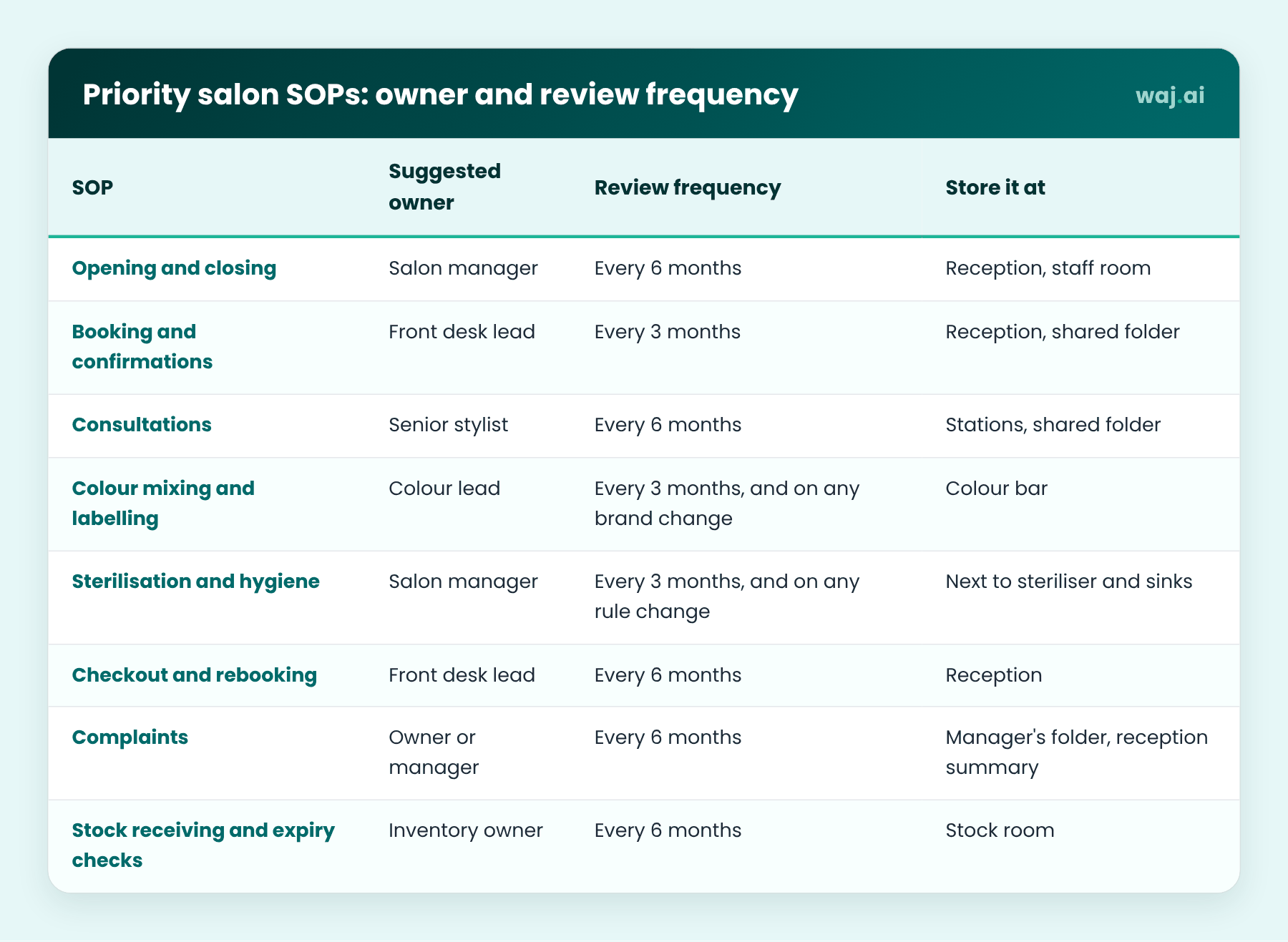
- Opening and closing
Suggested owner: Salon manager
Review frequency: Every 6 months
Store it at: Reception, staff room - Booking and confirmations
Suggested owner: Front desk lead
Review frequency: Every 3 months
Store it at: Reception, shared folder - Consultations
Suggested owner: Senior stylist
Review frequency: Every 6 months
Store it at: Stations, shared folder - Colour mixing and labelling
Suggested owner: Colour lead
Review frequency: Every 3 months, and on any brand change
Store it at: Colour bar - Sterilisation and hygiene
Suggested owner: Salon manager
Review frequency: Every 3 months, and on any rule change
Store it at: Next to steriliser and sinks - Checkout and rebooking
Suggested owner: Front desk lead
Review frequency: Every 6 months
Store it at: Reception - Complaints
Suggested owner: Owner or manager
Review frequency: Every 6 months
Store it at: Manager's folder, reception summary - Stock receiving and expiry checks
Suggested owner: Inventory owner
Review frequency: Every 6 months
Store it at: Stock room
Treat these as a starting point. With several branches, keep one master version and let branches add local notes rather than drift into their own rules. Our article on ladies' salon management in the Gulf covers staffing and privacy points that often belong in those notes.
When is the best time to write your salon manual?
Quiet weeks. In much of the Gulf, the summer slowdown is the natural window, with fewer bookings and time for training. We wrote about using it well in the salon summer slow season guide.
Don't aim for perfect. Write three SOPs this week, train on them, fix what the team says is wrong, then write the next three. A rough page people use beats a polished binder in a drawer.
FAQ
What is a salon SOP?
A short written instruction for one recurring task, such as opening, colour mixing or checkout, so everyone does it the same way.
How many SOPs does a small salon need?
Start with six or seven covering opening and closing, bookings, consultations, colour, sterilisation, checkout and complaints. Add more only when a real gap appears.
How long should each SOP be?
One page. Use numbered steps, a photo or two and a short checklist. If it runs longer, split it into two SOPs.
Do SOPs replace local health regulations?
No. SOPs are how you apply the rules day to day. Always check current requirements with your health authority or municipality, such as DHA, DOH, the Saudi MOH or Kuwait's Ministry of Health, and write those requirements into the relevant SOP.
Who should write the SOPs?
The person who does the task best writes the first draft, the manager edits it, and the team tests it. The owner of each SOP keeps it up to date.
If you want booking, reminders, client records and checkout to follow the same steps every time, without relying on memory, book a free WAJ demo: waj.ai/demo.
Follow WAJ on Google
Add WAJ as a preferred source to see more of our articles in your Google Search results, marked with a "preferred" badge.