
Salon Product Cost per Service: How to Calculate Your Backbar Costs
WAJ Team
May 17, 2026
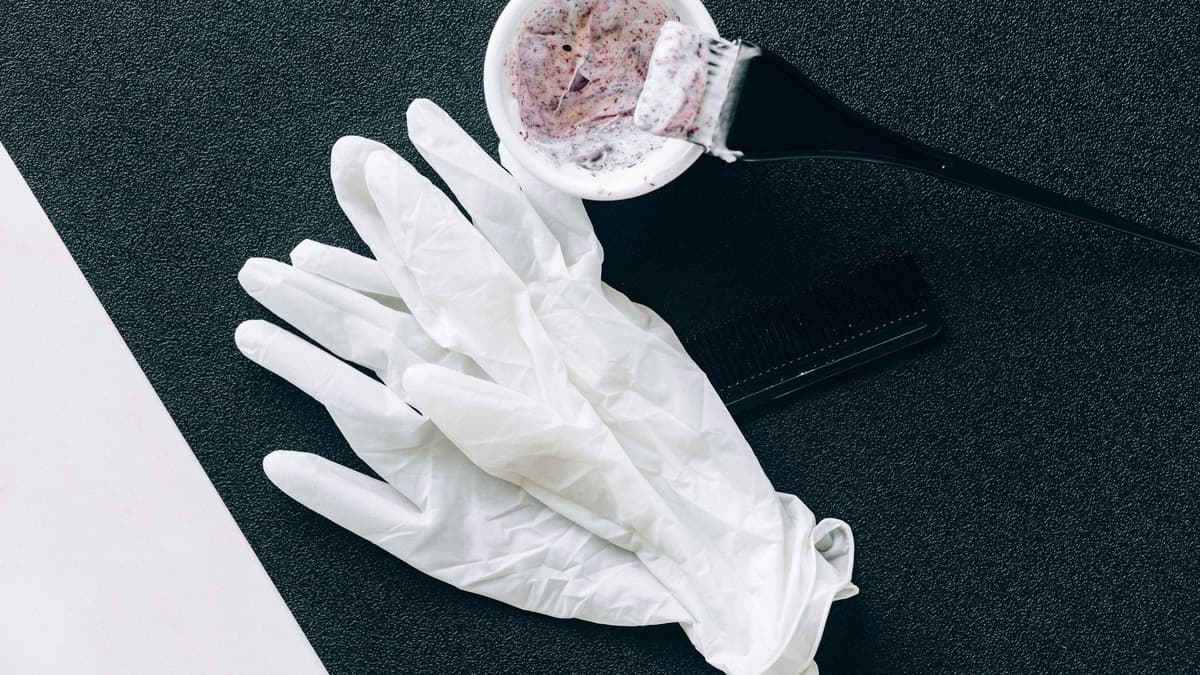
Salon product cost per service is the cost of the professional products used on a client during one service: colour, developer, shampoo, treatment and styling products. You calculate it by working out what each product costs per gram or millilitre, measuring how much a standard service uses, and adding it up. Once you know that number for your main services, you can price properly, spot waste, and see which stylists are mixing more than they need.
Most salon owners in the Gulf know their rent, their salaries and their monthly supplier bill to the dirham. Far fewer know what a root touch-up actually costs them in product. That gap is where margin quietly leaks.
What is backbar?
Backbar is the stock you use on clients, as opposed to retail stock you sell to them. It includes:
- Colour tubes, lighteners and developers
- Shampoo, conditioner and masks at the basin
- Treatments such as bond builders or keratin
- Styling products: heat protection, serum, spray
- Nail products: gel polish, base, top coat, remover
- Disposables: foils, gloves, cotton, neck strips
Retail and backbar should be tracked separately in your inventory. If they sit in one pool, you cannot tell whether a shampoo bottle was sold to a client or emptied at the basin.
How do you measure product usage?
You measure it the way a kitchen measures ingredients. Not by eye.
Colour by the gram
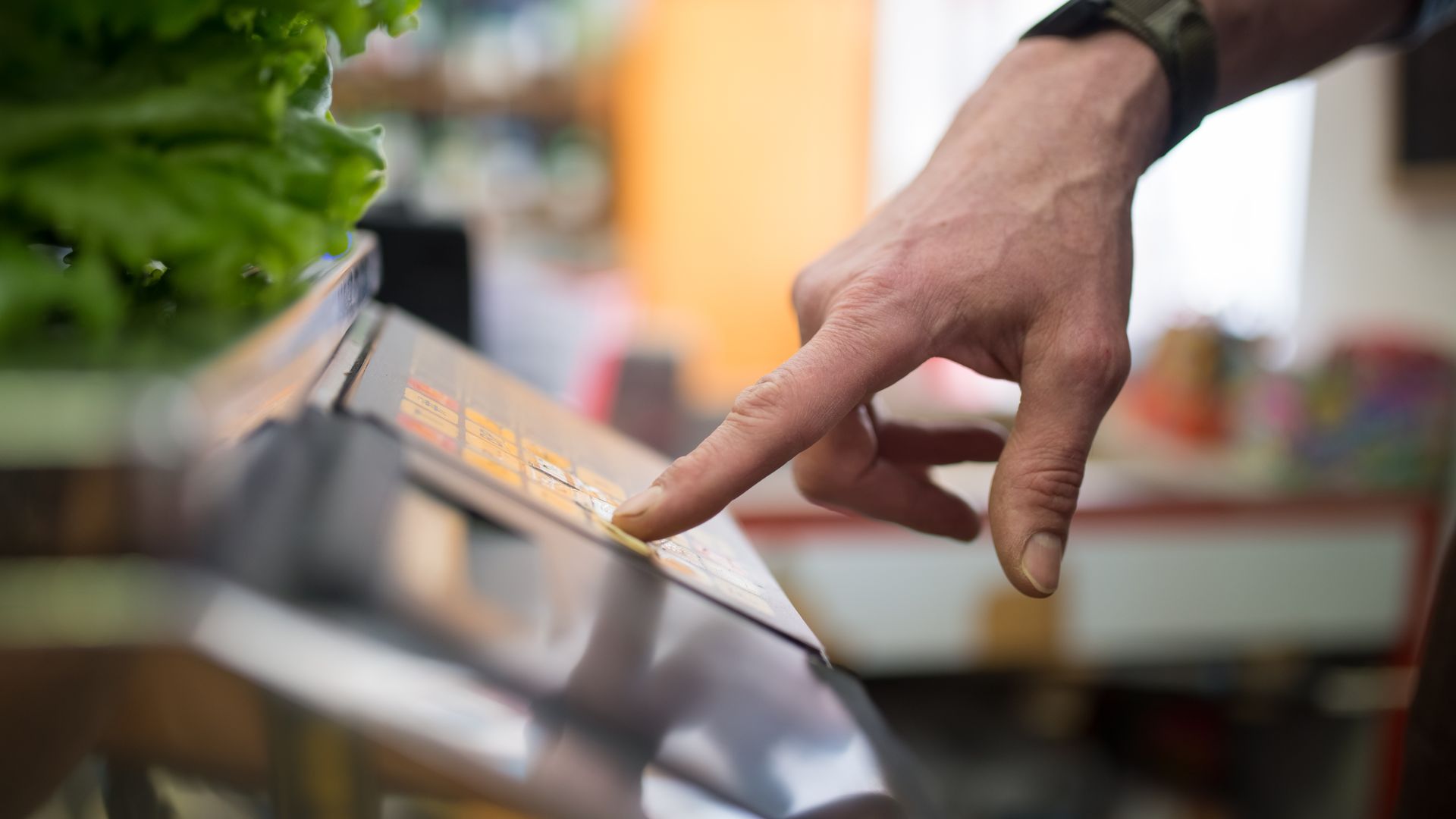
Put a digital scale at the colour bar. Weigh every bowl. It feels fussy for the first week, then it becomes habit, and stylists start to see for themselves how much they were over-mixing. Colour is usually the most expensive product per service, so this is where measuring pays back fastest.
Shampoo and conditioner by the pump
Basin products are harder to weigh, so use pumps. Here is how to cost a pump:
- Pump ten times into a measuring jug.
- Divide the total by ten to get millilitres per pump.
- Divide the bottle price by its volume to get the cost per millilitre.
- Multiply to get the cost per pump.
Then agree a standard: for example, two pumps of shampoo for short hair, three for long. Write it on a card above the basin.
Styling and treatments
Estimate these per service using the same method. Precision matters less here because the amounts are small, but they still add up over a month.
A worked example in AED
The figures below are an example only. Your supplier prices and recipes will differ. The point is the method.
Assume a salon buys colour at AED 45 for a 60 g tube (AED 0.75 per gram), developer at AED 60 per litre (AED 0.06 per ml), colour-safe shampoo at AED 120 per litre (AED 0.12 per ml) and a mask at AED 150 per litre (AED 0.15 per ml).
Example: root colour on medium-length hair
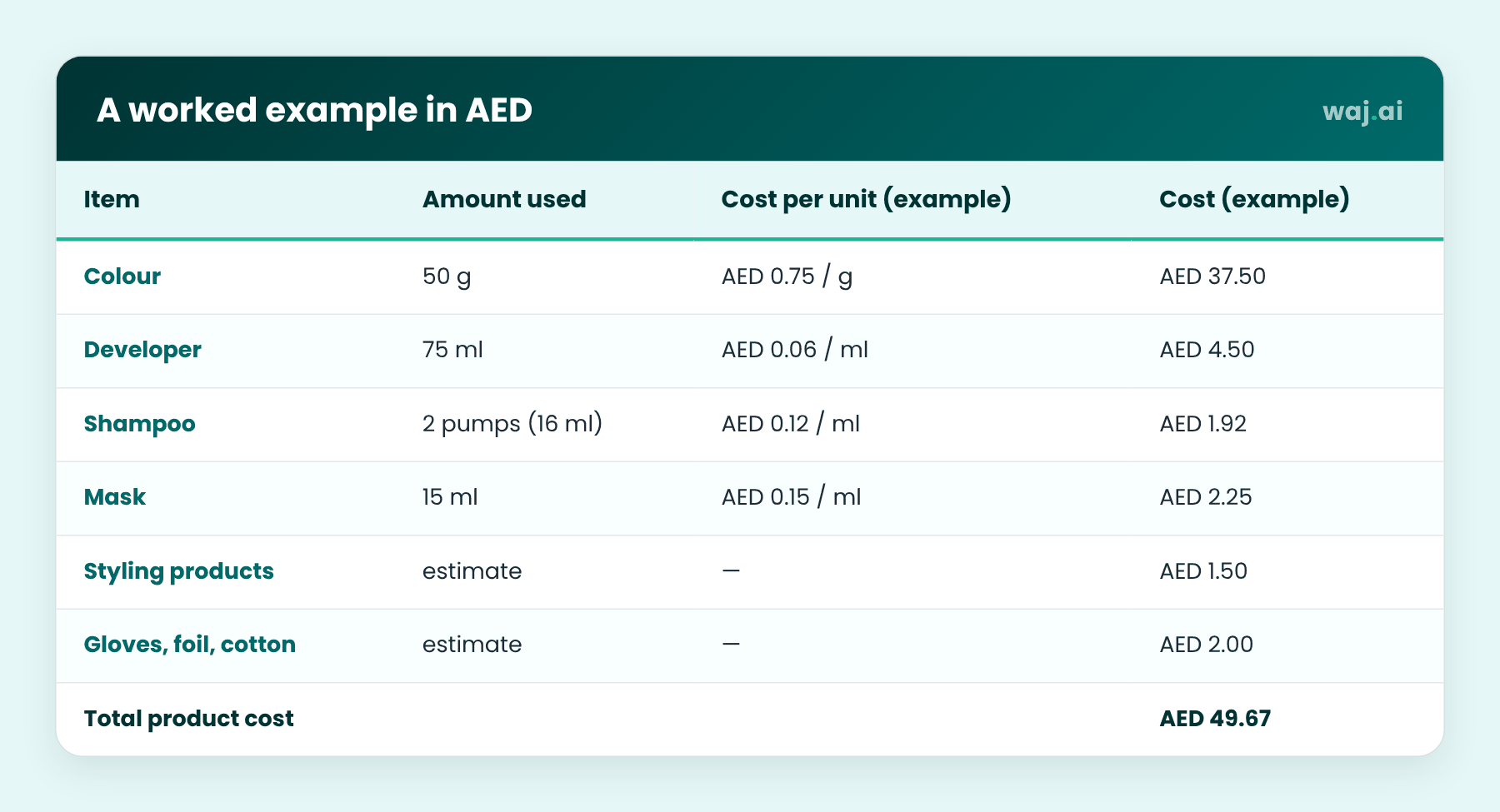
- Colour
Amount used: 50 g
Cost per unit (example): AED 0.75 / g
Cost (example): AED 37.50 - Developer
Amount used: 75 ml
Cost per unit (example): AED 0.06 / ml
Cost (example): AED 4.50 - Shampoo
Amount used: 2 pumps (16 ml)
Cost per unit (example): AED 0.12 / ml
Cost (example): AED 1.92 - Mask
Amount used: 15 ml
Cost per unit (example): AED 0.15 / ml
Cost (example): AED 2.25 - Styling products
Amount used: estimate
Cost per unit (example): —
Cost (example): AED 1.50 - Gloves, foil, cotton
Amount used: estimate
Cost per unit (example): —
Cost (example): AED 2.00 - Total product cost
Amount used:
Cost per unit (example):
Cost (example): AED 49.67
If this salon charges AED 350 for the service, product is about 14% of the price in this example. That number on its own does not tell you whether you are doing well. What matters is knowing it, watching it over time, and comparing it across services and stylists.
How to set standard recipes
A standard recipe is the agreed product amount for each common service and hair length. It is what you cost against, and what stylists aim for.
- List your ten most common services.
- For each one, weigh and record what a careful senior stylist uses on short, medium and long hair over a week or two.
- Agree a standard amount for each, with the team, not imposed on them.
- Cost it using your current supplier prices.
- Review the recipes when suppliers change prices or you switch brands.
Recipes also help training. A junior who knows a medium root touch-up is 50 g of colour does not have to guess.
Tracking variance per stylist
Variance is the difference between what the recipe says and what was actually used. Some variance is normal, because clients' hair is not identical. Consistent variance is a signal.
Here is an example. Say one stylist averages 62 g of colour on a root touch-up against a 50 g recipe. That is 12 g extra at AED 0.75, or AED 9 per service. If they do 40 of those a month, it is AED 360 a month on one service, from one person. Multiply across a team and a year and it becomes a real number.
The fix is usually a conversation, not a reprimand. Often the stylist is mixing extra "just in case" because they once ran short in front of a client. Show them the numbers, agree the recipe, and let them mix a top-up bowl when needed.
How to track it in practice:
- Record grams used against the service in the client's history.
- Compare actual stock used with what the recipes predict for the services sold.
- Review once a month, by stylist and by service.
If your salon software links inventory to services, this becomes a report rather than a spreadsheet project.
What this means for pricing
Once you know product cost per service, a few pricing decisions get easier:
- Services with thin margins become visible. If a treatment uses expensive product and your price has not moved in two years, you will see it.
- Supplier price rises can be passed on deliberately, rather than absorbed without noticing.
- Packages and memberships can be costed properly. Discounting a bundle is fine if you know what each service costs you.
In ladies' salons, where colour and treatments are often the heart of the menu, this matters even more. Our guide to ladies' salon management in the Gulf covers the wider operational side.
Should you charge extra for long or thick hair?
Yes, if it uses more product. Many salons already do. The fair way is to tie the charge to product used, not to a vague "long hair fee".
Using the example above, a client with very long, thick hair might need an extra 30 g of colour and 45 ml of developer. That is AED 22.50 plus AED 2.70, or AED 25.20 of extra product in this example, before the extra time. Some salons charge per extra bowl; others have short, medium and long price bands. Either works if it is written on the menu and explained at consultation, so the client is not surprised at the till.
The same logic applies to barbershops for beard and grooming products, though the amounts are smaller. Our Creators Barbers spotlight shows how one barbershop runs its day-to-day.
How software helps
You can do all of this with a scale, a notebook and a spreadsheet. Software just saves the hours. In WAJ, inventory tracks backbar and retail stock, client profiles keep notes and history, so each client's colour formula is on file for next time, and reports show stock movement so you can compare it with services sold.
If you would like to see how this works with your own services, book a free WAJ demo: waj.ai/demo.
FAQ
What is a good product cost percentage for a salon service?
It depends on the service, the brands you use and your prices. Calculate your own for each main service and watch how it changes, rather than chasing a single benchmark.
How do I measure how much colour a stylist uses?
Weigh every bowl on a digital scale at the colour bar and record the grams in the client's history.
How do I cost shampoo per wash?
Pump ten times into a measuring jug, divide by ten for millilitres per pump, then multiply by the cost per millilitre of the bottle.
Should stylists be penalised for using too much product?
Start with a conversation. Over-mixing is usually a habit or a fear of running short, and agreed recipes plus a top-up rule fix most of it.
Is it fair to charge more for long hair?
Yes, when it uses more product and time. Show the price bands on your menu and explain them at consultation.
Follow WAJ on Google
Add WAJ as a preferred source to see more of our articles in your Google Search results, marked with a "preferred" badge.