
How to Raise Salon Prices Without Losing Clients
WAJ Team
August 23, 2026

To raise salon prices without losing clients, increase in modest, planned steps, give regulars clear notice (usually a few weeks), explain the change in a short, honest message, and train your team to answer questions calmly. Tie the increase to stylist level or added value where you can, and protect your most loyal clients for a short period. Then watch rebooking closely for two or three months.
Most owners wait far too long. They absorb rising rent, product and staff costs for years because they are afraid of one awkward conversation at reception. Then they need a big jump all at once, which is exactly what drives clients away.
Signs it's time to raise your salon prices
Look for these:
- Your costs have gone up and your prices haven't. Rent renewals, supplier price lists, visa and staff costs, utilities in a Gulf summer. If your margin per service has shrunk, your clients are being subsidised by you.
- Your best stylists are fully booked weeks ahead. When clients wait weeks for one stylist, her time is underpriced.
- You haven't changed prices in years. If your menu shows the same numbers as on opening day, your prices have quietly fallen in real terms.
- You're turning away walk-ins on weekends. Thursday evening and Friday afternoon are full and the salon can't take more. That is pricing power you are not using.
- Your team is skilled but underpaid. If you can't raise commissions or salaries without raising prices, you will lose stylists to the salon down the road. And when a stylist leaves, her regulars often follow her.
If two or more of these are true, you are probably overdue.
How much should you raise prices, and how often?
There is no single right number; it depends on your costs, area and clientele. A ladies' salon in a busy Riyadh district and a neighbourhood barbershop in Amman live in very different markets. What works in practice:
- Smaller, regular increases beat rare, large ones. Clients barely notice a modest adjustment once a year. They definitely notice a big jump after four years of silence.
- Do the maths per service. Work out the real cost of each service (product, stylist time, overhead). You may not need to raise everything.
- Round to clean numbers. A price that ends in an odd figure looks like it was calculated to squeeze. Clean numbers look confident.
- Pick a fixed time each year. Many owners adjust after a quiet period rather than just before a busy season, so the team can settle in. The end of the Gulf salon summer slow season often works well.
Use tiered pricing by stylist level
Tiered pricing is the most painless way to raise prices, because it gives clients a choice. Instead of one haircut price, you price by stylist level: junior, senior and master, for example.
The client who wants your most in-demand stylist pays more for her time. The client who is price-sensitive can book a junior stylist and keep paying close to what she paid before. Nobody is forced out.
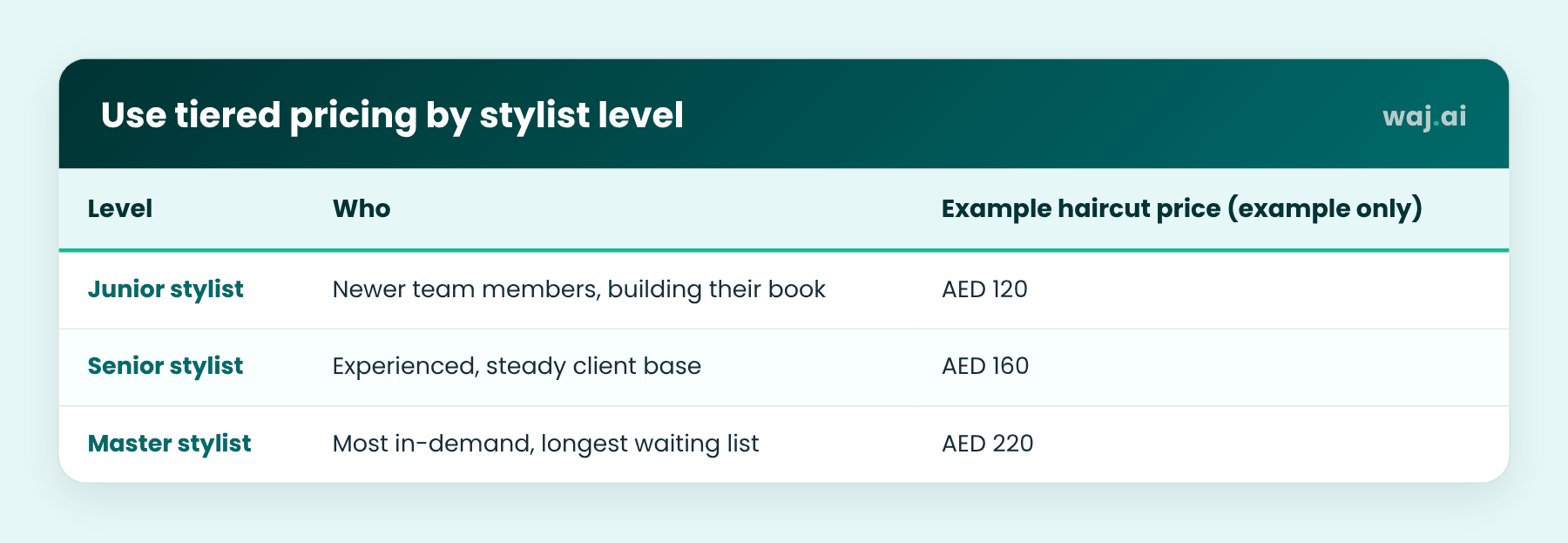
- Junior stylist
Who: Newer team members, building their book
Example haircut price (example only): AED 120 - Senior stylist
Who: Experienced, steady client base
Example haircut price (example only): AED 160 - Master stylist
Who: Most in-demand, longest waiting list
Example haircut price (example only): AED 220
Tiers also give your team a career path. A junior stylist can see what promotion means for her income, which helps with retention.

Give clients proper notice
Surprise is what upsets people. A client who finds a new price on her bill with no warning feels tricked, even if the increase is small.
Plan the announcement like this:
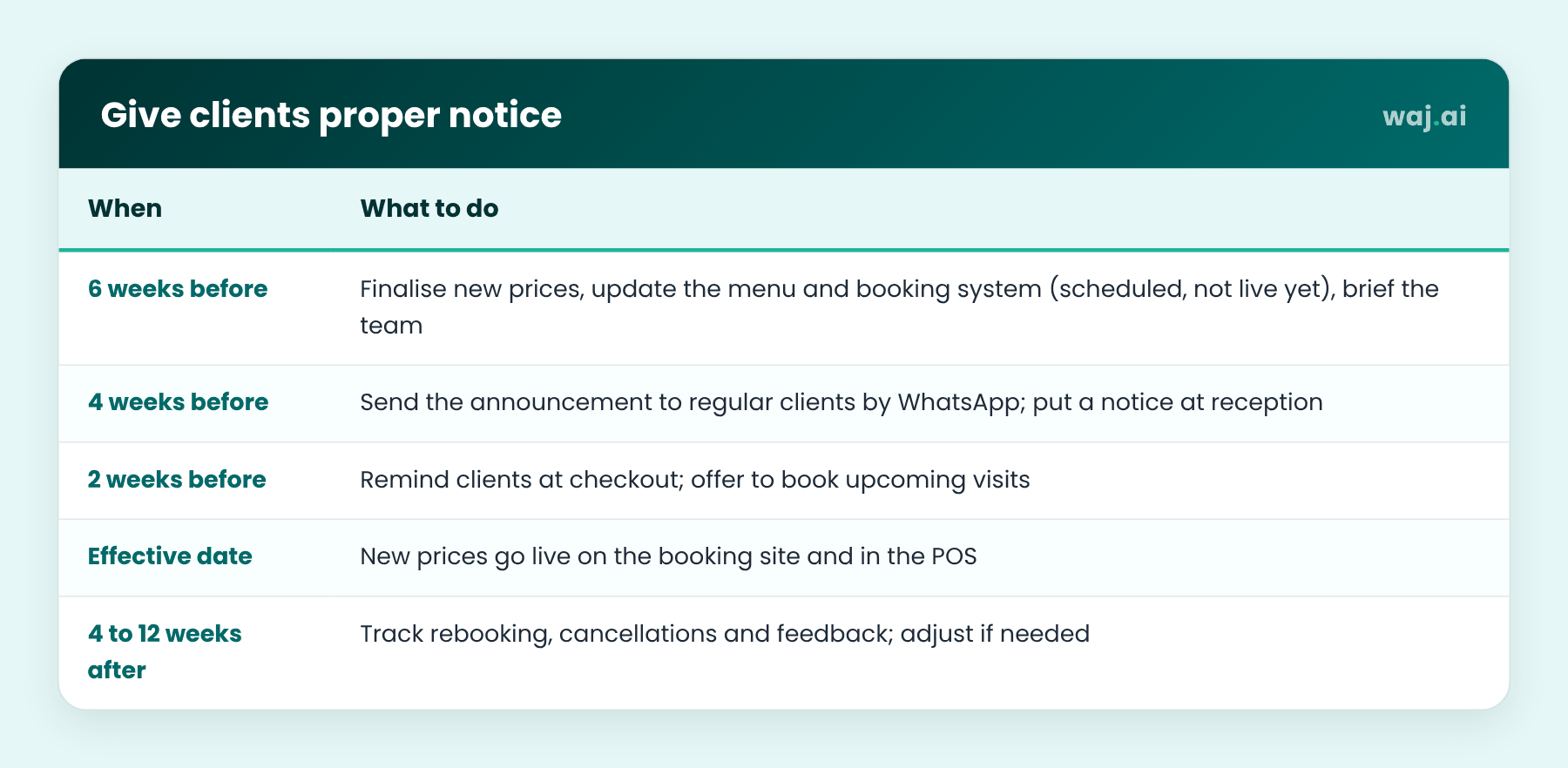
- 6 weeks before
What to do: Finalise new prices, update the menu and booking system (scheduled, not live yet), brief the team - 4 weeks before
What to do: Send the announcement to regular clients by WhatsApp; put a notice at reception - 2 weeks before
What to do: Remind clients at checkout; offer to book upcoming visits - Effective date
What to do: New prices go live on the booking site and in the POS - 4 to 12 weeks after
What to do: Track rebooking, cancellations and feedback; adjust if needed
Four weeks is a reasonable middle ground, with longer for members and package holders. In some countries the displayed price list must match what you charge. Kuwait's salon requirements, for example, call for a licensed price list displayed at reception. Check the rules where you operate and update everything on the same day.
How to word the price increase announcement
Keep it short, warm and honest. No long apology, no essay about your rent. One reason, a thank you, the date and a way to book.
English template:
Hi Sara, thank you for being with us. From [date], some of our service prices will change as our costs and team have grown. Your stylist and the care you get stay exactly the same. You can see the updated menu here: [link]. Want to book your next visit before then? Just reply to this message. Lina, [Salon name]
Arabic template:
مرحبًا سارة، شكرًا لثقتك بنا. اعتبارًا من [التاريخ] ستتغير أسعار بعض خدماتنا بسبب ارتفاع التكاليف ونمو فريقنا، بينما تبقى مصففتك ومستوى العناية كما هما تمامًا. يمكنك الاطلاع على قائمة الأسعار الجديدة هنا: [الرابط]. هل تودين حجز زيارتك القادمة قبل ذلك؟ يكفي الرد على هذه الرسالة. لينا، [اسم الصالون]
Send it in each client's preferred language, with her name and, if possible, her stylist's. Never send it as an anonymous broadcast.
Train your team to answer objections
Most pushback happens at the front desk or in the chair, not in reply to your message. Your team needs to know what to say and believe the new prices are fair. If your stylist looks embarrassed, the client will feel she has been overcharged.
Hold a 20-minute team briefing before the announcement. Cover:
- Why prices are changing, in one or two sentences anyone can repeat.
- What stays the same: the stylist, the products, the time spent.
- What options the client has: a different stylist level, a package, booking before the effective date.
- What not to say: no "I know, it's crazy", no blaming management, no promising discounts the owner hasn't approved.
A simple line works well: "Yes, prices changed this month. Your appointment with Hala is the same as always. If you'd like, I can show you the senior stylist rates too."
Grandfather loyal clients, briefly
Your longest-standing regulars deserve a softer landing. Consider keeping their old prices for a short period, perhaps their next visit or a month or two, and tell them personally.
Keep it time-bound. Indefinite grandfathering turns into two price lists, confused staff and resentment from clients who find out. Visit history in the client record shows who qualifies.
Add value alongside the increase
An increase lands better when the client gets something visible. It does not have to cost much:
- A short scalp massage or blow-dry finish added to certain services.
- Better products at the basin.
- Easier online booking and WhatsApp reminders, so clients don't have to call.
- A membership or package that locks in a fair rate for regulars. Our guide to the spa membership model in the Gulf shows how recurring plans work, and the same thinking applies to salons.
Track results after the increase
For two to three months afterwards, watch:
- Rebooking rate of regular clients, especially for stylists whose prices changed most.
- Cancellations and no-shows. If they rise, your reminders and deposits matter even more; see our guide on how to cut no-shows.
- Average ticket per visit.
- Feedback at reception, logged rather than remembered.
With WAJ, the POS, client CRM and reports sit in one place, so you can compare before and after without spreadsheets, and use win-back audiences to reach clients who have not returned since the change. Updated prices go straight to your booking site, and staff commissions follow the new rates.
A few clients may leave. Check who they are. If they were mostly occasional discount-seekers and your regulars stayed, the increase worked.
To see pricing, booking and client follow-up working together, book a free WAJ demo: waj.ai/demo.
FAQ
How often should a salon raise its prices?
Many salons review prices once a year and make small adjustments, rather than one large jump after several years.
How much notice should I give clients before a price increase?
Around four weeks for regular clients, with a notice at reception and a reminder at checkout.
Will I lose clients if I raise my prices?
You may lose a few, usually the most price-sensitive. Clear notice, tiered stylist pricing and a short grace period for loyal regulars keep most clients with you.
Should I explain why I'm raising prices?
Briefly, yes. One honest reason, such as rising costs or a growing team, is enough. Long explanations sound defensive.
Is tiered pricing by stylist level fair to clients?
Yes, because it gives them a choice. Clients who want the most in-demand stylist pay for her time, and price-sensitive clients can book a junior stylist.
Follow WAJ on Google
Add WAJ as a preferred source to see more of our articles in your Google Search results, marked with a "preferred" badge.