
Building a Junior Stylist Training Program: Grow Your Own Talent Instead of Chasing It
WAJ Team
June 19, 2026
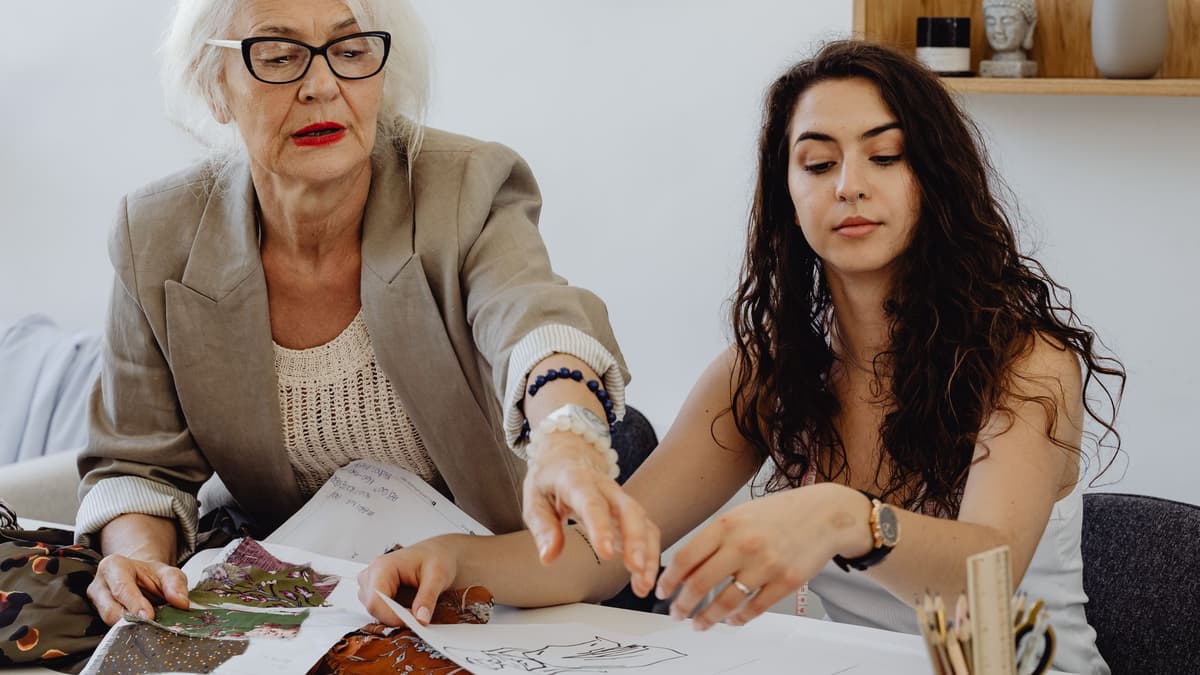
A junior stylist training program is a structured plan that takes a new hire from the shampoo basin to paying clients in about six months, through a clear skills ladder, regular practice on models and a sign-off at every step. For most Gulf salons it costs less over time than repeatedly recruiting finished stylists, and the people you train already work the way you want.
Why train stylists in-house instead of hiring ready-made?
Anyone who has recruited for a salon in Dubai, Riyadh or Amman knows the cycle. You post the job, wait out a visa or a notice period, and the senior who finally arrives brings her last salon's habits, and sometimes a client list she will take with her when she leaves.
Training your own juniors changes the maths. You hire for attitude and teach the skill, and a stylist who grew up in your salon usually feels a loyalty a hired-in senior rarely does.
It isn't free. A junior takes senior time, uses product on models and draws a salary while she learns. But the cost is planned, and it buys you people ready to step up when a senior resigns.
How do you choose who joins the program?
Skills can be taught. These things mostly can't:
- Careful hands. Watch a candidate shampoo a colleague on her trial day. Is she gentle around the hairline? Does she check the water temperature without being told?
- Ease with clients. Ladies' salons in the Gulf run on trust. A junior who chats warmly in Arabic or English beats one who is quick but silent.
- Coachability. Give one correction during the trial and see whether she applies it ten minutes later.
Take one or two juniors per intake, each with a named senior mentor.
What should the skills ladder look like?
Think of it as rungs. A junior moves up only after passing the assessment for the rung below.
Rung 1: Shampoo and basin work
Shampooing, scalp massage, rinsing colour without staining the skin, and a spotless basin area. It sounds basic, but clients remember it with their eyes closed.
Rung 2: Blow-dry and finishing
Sectioning, round-brush control, smooth finishes, volume and waves. In the Gulf the blow-dry carries the weeks before weddings, Eid and evening events, so this rung earns fastest.
Rung 3: Colour application
Application, not formulation. Clean root touch-ups, full-head application, timing, emulsifying and rinsing. The senior mixes and decides. The junior applies under supervision.
Rung 4: Cutting
One-length cuts, long layers, trims and fringes, on mannequin heads first and then on models. Cutting comes last because a bad cut takes months to grow out.

How do you run model nights?
Model nights are where training becomes skill. Choose one or two quiet evenings a week and block them in the staff calendar so nobody books paying clients over them.
- Recruit models on purpose. Friends, family, students and existing clients who would enjoy a free or low-cost blow-dry. Tell them plainly that a supervised trainee will do it and it will take longer.
- Set one learning goal per model. "Smooth blow-dry on thick, long hair" is a goal. "Practise" is not.
- Have the senior check at fixed points, not only at the end, so mistakes are caught while they can still be fixed.
- Write it down the same night. A short note in the model's client file: what went well, what to fix and who supervised.
In WAJ, model appointments sit in the same staff calendar as paid work and the notes stay in each client's history, so a mentor can track progress across sessions.
How should you assess a junior before she moves up?
Keep it simple and the same for everyone:
- A practical on a model, judged by a senior who is not her daily mentor.
- A short checklist per rung (for a blow-dry: sectioning, tension, heat, finish, timing, comfort).
- A pass, or a "not yet" with specific fixes and a retry date.
"Not yet" matters. Failing a rung should feel like the next model night, nothing more.
How should junior pay and progression work?
Many salons pay juniors a fixed salary during training and add commission once they take paying clients on their own. Tie every pay step to a rung so progress is visible and fair to everyone. One illustrative structure: base salary through rungs 1 and 2, a small commission on blow-dries after passing rung 2, and a higher commission band after passing cutting.
Put the progression in writing on day one; juniors leave when they cannot see where they are going. If you track staff commissions in WAJ, set each junior's commission to match her current rung, so payroll follows the plan rather than depending on someone remembering a promotion.
Should you offer junior pricing to clients?
Yes, openly. A "junior stylist" tier gives price-conscious clients a reason to book and juniors a steady stream of real work.
As an example only: if your senior blow-dry is AED 150, a junior one might be AED 90 to 100. List junior services as separate items so clients choose knowingly and your reports show what juniors earn.
Two rules keep it honest. Juniors only perform the junior-tier services they have passed. And for the first few weeks, a senior checks the finish before the client walks out.
Quiet weeks are the best time to launch, since a junior blow-dry offer fills empty chairs in the hot months. Our guide to the summer slow season for Gulf salons has more ideas for those weeks.
How do you keep juniors once they are trained?
Every owner asks this, usually right after losing one.
- A retention agreement. Some salons ask juniors to stay for a set period after training, or to repay part of the training cost if they leave early. Whether that is allowed, and in what form, depends on your country's labour law and the employment contract. Check with your labour ministry or a lawyer before you write one.
- A visible next step. Senior stylist, colour specialist, trainer for the next intake. Ambitious people stay when the ladder keeps going.
- Their own clients. Help juniors build a book through rebooking at the desk and WhatsApp reminders. A stylist with a full column in your salon has a good reason to stay in it.
- Recognition. Celebrate juniors on social media when they pass a rung.
None of this guarantees loyalty, but juniors who feel invested in tend to stay longer. For more on managing a women-only team, see our guide to ladies' salon management in the Gulf.
A 6-month junior stylist program, month by month
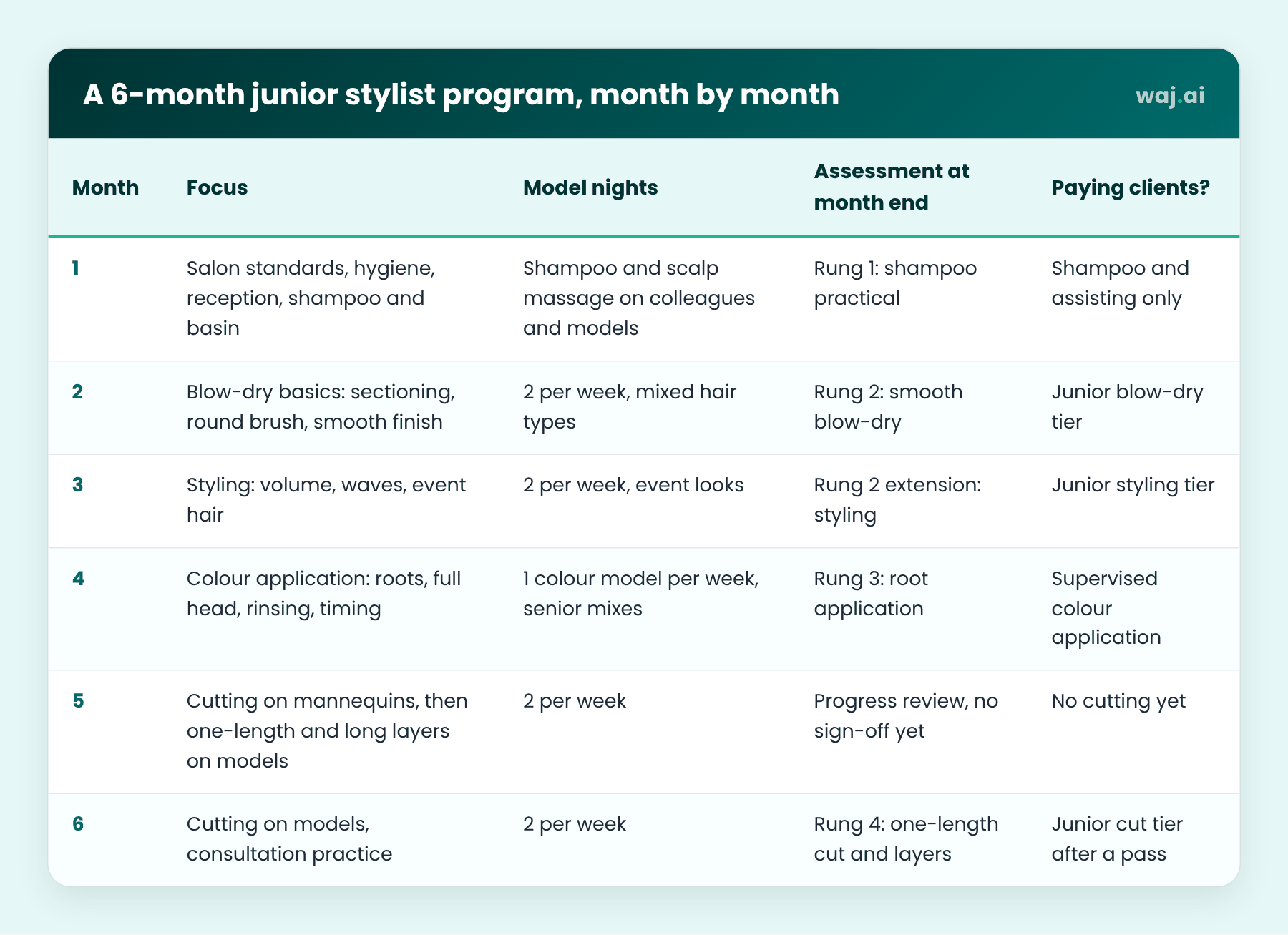
- 1
Focus: Salon standards, hygiene, reception, shampoo and basin
Model nights: Shampoo and scalp massage on colleagues and models
Assessment at month end: Rung 1: shampoo practical
Paying clients?: Shampoo and assisting only - 2
Focus: Blow-dry basics: sectioning, round brush, smooth finish
Model nights: 2 per week, mixed hair types
Assessment at month end: Rung 2: smooth blow-dry
Paying clients?: Junior blow-dry tier - 3
Focus: Styling: volume, waves, event hair
Model nights: 2 per week, event looks
Assessment at month end: Rung 2 extension: styling
Paying clients?: Junior styling tier - 4
Focus: Colour application: roots, full head, rinsing, timing
Model nights: 1 colour model per week, senior mixes
Assessment at month end: Rung 3: root application
Paying clients?: Supervised colour application - 5
Focus: Cutting on mannequins, then one-length and long layers on models
Model nights: 2 per week
Assessment at month end: Progress review, no sign-off yet
Paying clients?: No cutting yet - 6
Focus: Cutting on models, consultation practice
Model nights: 2 per week
Assessment at month end: Rung 4: one-length cut and layers
Paying clients?: Junior cut tier after a pass
Treat six months as a guide. Keep the standard fixed and let the timing flex.
FAQ
How long does a junior stylist training program take?
Most salons run a core program of about six months, from shampoo to basic cutting. Formulation and advanced cuts come later.
How many juniors should a salon train at once?
One or two per intake for a typical salon, because each junior needs a senior mentor and regular model nights.
Does junior pricing hurt a salon's brand?
Not if it is clearly labelled and quality-checked. Many clients like a lower-priced option.
Can I make a junior repay training costs if she leaves early?
It depends on your country's labour law and the contract. Confirm with your labour ministry or a lawyer before adding any repayment clause.
What should a junior learn first?
Shampoo and basin work, then blow-drying. Both earn early and teach the client care every later skill needs.
The bottom line
You will never stop hiring seniors entirely. But a salon that trains its own juniors stops being at the mercy of the recruitment market. If you want a calendar, commission setup and client notes that can carry a training program, book a free WAJ demo.
Follow WAJ on Google
Add WAJ as a preferred source to see more of our articles in your Google Search results, marked with a "preferred" badge.