
How to Value and Sell Your Salon Business in the Gulf
WAJ Team
July 16, 2026

To sell a salon business in the Gulf for a fair price, start preparing about 12 months before you list it. Buyers pay for profit they can verify, revenue that repeats, a client base that stays, and a team that works without you in the room. Valuation usually starts from a multiple of the salon's real profit or from the value of its assets, and the licence and lease terms can make or break the deal.
I have watched owners decide to sell on a Sunday and expect an offer by Thursday. It rarely goes that way. A salon that looks busy on Instagram can look very thin when the buyer asks for two years of sales reports and finds a shoebox of receipts.
What do buyers look at when you sell a salon business?
A serious buyer, whether a group expanding into a new emirate or a first-time investor in Riyadh, asks one question: will this salon keep making money after the owner leaves?
Clean, provable financials
Buyers want sales by month, service and staff member, matched to bank deposits and VAT returns. Cash sales that never hit the system don't exist in a buyer's eyes. If your POS, invoices and VAT records agree, you are ahead of most sellers.
Recurring revenue and memberships
Clients who come back on a schedule are worth more than walk-ins chasing promotions. Memberships and prepaid packages show revenue already committed. We explained how this works in our guide to the spa membership model and recurring revenue. But unused package sessions and gift card balances are obligations, and the buyer will want to know exactly what is owed.
Client retention
Buyers will ask how many clients returned in the last 6 or 12 months, and how many top clients are tied to one stylist. Repeat-client figures from your CRM are among the most convincing things you can show.
Staff stability
If your senior colourist leaves the week after the sale with half the bridal bookings, the buyer has lost money. Show how long key staff have stayed, how commissions work, and whether visas and contracts can continue under new ownership.
Lease terms
A buyer needs enough years left to recover their investment, and the landlord's agreement to assign or renew. A great location with eight months left on the lease is a risk.
Licence transferability
In some Gulf markets the trade licence, activity licence and premises approvals can't simply pass to a new owner. They may need amending, reissuing or fresh approval, depending on the country, emirate and activity. Check early.
How is a salon business valued?
There is no single formula, and anyone quoting "the market multiple" without seeing your books is guessing. Two approaches are common, often combined.
1. A multiple of profit. The buyer takes the salon's real annual profit and adjusts it for the owner. If you pay yourself nothing and work behind the chair all week, the buyer must hire your replacement, so that cost comes off. Personal expenses run through the business get added back. The adjusted profit is multiplied by a figure reflecting risk: stable, documented, owner-independent salons attract a higher multiple.
2. Asset value. This looks at what the business owns: fit-out, chairs, equipment, stock, sometimes the brand and booking site. It often sets a floor for a salon with weak profits. A used fit-out is usually worth far less to a buyer than it cost you.
Buyers also weigh goodwill: reputation, reviews and loyalty that make the profit likely to continue. Clean records let you prove it rather than claim it. For a real number, speak to an accountant or valuer who knows salons in your market.

How far ahead should you prepare to sell?
Twelve months gives you a full year of clean figures, which is what buyers want to see.
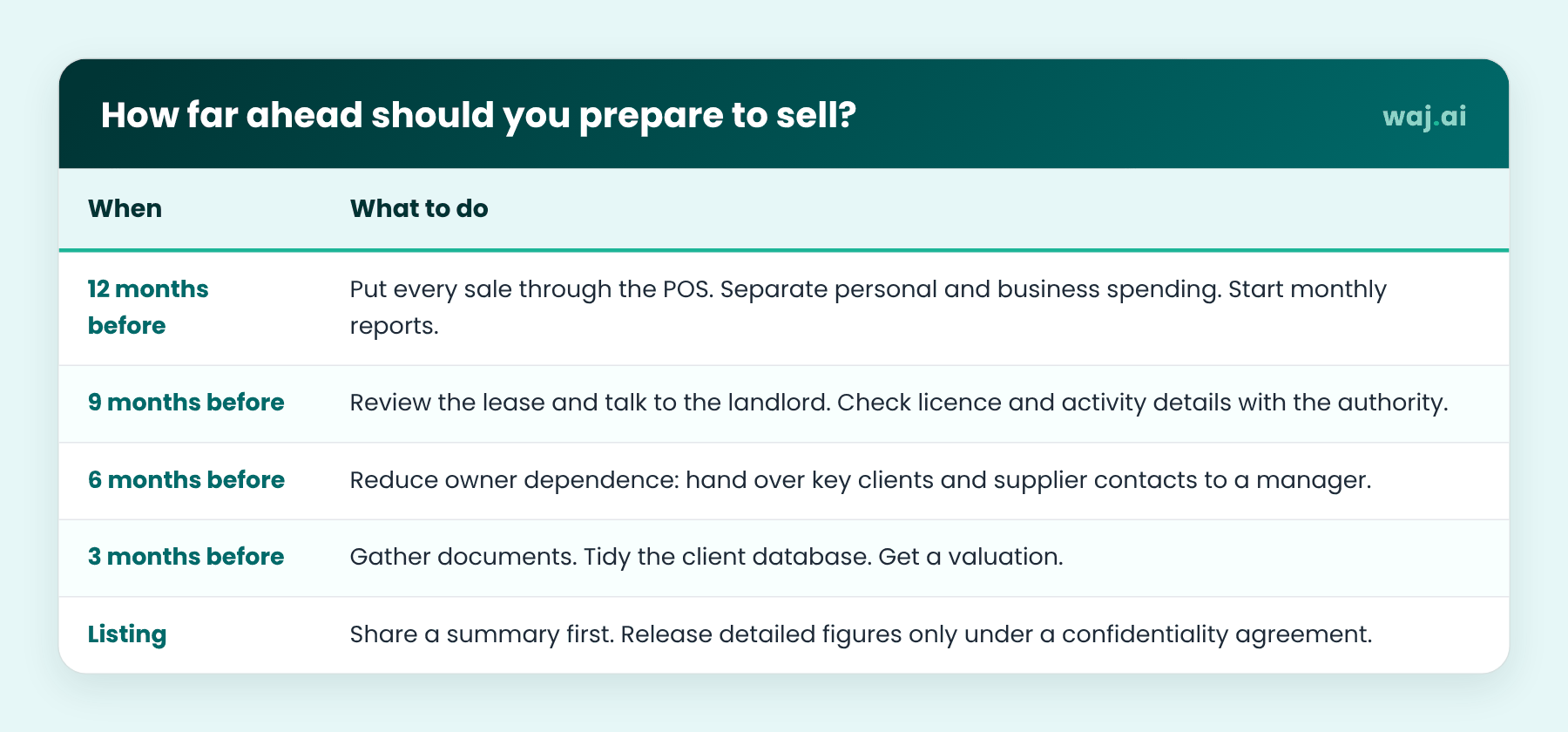
- 12 months before
What to do: Put every sale through the POS. Separate personal and business spending. Start monthly reports. - 9 months before
What to do: Review the lease and talk to the landlord. Check licence and activity details with the authority. - 6 months before
What to do: Reduce owner dependence: hand over key clients and supplier contacts to a manager. - 3 months before
What to do: Gather documents. Tidy the client database. Get a valuation. - Listing
What to do: Share a summary first. Release detailed figures only under a confidentiality agreement.
Summer, when bookings soften during the school holidays, is a good time for the paperwork.
What documents should you prepare?
Have these ready before the first serious meeting:
- Two to three years of sales and profit reports, by month
- VAT returns and e-invoicing records (UAE VAT, Saudi ZATCA, or JoFotara in Jordan)
- Bank statements that match the reported sales
- The lease, with any renewal or assignment terms
- Trade licence, activity approvals, and health and civil defence certificates
- Staff list with start dates, salaries, commissions and visa status
- Active memberships, prepaid packages and outstanding gift card balances
- Inventory list with supplier details
- Equipment list with finance or warranty papers
- Client and retention figures (totals only)
Client data is personal data. Share totals and trends during negotiations, not names and phone numbers. How client data passes to a new owner is a question for your lawyer under your country's data protection law.
How do you reduce owner dependence?
Owner dependence quietly drags down a lot of valuations. If clients book because of you and suppliers only deal with you, the buyer is buying a job.
Move your own regulars to other team members, gradually. Put a manager in charge of the rota, stock orders and daily cash-up. Write down opening and closing routines, pricing rules and how complaints are handled. If the salon runs well for two weeks while you travel, say so.
When bookings, client history, commissions and stock live in one system rather than in your phone, a new owner can step in on day one. WAJ brings online booking, POS, a client CRM, memberships, inventory and staff commissions into one place, with reports a buyer can read.

What about the legal side and licence transfer?
Rules differ across the Gulf and change over time, so treat these as questions to ask.
- Ownership structure. In Kuwait, foreign ownership generally needs a Kuwaiti partner holding at least 51% in a WLL, unless the investor holds a KDIPA foreign investment licence. In Bahrain, foreigners can own 100% in most commercial activities, and commercial registration runs through the Sijilat platform at the Ministry of Industry and Commerce.
- Share sale or asset sale. Selling the licence-holding company differs from selling the salon's assets, with different tax, licence and liability consequences.
- Activity approvals. Spa and massage activities often need extra approvals. Any clinic or medical activity sits under health authority rules. In Dubai, for example, the DHA treats injectables and medical lasers as medical acts for licensed clinics only.
- Staff visas. Check what happens to sponsorship and work permits when ownership changes.
Confirm every step with the relevant authority (MOCI in Kuwait, MOIC in Bahrain, or your emirate's or city's licensing and health authorities) and use a lawyer for the sale agreement. Our guide to opening a beauty salon or spa in Qatar shows how many approvals sit behind one shopfront.
Buyer-readiness checklist
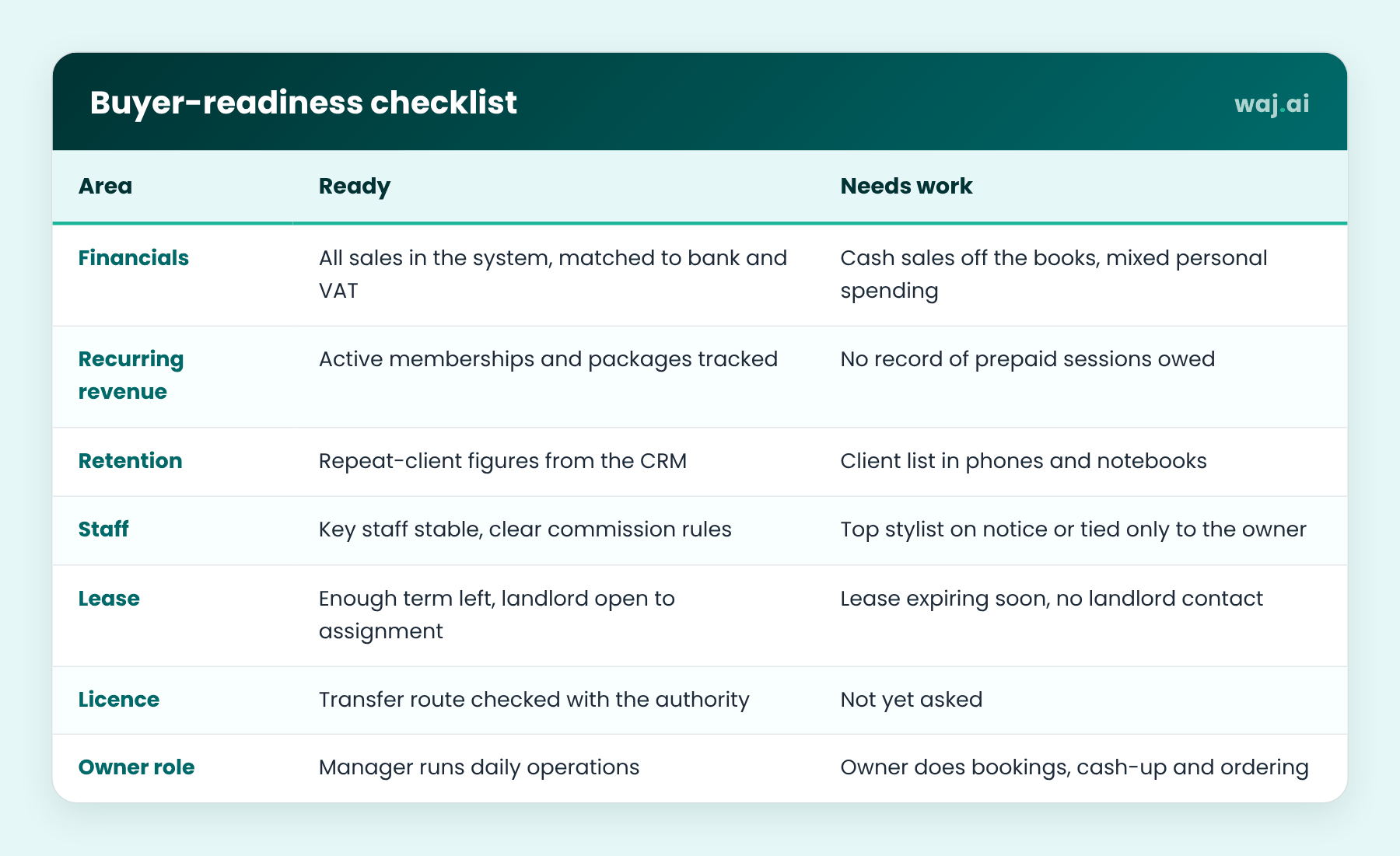
- Financials
Ready: All sales in the system, matched to bank and VAT
Needs work: Cash sales off the books, mixed personal spending - Recurring revenue
Ready: Active memberships and packages tracked
Needs work: No record of prepaid sessions owed - Retention
Ready: Repeat-client figures from the CRM
Needs work: Client list in phones and notebooks - Staff
Ready: Key staff stable, clear commission rules
Needs work: Top stylist on notice or tied only to the owner - Lease
Ready: Enough term left, landlord open to assignment
Needs work: Lease expiring soon, no landlord contact - Licence
Ready: Transfer route checked with the authority
Needs work: Not yet asked - Owner role
Ready: Manager runs daily operations
Needs work: Owner does bookings, cash-up and ordering
To get your numbers, clients and memberships in one place before talking to buyers, book a free WAJ demo: waj.ai/demo.
FAQ
How much is my salon worth?
It depends on your verified, owner-adjusted profit, how stable it looks, and your assets. A valuer who knows salons in your market can give you a realistic range.
How long does it take to sell a salon business?
Start preparing about 12 months ahead. The sale itself depends on the buyer, due diligence, the landlord and licence approvals, so allow several months after listing.
Can I transfer my salon licence to a buyer?
Not always directly. It may need amending or reissuing, depending on the country and activity. Check with your licensing authority and a lawyer before agreeing terms.
Do memberships increase the value of a salon?
Yes. They show committed, repeat revenue. Buyers will also count unused sessions and gift card balances as obligations, so keep accurate records of both.
Should I tell my staff I am selling?
Tell key staff once a serious buyer is close. Too early and people may leave; too late and trust suffers.
Follow WAJ on Google
Add WAJ as a preferred source to see more of our articles in your Google Search results, marked with a "preferred" badge.