
How to Reduce Clinic Wait Times on Your Busiest Days
WAJ Team
May 25, 2026
To reduce clinic wait times, first measure where the minutes are actually lost, then fix the causes one by one: move paperwork before the visit, set slot lengths that match real treatment times, protect a few buffer slots, let nurses prepare patients in parallel within their scope, and tell waiting patients the truth by WhatsApp. Most clinics don't have a "too many patients" problem. They have five small delays that stack up by 4 pm.
Anyone who has run a clinic in Jumeirah or Riyadh's Olaya district on a Thursday evening knows the scene. One patient is twenty minutes late, the doctor is still in Room 2 explaining aftercare, and the receptionist is apologising to someone holding a clipboard. Nobody did anything wrong. The day was built on optimistic assumptions.
Where do clinic delays actually come from?
In aesthetic and dermatology clinics, the same culprits show up again and again.
Late patients
Squeeze in a patient who is 15 minutes late for a 30-minute slot, and everyone after them waits. Traffic on Sheikh Zayed Road is real, but a clear late policy, applied kindly, protects the people who arrived on time.
Consultations that overrun
New-patient consultations almost always take longer than booked. The patient has questions, wants to see before-and-after photos, and needs time to think about price. If you book a consult in the same slot length as a follow-up, you are planning to run late.
Paperwork at the desk
Medical history, consent forms and ID details filled in on paper at reception eat the first part of the appointment, and then someone types it all in again.
Numbing time
Many injectable and laser treatments need topical numbing before the procedure. If numbing starts only when the patient enters the treatment room, the doctor either waits or moves on and comes back, and both create gaps elsewhere.
The doctor running between rooms
Running two or three rooms looks efficient on paper. In practice the doctor becomes the bottleneck, and a small delay in one room ripples into the next.
How to reduce clinic wait times: the core fixes
1. Move paperwork before the visit with digital forms
Send a pre-visit form by WhatsApp or email when the booking is confirmed, then a reminder the day before. Ask for medical history, current medication, allergies, and consent for the planned treatment. The doctor reviews it before the patient walks in, and reception stops being a data-entry desk.
Keep health questions inside your clinical records system, not in a generic form tool that stores data abroad. In the UAE, Federal Law No. 2 of 2019 keeps health data inside the country by default, and under Saudi Arabia's PDPL health data is sensitive data. Confirm your setup with DHA, DOH, MOH or SDAIA, or a lawyer.
2. Set slot lengths that match reality
Compare booked time with actual time for each service over the last month. You will find treatments that run over almost every time. Lengthen those. A follow-up can stay short, while a first filler consultation needs a longer slot than you think.
3. Protect buffer slots
Leave one short, unbookable gap in the morning and one in the afternoon per doctor. On a smooth day, it's time for notes and calls. On a messy day, it absorbs the overrun so the 6 pm patient isn't punished for the 11 am consult.
4. Prepare patients in parallel
Let nurses or assistants handle what they are licensed and trained to do while the doctor finishes elsewhere: taking photos, cleansing, applying topical numbing where that falls within their scope, and checking that consent is signed. Injectables and medical lasers remain medical acts for licensed clinics and qualified practitioners only, so the preparation must stay within each person's licence. Check the exact scope with your regulator.
5. Send live updates to waiting patients
If the doctor is running 20 minutes behind, tell the next two patients before they leave home or the office. A short WhatsApp message ("Dr Lina is running about 20 minutes late today. You're welcome to arrive at 5:20 instead of 5:00.") turns a frustrated patient into a grateful one. Keep these messages free of treatment details.
6. Coordinate the doctor's route
Give one person, often the senior nurse or the front-desk lead, the job of telling the doctor which room is ready next. A simple room board or a shared calendar view showing which patient is numbed, photographed and ready avoids the doctor opening a door to a patient who still has ten minutes of numbing left.
How do you measure patient waiting time?
You can't reduce what you don't measure. Track three timestamps for each visit: when the patient checks in, when they enter the treatment room, and when the doctor starts. The gap between check-in and room is the waiting-room time. The gap between room and doctor is the hidden wait patients feel most, because they are sitting alone in a gown.
Review it weekly, by doctor and by day. The problem is usually concentrated: late afternoons, one treatment, or one doctor who books consults back to back. That is far easier to fix than a vague feeling that "we're always late".
Cause and fix: a quick reference table
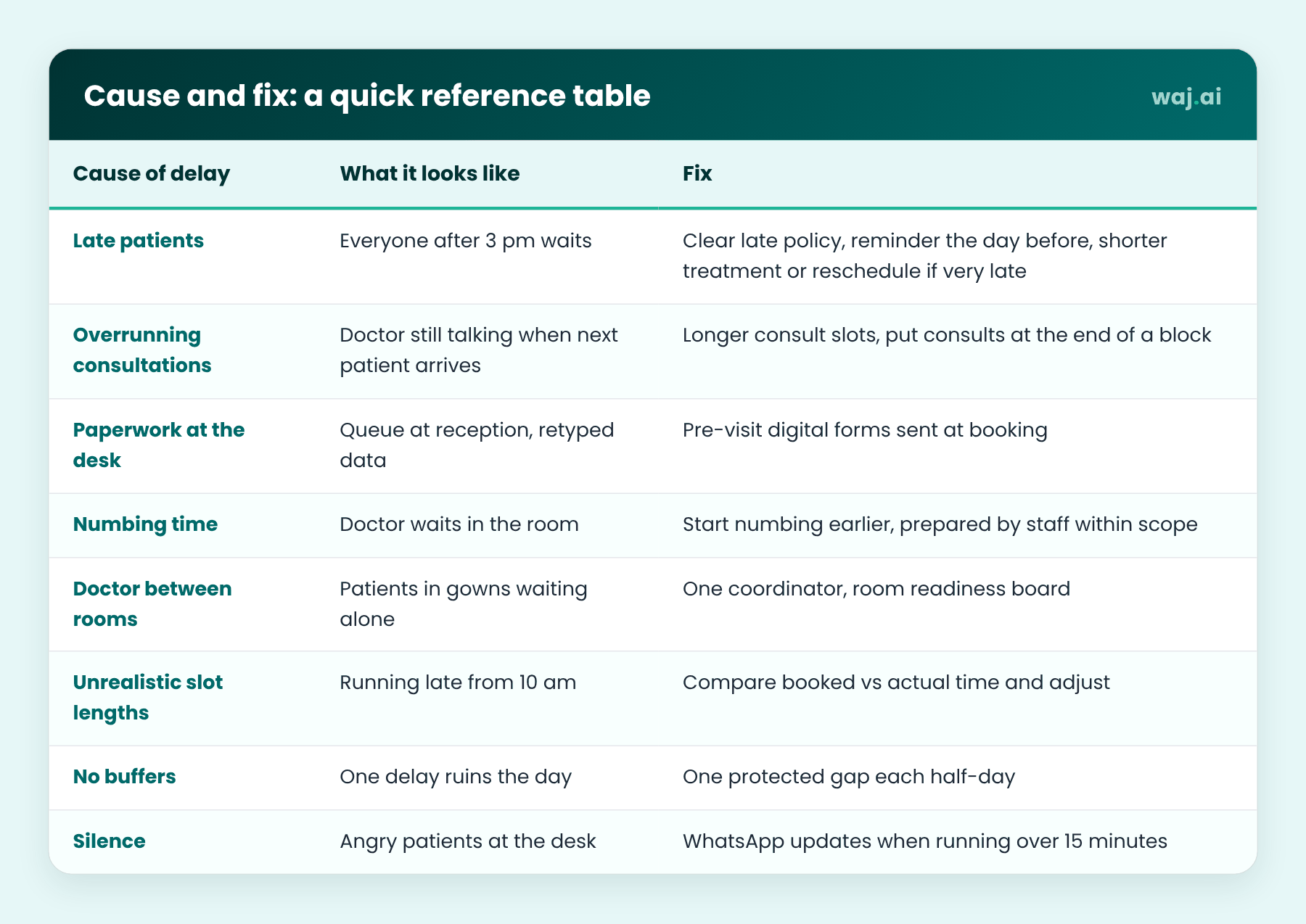
- Late patients
What it looks like: Everyone after 3 pm waits
Fix: Clear late policy, reminder the day before, shorter treatment or reschedule if very late - Overrunning consultations
What it looks like: Doctor still talking when next patient arrives
Fix: Longer consult slots, put consults at the end of a block - Paperwork at the desk
What it looks like: Queue at reception, retyped data
Fix: Pre-visit digital forms sent at booking - Numbing time
What it looks like: Doctor waits in the room
Fix: Start numbing earlier, prepared by staff within scope - Doctor between rooms
What it looks like: Patients in gowns waiting alone
Fix: One coordinator, room readiness board - Unrealistic slot lengths
What it looks like: Running late from 10 am
Fix: Compare booked vs actual time and adjust - No buffers
What it looks like: One delay ruins the day
Fix: One protected gap each half-day - Silence
What it looks like: Angry patients at the desk
Fix: WhatsApp updates when running over 15 minutes

A simple plan for next week
- Record check-in, room and doctor-start times for every patient for five working days.
- Find the two biggest sources of delay from that data.
- Change slot lengths for the services that ran over most.
- Add one buffer per doctor per half-day.
- Switch to pre-visit forms for new patients.
- Agree on a message template for running-late updates.
- Review the numbers again after two weeks.
Where software helps, and where it doesn't
A good system doesn't make your doctor faster. It removes the friction around them. With WAJ, clinics can take online bookings with a set duration for each service, see each practitioner's calendar, send WhatsApp reminders and messages, and keep client notes and history in the CRM, so the doctor has the context before the patient sits down. WAJ's clinic product, Nabd, is built for this kind of day. If you're deciding what to automate first, our guide to aesthetic clinic management automation sets out the order that tends to work.
Reminders also cut late arrivals and no-shows, as we covered in how to cut no-shows.
The busy days before Eid al-Adha, expected around 27 May, are a good test. If your waiting room gets through that week calmly, your system works.
To see how this looks in practice, book a free WAJ demo: waj.ai/demo
FAQ
What is an acceptable wait time in a private clinic?
There is no single standard, but private aesthetic patients expect to be seen close to their booked time. Measure your average, keep most waits short, and message patients whenever you're running behind.
Should we charge or reschedule patients who arrive late?
Set a clear policy and share it at booking. Many clinics shorten the treatment or rebook if a patient arrives well past their slot. What matters most is applying it consistently and politely.
Can nurses apply numbing cream before the doctor arrives?
Often yes, if it falls within their licence and your clinic's protocols. Rules differ by regulator, so confirm the scope with DHA, DOH or MOH. Injections and medical lasers stay with qualified practitioners.
Is it safe to send medical forms by WhatsApp?
Send a link to a secure form rather than collecting health details in the chat itself, and keep the data in your clinical system. In the UAE health data stays in the country by default, and in Saudi Arabia it's sensitive data under the PDPL. Check your setup with a lawyer or the regulator.
How many buffer slots does a clinic need?
Start with one short protected gap per doctor in each half of the day. If your measurements show you still run late, add another; if the buffers sit empty for weeks, shrink them.
Follow WAJ on Google
Add WAJ as a preferred source to see more of our articles in your Google Search results, marked with a "preferred" badge.