
Aesthetic Clinic Intake Form: What to Ask Patients and How to Store It
WAJ Team
September 18, 2026

An aesthetic clinic intake form collects the patient's contact details, medical history, current medications, allergies, pregnancy status, previous aesthetic treatments and consent before any treatment is planned. The questions themselves should be decided by your medical director, not copied from the internet. The best clinics send the form digitally before the visit, offer it in Arabic and English, review it at every appointment, and store it in the clinic system where only the right roles can see it.
Picture a Saturday morning at a busy clinic in Al Barsha. Four patients arrive within ten minutes, each handed a clipboard and a three-page form. One forgot her reading glasses. One writes "no allergies" because she is in a hurry. One writes in Arabic on an English-only form. The doctor is fifteen minutes behind before she has seen anyone. Most of that is avoidable.
This article is general guidance for clinic operators, not medical or legal advice. The clinical content of your intake form must be set by your medical director, and your data obligations confirmed with your regulator (DHA, DOH, MOH, SDAIA) or a lawyer.
Why does an aesthetic clinic intake form matter?
Because aesthetic treatments are medical. Injectables and medical lasers are medical acts under DHA rules, reserved for licensed clinics and qualified practitioners, and the same seriousness applies across the region. The intake form is where the practitioner learns what could make a treatment unsafe for this patient today.
It also saves consultation time, creates a record of what the patient told you and when, and tells you when to recommend the next session.
What should an aesthetic clinic intake form ask?
Your medical director decides the exact questions, the wording and which answers stop a treatment. Most clinics cover these sections.
Personal and contact details
Full name as on ID, date of birth, WhatsApp number, email, nationality if required, emergency contact, and how she heard about you.
Medical history
Ongoing conditions, recent surgery, autoimmune conditions, bleeding or clotting issues, skin conditions, keloid scarring, and anything else your medical director considers relevant.
Medications and supplements
Current prescription medicines, over-the-counter medicines, blood thinners, supplements and topical products such as retinoids. Ask patients to list them rather than tick "none", because many forget supplements.
Allergies
Medication allergies, anaesthetic allergies, latex, and reactions to any previous aesthetic product.
Pregnancy and breastfeeding
A direct question, asked privately and respectfully. Many treatments are postponed during pregnancy and breastfeeding, and your medical director should decide which.
Previous aesthetic treatments
What was done, where, roughly when, and with what result. Filler from another clinic six months ago matters for the treatment you plan today.
Contraindications
A checklist your medical director builds for each treatment you offer. Laser, injectables and chemical treatments each have their own list.
Goals and expectations
What she wants to change, in her own words. Unrealistic expectations show up here first.
Consent
Treatment consent, photography consent for the medical record, and a separate optional consent for marketing. Keep the marketing one genuinely optional: a patient who says no should get exactly the same care.
Intake form sections at a glance
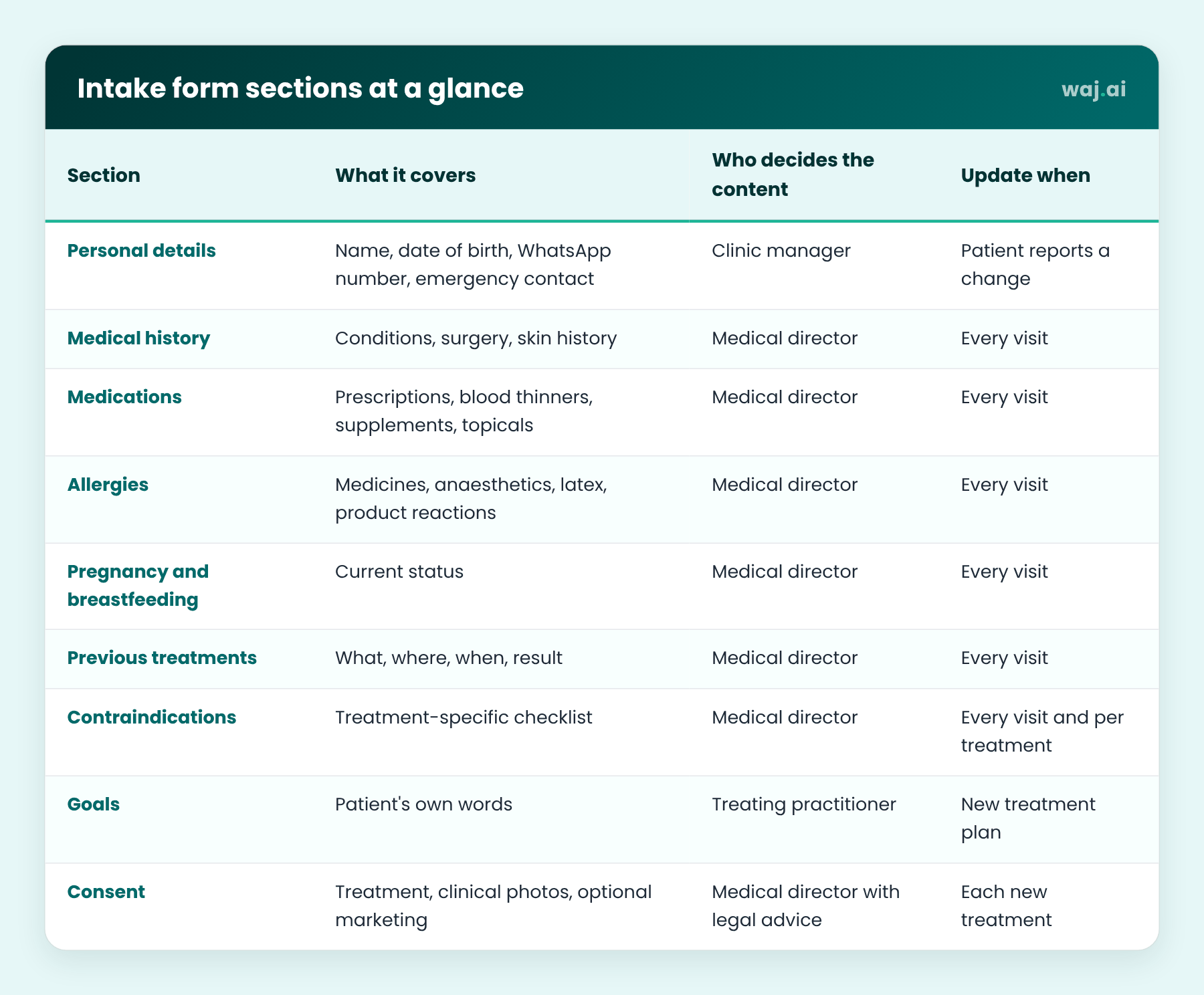
- Personal details
What it covers: Name, date of birth, WhatsApp number, emergency contact
Who decides the content: Clinic manager
Update when: Patient reports a change - Medical history
What it covers: Conditions, surgery, skin history
Who decides the content: Medical director
Update when: Every visit - Medications
What it covers: Prescriptions, blood thinners, supplements, topicals
Who decides the content: Medical director
Update when: Every visit - Allergies
What it covers: Medicines, anaesthetics, latex, product reactions
Who decides the content: Medical director
Update when: Every visit - Pregnancy and breastfeeding
What it covers: Current status
Who decides the content: Medical director
Update when: Every visit - Previous treatments
What it covers: What, where, when, result
Who decides the content: Medical director
Update when: Every visit - Contraindications
What it covers: Treatment-specific checklist
Who decides the content: Medical director
Update when: Every visit and per treatment - Goals
What it covers: Patient's own words
Who decides the content: Treating practitioner
Update when: New treatment plan - Consent
What it covers: Treatment, clinical photos, optional marketing
Who decides the content: Medical director with legal advice
Update when: Each new treatment

Should you send intake forms before the visit?
Yes, wherever you can. A form sent by WhatsApp link after booking lets the patient fill it in at home with her medication boxes in front of her. Answers are more complete and the waiting room calmer.
A simple flow that works:
- Patient books online or through reception.
- Confirmation goes out on WhatsApp, with the intake form link for first-time patients.
- A reminder goes out before the visit, nudging anyone who has not completed the form.
- The practitioner reviews the form before the consultation and flags anything to discuss.
- At the visit, the patient confirms the answers and signs the consent.
For returning patients, a short "has anything changed?" form is enough.
WAJ sends WhatsApp reminders and messages automatically and keeps notes and history in each client's record, so the practitioner can see past treatments before the patient walks in. WAJ's clinic product, Nabd, is built around how clinics work. Our guide to aesthetic clinic management and automation covers the full patient journey from booking to follow-up.
How should patients sign intake forms and consent?
A digital signature on a reception tablet or the patient's own phone is common practice. Whatever the method, the signed form should record the patient's name, the date and time, the form version, the treatment covered and the practitioner who explained it.
A signature alone is not consent. The practitioner still explains the treatment, risks and alternatives in person and answers questions. The form records that the conversation happened.
Do you need Arabic and English intake forms?
In the Gulf, yes. A patient who signs a medical form she does not fully understand has not really consented. Offer both languages, let the patient choose, and keep both versions identical in meaning.
Have a medical translator check the Arabic, because machine translation of medical terms often misses. Lay the Arabic version out properly right to left, so tick boxes and signature lines sit where the reader expects. And keep versions matched: when the medical director updates the English form, the Arabic one changes the same day.

Why update the intake form at every visit?
Because patients change. A new medication, a pregnancy, filler at another clinic: a form completed in January is out of date by May.
At every visit, ask her to confirm or update her history, medications, allergies and pregnancy status, and record the date of the review.
It also helps retention, because patients notice when a clinic checks properly. Our guide to aesthetic clinic patient retention explains how that care turns into rebookings.
Who should see what? Role-based access
A receptionist needs the patient's name, phone number and appointment, not her medication list or pregnancy status. A sensible split:
- Reception: contact details, appointments, payments
- Nurses and therapists: the medical information relevant to the treatments they perform
- Doctors and the medical director: the full record
- Marketing team: only what patients have consented to for marketing, and never health data
Check your clinic system can limit access by role, and review access whenever someone joins or leaves.
How should clinics store intake forms and protect privacy?
Intake forms are health data. In Saudi Arabia, health data is classed as sensitive under the PDPL, which has been fully enforceable since 14 September 2024 and is regulated by SDAIA, and it cannot be used for marketing. In the UAE, Federal Decree-Law No. 45 of 2021 on personal data applies, and Federal Law No. 2 of 2019 on ICT in health fields means health data on services provided in the UAE must by default be stored and processed inside the UAE. Dubai clinics also connect to NABIDH, Dubai's health information exchange.
In practice:
- No paper forms in open trays. Scan paper into the patient record and lock up originals.
- No photos of forms on phones or in WhatsApp chats.
- Ask your software provider where patient data is hosted and who can access it.
- Keep health data out of marketing lists. A patient's treatment history should never decide which promotional message she receives without a proper legal basis.
FAQ
What should an aesthetic clinic intake form include?
Personal details, medical history, medications, allergies, pregnancy status, previous treatments, contraindications, goals and consent. Your medical director decides the exact questions.
Can I send the intake form by WhatsApp?
Yes, as a secure link before the visit. The completed form should be stored in your clinic system, not in the chat.
How often should patients update their intake form?
At every visit, because medications, allergies and pregnancy status change.
Do I need the intake form in Arabic?
In the Gulf, offering Arabic and English is the safest approach, so every patient understands what she signs.
Who in the clinic can see a patient's intake form?
Only those who need it for their role. Reception does not need medical details.
If you want bookings, WhatsApp reminders and patient history working together in one system, book a free WAJ demo: waj.ai/demo.
Follow WAJ on Google
Add WAJ as a preferred source to see more of our articles in your Google Search results, marked with a "preferred" badge.