
Clinic Patient Complaints: A Calm, Documented Process for Aesthetic Clinics
WAJ Team
June 15, 2026

The best way to handle clinic patient complaints is a fixed, written process: listen without arguing, decide quickly whether the issue is about satisfaction or about health, escalate any medical concern to the treating practitioner, record everything in the patient's file, and reply within a set time. Most complaints in an aesthetic clinic are about expectations rather than harm, and they can be resolved in one calm conversation. The ones that involve a possible complication need a doctor, not a discount.
Every clinic gets complaints. A patient in Riyadh feels her filler looks uneven. A man in Abu Dhabi waited 40 minutes and missed a meeting. None of these is a disaster. What turns them into one is a defensive receptionist, a refund offered before anyone has looked at the patient, or a public reply that names the treatment.
Why does an aesthetic clinic need a complaints process?
Because complaints arrive at the worst moments, to whoever is on shift. Without a process, the response depends on that person's mood. With one, a coordinator in her second week handles it the way your best manager would.
It also protects you. If a complaint reaches the regulator, a dated record showing you listened, examined the patient and responded beats anyone's memory.
Step one: listen before you explain
The first two minutes decide how the rest goes. Take the patient somewhere private, away from the waiting area. Let them finish. Write down what they say in their words. Don't explain the procedure, defend the doctor or mention the consent form yet.
Useful phrases for the front desk:
- "Thank you for telling us. I want to make sure I understand everything."
- "I'm going to write this down so the doctor sees exactly what you've said."
- "I can't answer the medical part myself, but I will get Dr Khalid to call you today."
Avoid "That's normal" unless a clinician has said so. It sounds dismissive.
Is it dissatisfaction or a medical concern?
This is the most important decision in the whole process, and front-desk staff should be trained to make it fast.
Dissatisfaction covers waiting times, rudeness, billing, a result the patient doesn't like but that looks clinically fine, or a booking error. The manager can handle these.
A medical concern is anything involving pain, swelling beyond what was explained, skin changes, asymmetry the patient links to a reaction, signs of infection, or any symptom after an injectable or laser treatment. These go to the treating practitioner the same day. In the UAE, DHA rules treat injectables and medical lasers as medical acts for licensed clinics and qualified practitioners only, so a beauty therapist or receptionist should never assess or reassure on them.
If anything sounds urgent, such as difficulty breathing, severe pain, vision changes or rapidly spreading redness, the patient must be directed to urgent medical care immediately. The complaint paperwork can wait.
How should you document a patient complaint?
Record it in the patient's record, not in a WhatsApp group or a notebook at reception. A good complaint note includes:
- Date, time and how it arrived (in person, phone, WhatsApp, email, review site).
- The patient's words, quoted where possible.
- The treatment and practitioner involved.
- Whether it was classed as dissatisfaction or medical, and who decided.
- Every action taken, with dates.
- The outcome and what the patient was told.
In WAJ, complaint notes sit on the patient's record next to their booking and treatment history, so the doctor sees the full picture before calling back. WhatsApp messages with the patient stay attached to the same profile. We covered how records and messaging fit together in our guide to aesthetic clinic management and automation.
Keep notes factual, and assume a regulator or lawyer may read them one day.

How quickly should a clinic respond to a complaint?
Set your own timelines and publish them internally. A reasonable example:
- Acknowledge the same working day.
- Clinical callback from the practitioner within 24 hours for any medical concern.
- Full written response within 5 working days for most complaints.
- Update the patient if it will take longer, and say why.
These are example timelines. Check whether DHA, DOH, MOH or your local authority set their own requirements for your licence type.
When should you offer a review appointment?
For most result-related complaints, the answer is a free review appointment with the treating practitioner, booked within a few days. Many "my filler is uneven" complaints are settled by a calm look in good light, photos compared with the before images, and a clear plan. Sometimes the plan is "wait two weeks while swelling settles". Sometimes it is a small top-up or correction.
Never charge for this visit. Handled well, these reviews are a retention moment. We wrote more about that in our article on aesthetic clinic patient retention.
What should your refund and goodwill policy say?
Decide this before the angry phone call arrives. A simple structure:
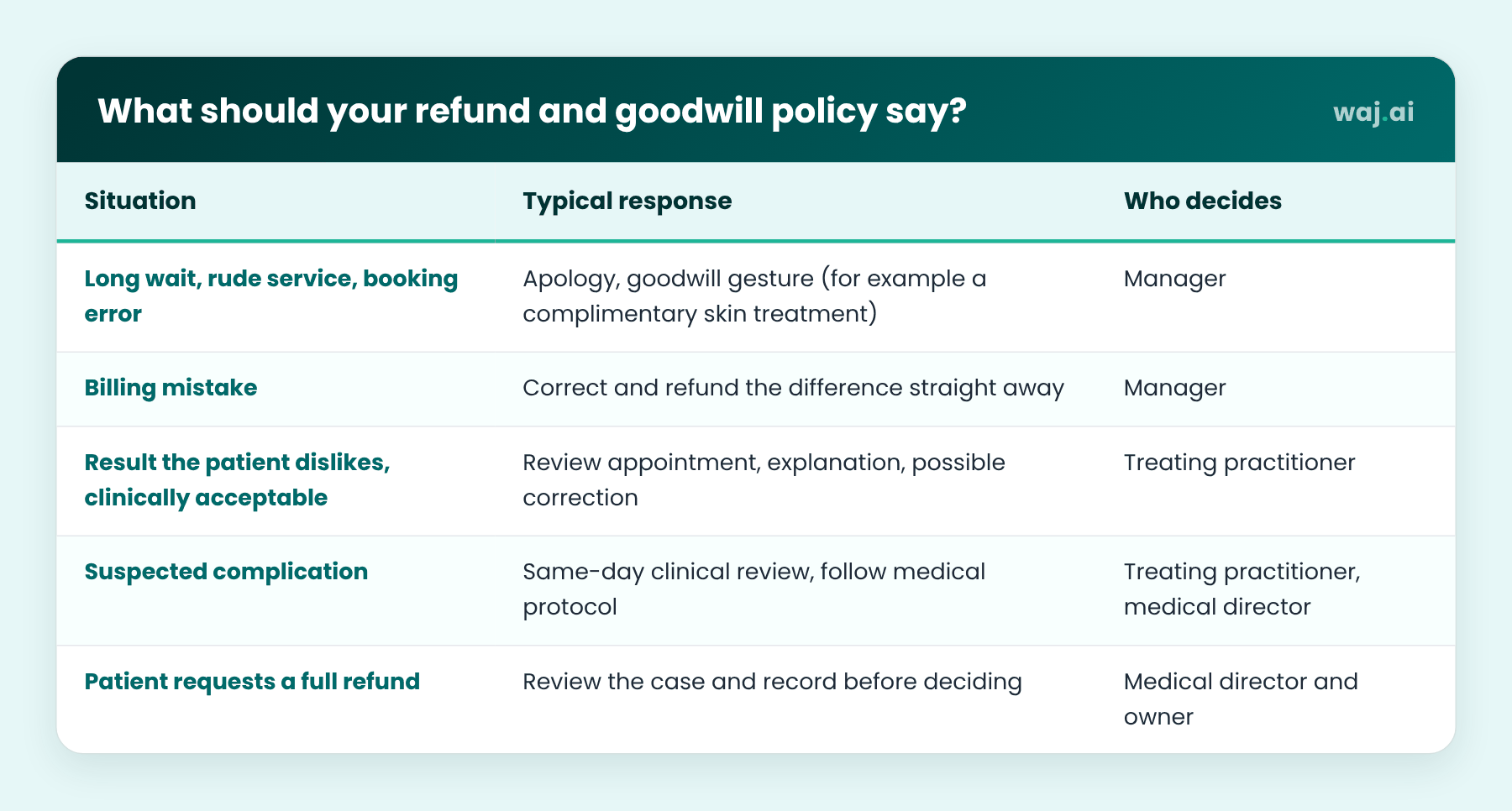
- Long wait, rude service, booking error
Typical response: Apology, goodwill gesture (for example a complimentary skin treatment)
Who decides: Manager - Billing mistake
Typical response: Correct and refund the difference straight away
Who decides: Manager - Result the patient dislikes, clinically acceptable
Typical response: Review appointment, explanation, possible correction
Who decides: Treating practitioner - Suspected complication
Typical response: Same-day clinical review, follow medical protocol
Who decides: Treating practitioner, medical director - Patient requests a full refund
Typical response: Review the case and record before deciding
Who decides: Medical director and owner
Write down what goodwill gestures the manager can offer without approval, and up to what value. Refunds should be rare and decided only after the clinical review. A refund offered too fast can sound like an admission, and it doesn't fix a patient who is genuinely worried about their face.
How do you respond to a negative review without breaking patient privacy?
Carefully, briefly and without any health information. Treat everything about a patient's treatment as protected health data. In the UAE, Federal Law No. 2 of 2019 governs health data, alongside the federal data protection law (Federal Decree-Law No. 45 of 2021). In Saudi Arabia, the PDPL treats health data as sensitive. Even confirming that someone is your patient, or naming the treatment they had, can be a problem.
A safe public reply looks like this:
"Thank you for your feedback. We take every concern seriously and would like to speak with you directly. Please contact our patient care manager on the clinic number so we can help."
Don't argue the facts, mention dates or treatments, or say "as we explained during your visit". Take it private, resolve it, and let the patient decide whether to update their review. Confirm your obligations with the relevant authority or a lawyer.

Patients can also complain to the regulator
Regulators such as DHA in Dubai, DOH in Abu Dhabi and the Ministry of Health (MOH) have routes for patients to complain about healthcare providers. Your team should know they exist and should never discourage a patient from using them. A clinic that handles complaints well internally rarely has to deal with a regulator's letter, and when it does, its records are ready.
How do you train staff on complaints?
Run a short session every quarter. Role-play a billing complaint, an unhappy result and a possible complication, practising the first two minutes, the classification and the note. New hires should shadow a complaint before handling one alone.
Complaint handling at a glance
- Listen in private and write down the patient's words.
- Classify: dissatisfaction or medical concern.
- Escalate medical concerns to the treating practitioner the same day, and urgent ones to medical care at once.
- Record everything in the patient's file.
- Acknowledge the same day and respond within your set timeline.
- Offer a free review appointment where the result is in question.
- Apply your refund and goodwill policy.
- Close the complaint with a note, and review patterns monthly.
FAQ
Who should handle a patient complaint in an aesthetic clinic?
The manager handles service and billing complaints. Anything about a treatment result or symptom goes to the treating practitioner.
Should we refund an unhappy patient straight away?
No. Review the case clinically first. Fast refunds rarely solve the patient's real worry and can complicate the record.
Can we reply to a bad Google review with the details of the case?
No. Don't confirm the person is a patient or mention any treatment. Invite them to contact the clinic privately.
Where should complaints be recorded?
In the patient's record, with dates, actions and outcomes, not in personal phones or chat groups.
Do patients have the right to complain to DHA, DOH or MOH?
Yes. Regulators have patient complaint routes, and clinics should never discourage patients from using them.
If you want complaint notes, treatment history and patient messages on one record, you can book a free WAJ demo and see how it works for clinics, including WAJ's clinic product, Nabd.
Follow WAJ on Google
Add WAJ as a preferred source to see more of our articles in your Google Search results, marked with a "preferred" badge.