
Aesthetic Clinic Consultation Fee: Should Your Clinic Charge for Consultations?
WAJ Team
June 13, 2026

For most aesthetic clinics, the best answer is a consultation fee that is credited against treatment if the patient books within a set period. It filters out casual enquiries and cuts no-shows, while patients who go ahead pay nothing extra. Free consultations still have a place for quick, low-risk questions, but a doctor's full assessment is too valuable to give away by default.
Picture a Tuesday at a clinic in Jumeirah. The doctor has three consultations before lunch. One patient arrives late, asks the price of lip filler and leaves. One never shows up. The third is serious, but she waited a week for a slot because the diary was full of people who were never going to book.
What does a free consultation really cost your clinic?
The cost isn't the coffee and the chair. It is the treatment slot the consultation displaced.
Take an example. If an hour of your injector's treatment time typically brings in AED 2,000 (an example figure, not a benchmark), a free 30-minute consultation that doesn't convert costs you around AED 1,000 in lost chair time. Add the coordinator's time, the photos and the WhatsApp follow-ups. Ten of those a week and you have given away a working day.
Free consultations also attract price shoppers: people comparing three clinics in a week, or wanting a professional opinion before buying a cheaper treatment elsewhere. Your doctor's time pays for their research.
Free vs paid vs credited: what are your options?
There are three common models, and each sends a different message.
Free consultation
Easy to book, easy to forget. Works well for simple treatments with low clinical risk, or for a short nurse-led skin check. It is weakest for anything that needs a doctor's time and a written plan.
Paid, non-refundable consultation
The patient pays for the doctor's time, full stop. It suits specialists with long waiting lists and complex cases such as full-face assessments, but can feel steep to a new patient who only wants to "ask a few questions".
Fee credited against treatment
The patient pays upfront, and the full amount comes off their treatment if they book within, say, 30 days (an example window). Serious patients effectively pay nothing. Window shoppers pay for the time they used. For most Gulf aesthetic clinics, this is the fairest middle ground.
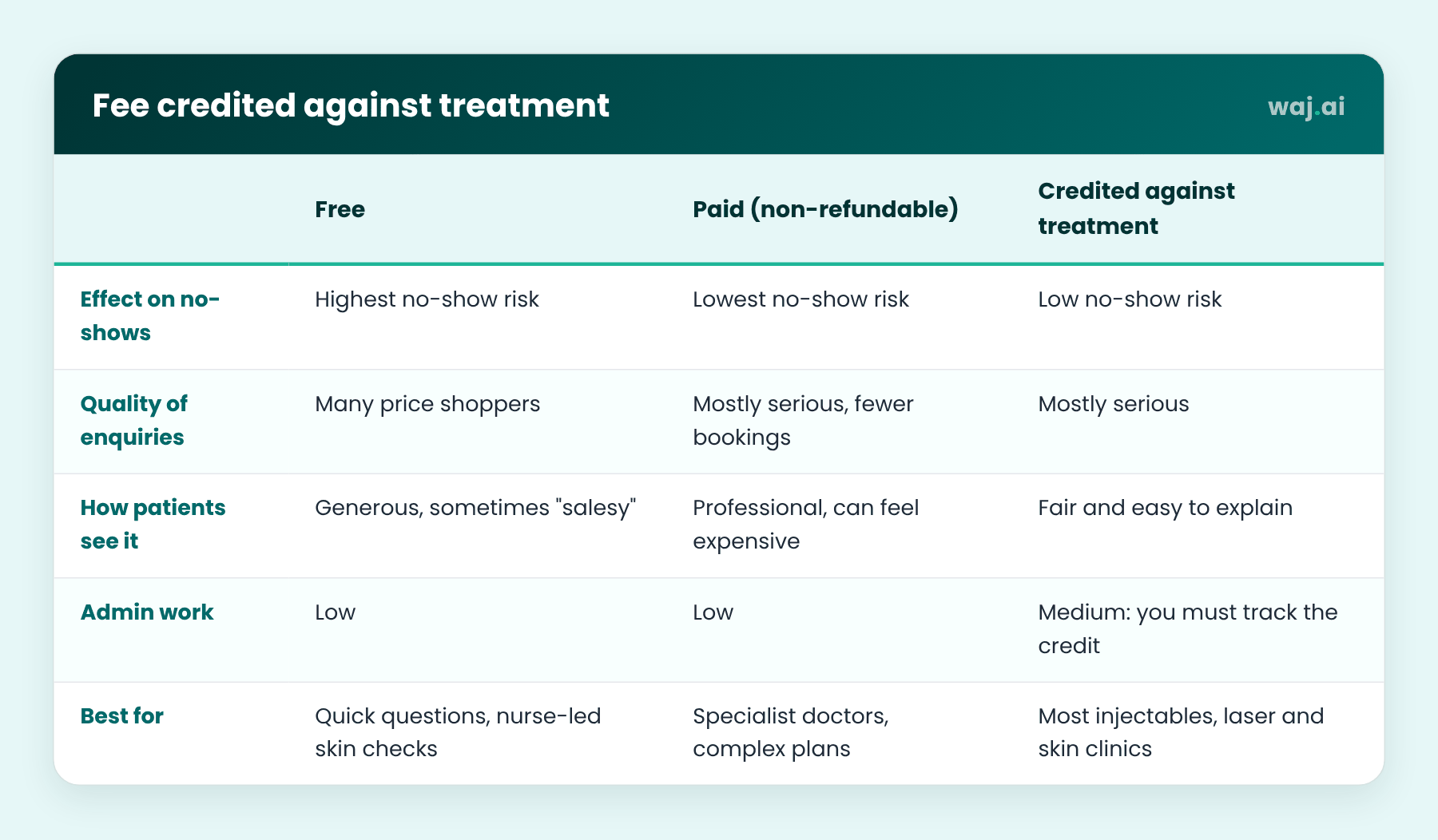
- Effect on no-shows
Free: Highest no-show risk
Paid (non-refundable): Lowest no-show risk
Credited against treatment: Low no-show risk - Quality of enquiries
Free: Many price shoppers
Paid (non-refundable): Mostly serious, fewer bookings
Credited against treatment: Mostly serious - How patients see it
Free: Generous, sometimes "salesy"
Paid (non-refundable): Professional, can feel expensive
Credited against treatment: Fair and easy to explain - Admin work
Free: Low
Paid (non-refundable): Low
Credited against treatment: Medium: you must track the credit - Best for
Free: Quick questions, nurse-led skin checks
Paid (non-refundable): Specialist doctors, complex plans
Credited against treatment: Most injectables, laser and skin clinics
How does a consultation fee affect no-shows and serious enquiries?
People who have paid tend to turn up. That is the simple reason a fee works. A free slot booked at 11pm on a Thursday is easy to forget by Sunday. A slot with AED 200 attached is not.
You will see fewer bookings at first. That is partly the point: the slots those patients used to block are now open for people who will book treatment. Pair the fee with a clear reminder routine (a WhatsApp confirmation at booking and a reminder the day before) and the diary starts to look very different. We covered reminder routines in detail in our guide to cutting no-shows.
How much should an aesthetic clinic charge for a consultation?
There is no right number, but there are a few rules of thumb.
- Enough to be felt. A token fee doesn't change behaviour.
- Not so high it looks like a barrier. If the fee is close to the price of a small treatment, new patients will go elsewhere.
- Match it to who sees the patient. A doctor's assessment can carry a higher fee than a therapist's skin analysis.
As an example structure only, a clinic might charge AED 150 to 300 for a doctor's consultation in Dubai, credited in full within 30 days. In Riyadh or Amman the same logic applies in SAR or JOD, set to your local market. Check whether your licensing authority has rules on how consultation fees are listed or approved before you publish a price.
How do you explain a consultation fee without sounding greedy?
Explain what the patient gets, not what you are protecting. Reception staff should have one script and use it every time.
"Our consultations are with Dr Sara and take about 30 minutes. She'll assess your skin, take photos, and give you a written treatment plan with prices. The fee is AED 200, and if you book your treatment within 30 days it comes off the total, so it's effectively free."
Put the same wording on your booking page and WhatsApp quick replies. Patients accept a fee easily when they read it before paying. What they resent is surprise.
Should you take the fee as an online deposit?
Yes, where you can. Asking for payment at the time of booking is what makes the commitment real. It also suits how patients behave: according to Zenoti's 2025 survey of medspa regulars, 79% have skipped booking because they couldn't reach someone or book online. A booking page that lets someone pick a slot and pay at midnight captures the patient who would otherwise forget by morning.
Keep the rules short:
- Pay the fee online when booking, or at the front desk for walk-ins.
- Free rescheduling up to 24 hours before (an example window; set your own).
- Late cancellations and no-shows lose the fee, or keep it as credit, depending on your policy.
- The credit applies to any treatment booked within the window.
In WAJ, patients book through your online booking site, get WhatsApp reminders, and the consultation is recorded in POS with a note on the patient's record. That note matters: if the coordinator who took the payment is off when the patient returns, the credit is still applied without a debate at the desk.

Should follow-up consultations be free?
A post-treatment review, such as a two-week check after toxin or filler, should always be free. It is part of the treatment and part of good clinical care, and charging for it feels like a penalty for coming back.
A new concern, a new treatment area or a full reassessment a year later is a fresh consultation, and it is fair to charge for it. Many clinics waive it for active patients, which also supports retention. We wrote about that balance in our article on aesthetic clinic patient retention.
When should you waive the consultation fee?
Write your exceptions down so reception isn't deciding case by case.
- Concerns after treatment. Never charge a patient who comes back worried about a result or a reaction. Escalate to the treating practitioner straight away, and send anything urgent to medical care.
- Members and regular patients. A free consultation is a natural membership benefit. See our guide to the aesthetic clinic membership model.
- Referrals from another doctor, if you want to build those relationships.
- Manager discretion, logged on the patient record with a reason.
Injectables and medical lasers are medical acts in the UAE under DHA rules, reserved for licensed clinics and qualified practitioners. The consultation for them should be with someone qualified to assess and treat, whatever you charge. Confirm the details with DHA, DOH, MOH or your licensing authority, or a lawyer.
How to introduce a consultation fee: a short plan
- Choose the model: free, paid or credited.
- Set the fee and the credit window.
- Write the policy, including cancellations and exceptions.
- Train reception on one script for phone, WhatsApp and the front desk.
- Update your website and booking page.
- Record every fee and credit on the patient's record.
- Review after three months: attendance, conversion to treatment, and complaints.
FAQ
Is it normal for aesthetic clinics to charge for consultations?
Yes. Many clinics charge, especially for doctor-led assessments. A fee credited against treatment is a common compromise.
Will a consultation fee scare patients away?
Some casual enquiries will drop off. Serious patients rarely object when the fee is explained clearly and credited against treatment.
Should the fee be refundable if the patient doesn't go ahead?
Usually not. The patient received an assessment and a plan. Credit it against treatment within your window instead.
Do I charge for a review after treatment?
No. Planned post-treatment reviews and any concern about a result should be free and handled by the treating practitioner.
Can I take the consultation fee online?
Yes, and it works best that way. Taking payment at booking turns a casual reservation into a commitment.
If you want your booking, reminders, POS and patient notes in one place, you can book a free WAJ demo and see how the consultation flow works.
Follow WAJ on Google
Add WAJ as a preferred source to see more of our articles in your Google Search results, marked with a "preferred" badge.