
How to Open a Salon or Barbershop in Jordan (Licensing, Costs & Full Setup Guide 2026)
WAJ Team
May 18, 2026
The Jordanian Grooming Market: Stable Demand, Underserved Capacity
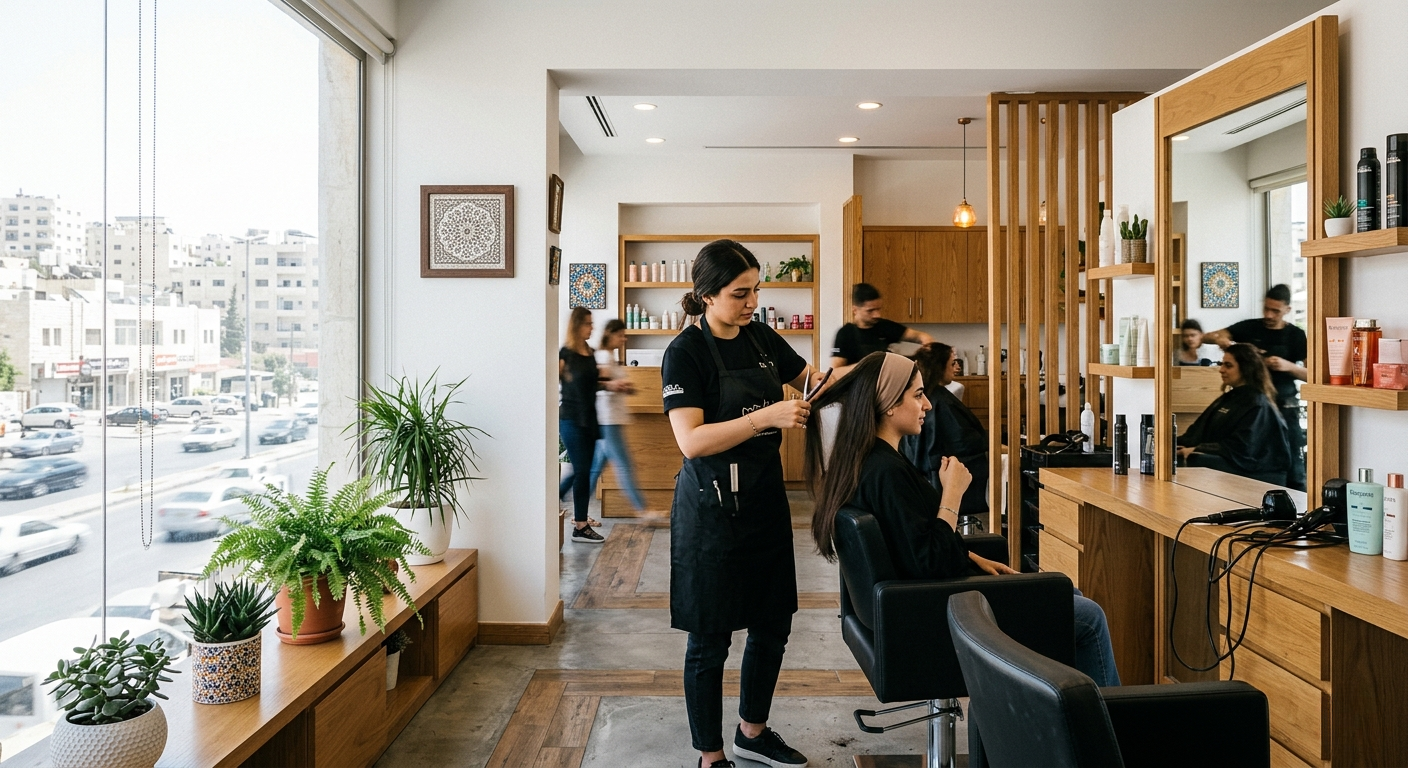
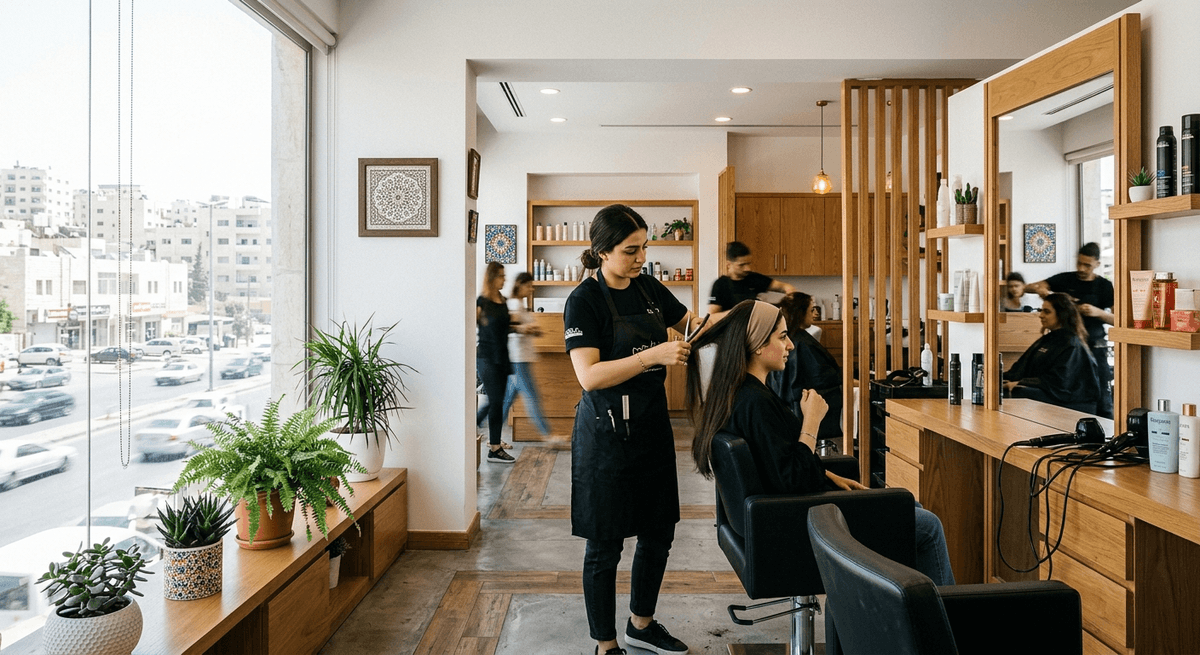
Jordan's beauty and personal care sector is one of the kingdom's most enduring consumer service categories. With a population of approximately 11 million including a substantial refugee and diaspora population that contributes significantly to urban service demand — the grooming industry operates on consistent, year-round consumption patterns.
Amman, particularly its western districts (Abdoun, Sweifieh, Khalda, Gardens Street), hosts a dense concentration of middle and upper-middle income households with high per-capita spending on grooming services. Industry observation across Jordanian salons suggests that a well-positioned mid-range salon in west Amman generates between JD 3,000 and JD 8,000 per month in revenue. Premium salons in luxury compounds or high-footfall commercial areas consistently outperform this range.
At the same time, the Jordanian salon market remains structurally underserved in several key areas: digital booking infrastructure, loyalty systems, and standardized service quality outside the premium segment. This gap represents a genuine opportunity for founders who enter the market with both operational quality and a systems mindset.
This guide details every step of the setup, licensing, and launch process for salons and barbershops in Jordan legally accurate, practically focused, and structured for founders making real investment decisions.
Market Overview: Why the Salon Business in Jordan Continues to Grow
Structural Demand Drivers
- Dense urban concentration: Greater Amman accounts for approximately 40% of Jordan's population, creating a concentrated consumer market within a relatively small geographic area. This density is favorable for salon businesses relying on repeat visits and word-of-mouth.
- Young population profile: Over 60% of Jordan's population is under 35 years old. This demographic cohort has high aesthetic awareness, strong social media influence on service choices, and consistent personal grooming expenditure.
- Wedding and events culture: Jordan's vibrant wedding sector generates substantial recurring demand for bridal packages, hair styling, makeup, and grooming services. Wedding season (spring and fall) consistently represents 30–40% of annual revenue for many Amman salons.
- Professional and academic demographics: Amman's large professional and university-educated population — including returnees from the Gulf — has elevated expectations for service quality and is accustomed to higher price points.
Revenue and Market Context
On average, barbershops in Amman operate at JD 1,500–4,000 monthly revenue. Mid-range women's salons in western Amman report JD 3,000–8,000 monthly. Salons combining multiple services (hair, nails, skin, threading) and positioned in high-density retail areas can exceed JD 10,000 monthly. These are industry-observed estimates used for feasibility planning, not guarantees.
Step-by-Step: How to Open a Salon or Barbershop in Jordan

Step 1: Choose Your Business Structure
In Jordan, salon businesses typically operate under one of two main legal structures:
Individual Establishment (Munshaah Fardiya)
- Simplest structure; registered under the owner's personal identity
- Suitable for small barbershops and single-location salons
- The owner bears unlimited personal liability
- Registered with the Ministry of Industry, Trade, and Supply (MITS)
Limited Liability Company (LLC / Sharikat Dhaat Masooliya Mahdooda)
- More appropriate for multi-service salons, partnerships, or businesses with investor involvement
- Minimum capital requirement: JD 1,000 (though typically higher amounts are advisable)
- Provides personal liability protection
- Registered with the Companies Control Department (CCD) under MITS
For most mid-size salon operations: An LLC is recommended for formal scalability, ability to enter commercial lease agreements, and investor confidence.
Step 2: Obtain the Correct Salon License in Jordan
Licensing a salon or barbershop in Jordan involves multiple government bodies. The process is sequential, not parallel, and this is where most delays occur.
Stage 1: Commercial Registration
- Register the business name and activity with the Ministry of Industry, Trade, and Supply (MITS)
- Activity classification: "Personal Care Services" or "Beauty Salon" under the Jordanian commercial activity classification
- Cost: approximately JD 50–150 for registration fees
Stage 2: Municipality License (Rakhsat Mahal)
- Apply for a premises license (rakhsa) with the Greater Amman Municipality (GAM) or relevant municipal authority depending on the governorate
- Requires: commercial registration certificate, tenancy contract, premises inspection
- For Amman: The municipality classifies salons under "personal service establishments" and requires compliance with building zone regulations (residential areas have specific restrictions on commercial activities)
- For other governorates: Apply at the relevant municipality or governor's office
Stage 3: Health Directorate Approval
- Apply to the Ministry of Health (MoH) Directorate in the relevant governorate for health approval of the premises
- Inspector will assess: sanitation facilities, sterilization equipment, ventilation, hot water supply, chemical storage, and overall hygiene standards
- Critical: No salon in Jordan can legally operate without health directorate approval
Stage 4: Chamber of Commerce Membership
- Membership in the Amman Chamber of Commerce (or the relevant governorate chamber) is mandatory for businesses operating under commercial registration
- Annual membership fee varies by business classification
Stage 5: Jordan Royal Medical Services / Other Relevant Body (if applicable)
- For salons offering specialized dermatological or cosmetic medical services (laser, chemical peels, injectables), additional licensing from the Jordan Medical Association or MoH Medical Services is required
- Standard hair and beauty services do not require this license
Step 3: Register Trade Name and Business Activity
- Submit trade name to MITS for approval (3 working days typical)
- Name must not duplicate existing registrations or violate trademark protections
- For salons targeting the Amman residential market: Arabic trade names with clear neighborhood or quality positioning tend to perform better in local word-of-mouth and Google Maps
- For salons targeting a premium segment: bilingual or English trade names signal international-quality positioning
Step 4: Select Your Location with Strategic Precision
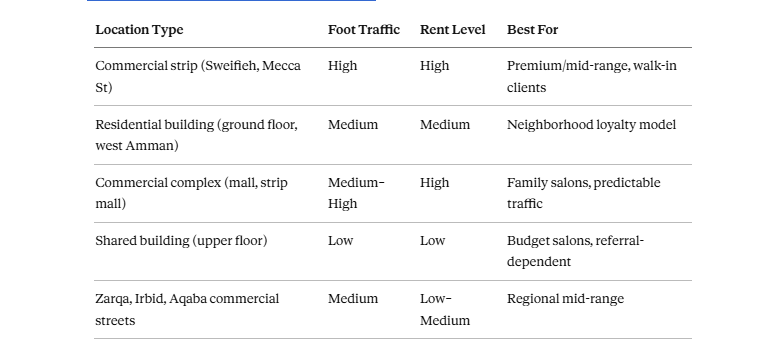
Location selection in Jordan is materially different from the Gulf: rent is lower, but foot traffic infrastructure (walkability, parking, signage visibility) varies enormously by neighborhood and building type.
Location Decision Framework for Jordan:
Practical guidance specific to Jordan:
- Parking availability is a significant driver of salon choice in Amman. Ground-floor units with accessible parking consistently outperform equivalent locations without it.
- Ground-floor frontage on Sweifieh, Abdullah Ghosheh, or Rainbow Street generates measurable walk-in traffic that upper-floor locations cannot replicate, regardless of quality.
- Residential zones in west Amman (Khalda, Rabiah, Dabouq) serve returning clientele well — but signage restrictions in some areas limit visibility. Confirm with municipality before committing.
- Second-tier cities (Irbid, Zarqa, Aqaba): Lower rent, lower competition, and catchment areas where a quality-positioned salon commands strong pricing power and rapid loyalty building.
Step 5: Secure Premises and Prepare for Municipality Inspection
- Sign tenancy contract and register with municipality
- Ensure the building's zoning classification permits commercial service use (not all residential-area ground floors are approved for salons in Amman's zoning framework)
- Prepare scaled floor plan for municipality submission
- Ensure premises meet the following before health inspection:
- Hot and cold running water at every workstation
- Proper ventilation or air extraction (mandatory for chemical fumes in coloring/treatment areas)
- Clean, separate storage for chemicals and consumables
- Clearly separated clean and dirty towel storage
- Functional sterilization equipment visible during inspection
Step 6: Fit-Out, Equipment, and Interior Design
Jordanian consumers across all price segments have become increasingly quality-conscious regarding salon environments, driven in part by social media influence and comparison with Gulf-standard salons. A clean, well-lit, professionally designed interior is a competitive advantage at every price point.
Equipment Checklist (Standard Salon — Jordan):
- Styling chairs (hydraulic) — JD 80–250 each
- Wash basins with reclining chairs — JD 100–300 each
- Work trolleys and mirror stations — JD 30–70 each
- Reception desk and waiting area furniture
- Hair dryers, processors, steamers
- UV sterilization cabinet or autoclave — mandatory for health inspection
- Chemical storage (lockable, ventilated)
- POS system (cash register or digital POS)
- Mirrors and professional lighting
Barbershop-specific:
- Reclinable barber chairs — JD 100–350 each
- Hot towel system and shaving stations
- Disposable neck strips, single-use razor blades (mandatory)
Fit-out cost range (Jordan):
- Basic fit-out (4 chairs, minimal renovation): JD 3,000–8,000
- Mid-range fit-out (quality materials, full renovation): JD 8,000–20,000
- Premium fit-out: JD 20,000–40,000+
Step 7: Staff Hiring and Employment Formalities
Jordan's labor market for salon professionals is competitive at the skilled end. Experienced colorists, Keratin specialists, and professional barbers command above-average compensation.
Employment requirements under Jordanian Labor Law:
- Employment contracts are legally required for all staff
- Social Security registration for Jordanian national employees is mandatory (PAYG contributions: ~14.25% employer, ~7.5% employee)
- Foreign workers (Syrian, Egyptian, and others are common in the sector) require valid work permits from the Ministry of Labor
- For non-Jordanian workers: Work permit fees vary; annual renewal required
- Staff performing cosmetic services should ideally hold vocational certificates from the Vocational Training Corporation (VTC) or recognized private training institutes — this is assessed during MoH health inspection
Staffing model for a standard 4-chair salon:
- 1 salon manager / senior stylist
- 2–3 stylists or barbers (mix of Jordanian and expatriate professionals)
- 1 receptionist/cashier
- 1 cleaning staff
Hiring channels in Jordan: Facebook groups (Amman Professionals, Beauty Sector groups), VTC placement services, direct outreach to beauty academies (Amman, Zarqa, Irbid), and referrals from existing salon networks.
Step 8: Health, Safety, and Compliance Setup
The Ministry of Health inspectors in Jordan assess the following during routine and initial inspections:
- Sterilization equipment (UV cabinet or autoclave): must be operational, not just present
- Log of tool sterilization (signed daily)
- Single-use disposable items protocol (razors, neck strips, gloves)
- Chemical storage: MSDS binders, proper labeling, no leakage
- Staff personal hygiene: clean uniforms, no visible communicable conditions
- Ventilation: functional, especially in chemical treatment areas
- Clean water access and sewage connection certification
- Fire extinguisher and first aid kit
Inspection frequency: Initial inspection before license issuance; follow-up inspections typically every 6–12 months. Unannounced inspections may occur following complaints.
Step 9: Launch Timeline (Realistic — Jordan)
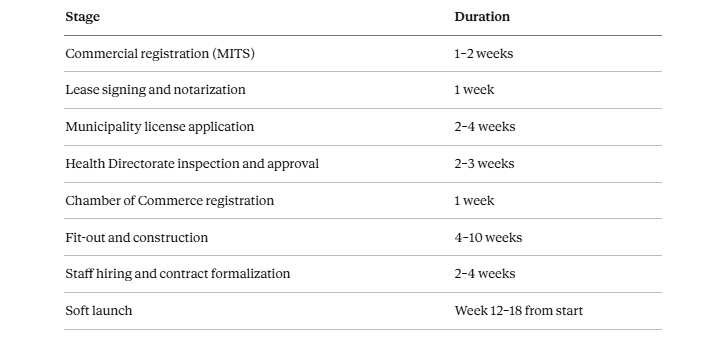
Total realistic timeline: 3–4 months from initial registration to first day of operations.
Detailed Cost Breakdown: Opening a Salon in Jordan
The following estimates apply to a standard 4–6 chair salon in Amman (mid-range positioning). Costs in second-tier cities (Irbid, Zarqa, Aqaba) are typically 25–40% lower.
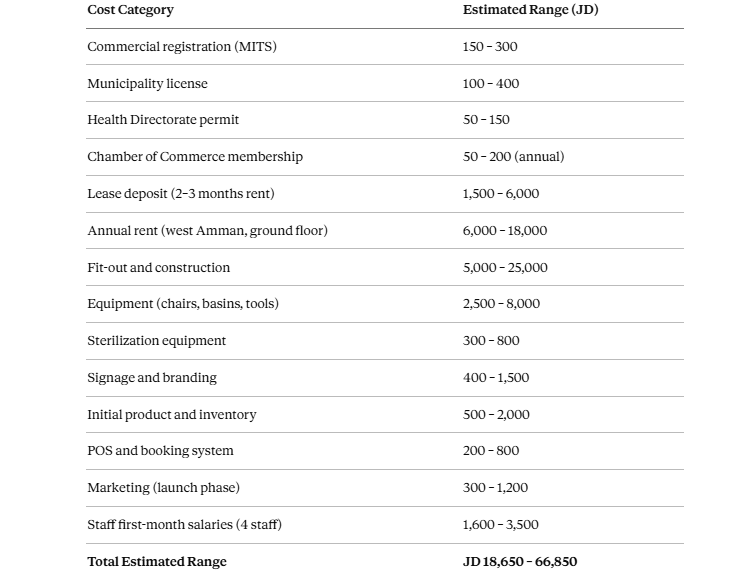
Working capital recommendation: Maintain 3 months of operating expenses (rent + salaries) as a cash reserve. Many Jordan salon operators underestimate Month 1–3 cash needs, particularly when delayed license approvals push back revenue generation.
Common Failure Points: Why Salons in Jordan Struggle
1. Location Chosen Primarily on Rent
In Amman's fragmented urban geography, a JD 300/month location with poor visibility and no parking consistently underperforms a JD 600/month location with frontage on a main road. Revenue potential must drive the location analysis, not cost minimization alone.
2. Municipality and Zoning Surprises
Signing a commercial lease in a residential zone before confirming municipal commercial use approval is a common — and expensive — mistake. The building owner's assurance that "it's fine" is not a substitute for municipal confirmation in writing.
3. Delayed License Approval
The sequential nature of Jordan's licensing process means that a delay at any single stage (health directorate inspection backlog, municipality review) can push back the launch date by weeks. Building buffer time into the financial plan is essential.
4. Underestimating Talent Acquisition Cost
Experienced colorists and barbers in Amman — particularly those with a loyal personal following — command competitive salaries. Attempting to build a mid-range or premium salon primarily on minimum-wage staff is a quality-consistency risk that typically shows up in reviews and churn within 6 months.
5. Manual Operations as the Business Scales
Salons that manage scheduling via WhatsApp and phone calls face a predictable growth ceiling. No-shows go untracked, premium appointment slots are not managed strategically, and customer data is never captured systematically. The result is a business that works hard but cannot scale — and whose operator cannot take a day off without the appointment system collapsing.
Marketing and Customer Acquisition in Jordan
Google Maps SEO — The Primary Discovery Channel
For salons in Jordan, Google Maps is the single most important customer acquisition channel. "Salon near me" and "barber in Amman" are among the most common service search queries. A complete, regularly updated, and review-rich Google Business profile consistently outranks larger competitors with neglected listings.
Optimization essentials:
- Complete profile: hours, services listed individually, 20+ photos (interior, services, results)
- Minimum 15 Google reviews within the first 2 months
- Regular Google Business posts (new services, seasonal offers, before/after photos)
- Respond to every review — positive and negative
Instagram Strategy for Amman Salons
Amman's salon discovery process is heavily social-media influenced. Before-and-after hair transformation posts, nail art content, and bridal looks consistently generate high organic reach on Instagram in Jordan.
- Post 4–5 times per week; use Arabic captions for local reach
- Use Amman-specific geotags and neighborhood hashtags
- Stories with polls, "ask the stylist" features, and booking CTAs drive direct engagement
- Micro-influencer partnerships (5K–30K followers in Amman/Jordan lifestyle niches) deliver higher conversion per JD spent than paid advertising at similar budgets
Opening Promotions
- "First visit 25% discount" for bookings through the salon's booking system
- Referral incentive: refer a friend, receive a complimentary service
- Loyalty card with 6-visit punchcard (effective in repeat-visit acceleration)
WhatsApp as a CRM Channel
WhatsApp remains the dominant communication tool for service businesses in Jordan. Building a WhatsApp contact list from day one — with customer permission — is an effective low-cost retention channel. Monthly broadcast messages with new services, seasonal promotions, and appointment reminders maintain top-of-mind awareness.
Operational Reality: The Post-Launch Challenge
Many salon founders in Jordan invest significant energy in the setup process — licensing, fit-out, hiring, launch marketing — and then discover that the ongoing operational management is where the real difficulty lies.
The daily reality of running a busy Amman salon includes:
- Booking conflicts and no-shows: WhatsApp booking requires manual confirmation, creates gaps, and generates no automatic reminder. No-show rates in manually managed salons typically run at 15–25% of appointments.
- Staff scheduling: Aligning stylist availability, appointment types, and shift hours is a daily management overhead that grows non-linearly as staff numbers increase.
- Revenue tracking: Without a structured POS and service logging system, end-of-day reconciliation is unreliable. Discounts, complimentary services, and partial payments generate cash flow confusion.
- Inventory leakage: Hair color, treatments, and consumables represent a meaningful cost center. Without inventory tracking, product theft and overuse are invisible until the business conducts a stock count — often revealing losses that were entirely preventable.
- Lapsed client follow-up: Salons that do not systematically follow up with clients who haven't visited in 60–90 days lose between 20–30% of their active client base annually to simple neglect.
The Digital Shift in Jordan's Salon Industry
Jordanian consumers particularly in Amman's western districts are increasingly accustomed to digital service interactions. Online food ordering, ride-hailing, and e-commerce have set behavioral expectations that are now being applied to service booking.
The adoption of digital booking and salon management tools in Jordan has accelerated since 2022, driven by:
- Consumer expectation of WhatsApp-free booking options
- The normalization of digital payment across QR codes and bank transfers
- New salon openings (particularly in premium segments) launching with digital-first operational models that set competitive standards
- The gradual exit of manually operated salons that cannot compete on experience quality
Salons entering the Jordan market in 2025–2026 with manual operations are not launching neutral — they are launching at a competitive disadvantage relative to the digitally equipped peers they will compete with for the same customers.
Selecting a Salon Management System: Why It's Now a Business Decision
For salon operators in Jordan, the choice of a management platform is increasingly a strategic business decision, not a technology preference. The right system directly affects:
- Revenue capture per available slot (scheduling efficiency)
- Customer retention (automated follow-up, loyalty tracking)
- Staff productivity (shift planning, performance visibility)
- Cash flow control (POS integration, daily reconciliation)
Key capabilities to evaluate include:
- Online booking accessible from mobile and desktop
- Automated appointment reminder SMS/WhatsApp
- Customer profile and visit history management
- Staff scheduling and commission calculation
- Inventory tracking
- Revenue reporting by service, staff, and period
WAJ (waj.ai) is a regional salon management platform built for salons and barbershops in the Middle East — including the Jordanian market. It offers integrated booking, staff scheduling, customer management, and business analytics within a single platform designed for the operational context of the region.
For founders planning a salon launch in Jordan, or operators looking to replace fragmented manual systems, evaluating WAJ as part of the technology planning process is a logical step.
Frequently Asked Questions (FAQ)
Q: How much does it cost to open a salon in Amman, Jordan? A: A standard 4–6 chair mid-range salon in Amman costs approximately JD 18,000–67,000 all-in, including licensing fees, fit-out, equipment, lease deposits, first-month salaries, and initial inventory. Budget salons in secondary locations can launch at the lower end; premium salons with full fit-out in prime locations are at the higher end.
Q: Which government bodies are involved in licensing a salon in Jordan? A: The primary bodies are: (1) Ministry of Industry, Trade, and Supply for commercial registration; (2) Greater Amman Municipality (or local municipality in other governorates) for the premises operating license; (3) Ministry of Health Directorate for the health inspection and permit; and (4) the relevant Chamber of Commerce for mandatory membership.
Q: How long does it take to get a salon license in Jordan? A: The complete licensing process — from commercial registration through municipality license and health directorate approval — typically takes 6–12 weeks when there are no complications. Adding fit-out time, the realistic launch timeline from registration to opening day is 3–4 months.
Q: Do I need a cosmetology or beauty certificate to open a salon in Jordan? A: The salon owner is not required to personally hold a cosmetology certificate. However, the Ministry of Health inspector will review staff qualifications during the premises inspection. It is strongly advisable that at least the lead stylist holds a recognized vocational certificate from the Vocational Training Corporation (VTC) or an accredited private institute.
Q: Can a non-Jordanian open a salon in Jordan? A: Yes, with conditions. Non-Jordanian investors can own shares in a Jordanian company. However, certain business registration formalities and work permit requirements apply. Consulting a licensed Jordanian legal firm or business registration consultant is advisable for non-resident founders.
Q: What is the most profitable salon service in Jordan? A: Bridal packages, hair color and Balayage, Keratin treatments, and eyelash extensions are typically the highest revenue-per-hour services. For barbershops, beard sculpting, skin fade, and grooming packages (haircut + beard + face) offer strong per-visit value.
Q: Is a women's salon different from a men's barbershop in terms of licensing? A: They both require the same licensing sequence (commercial registration, municipality license, health permit), but the activity classification differs. In some Jordanian municipalities, mixed-gender salons require explicit approval. It is advisable to confirm activity classification with the municipality before committing to a space.
Q: What are typical salon rents in Amman? A: Ground-floor commercial units in western Amman (Sweifieh, Khalda, Gardens Street area) typically rent for JD 500–1,500/month depending on area and visibility. East Amman and secondary neighborhoods: JD 200–600/month. Second-tier cities (Irbid, Zarqa): JD 150–400/month.
This guide is prepared for informational purposes. Regulatory requirements and fee structures may change. Always verify current requirements with the relevant Jordanian authorities (MITS, GAM, MoH) before initiating the licensing process.
Follow WAJ on Google
Add WAJ as a preferred source to see more of our articles in your Google Search results, marked with a "preferred" badge.