
How to Open a Salon or Barbershop in Saudi Arabia (2026 Complete Legal + Business Guide)
WAJ Team
June 11, 2026
.png&w=1200&q=75)
This guide is designed as a definitive reference for entrepreneurs, investors, and franchise operators planning to establish a salon or barbershop in Saudi Arabia. It covers legal registration, municipal licensing, cost planning, location strategy, hiring, and operational infrastructure structured to serve both first-time business owners and experienced operators entering the Kingdom's rapidly expanding beauty and grooming market.
.png)
1. The Saudi Arabia Beauty & Grooming Market: A Strategic Overview
Saudi Arabia's salon and beauty industry has undergone a structural transformation since 2017. The lifting of long-standing social restrictions, combined with Vision 2030's economic diversification mandate, has catalyzed a wave of new consumer spending across grooming, wellness, and personal care categories.
Industry observations indicate that the personal care market in Saudi Arabia is among the fastest-growing in the GCC region, with urban consumers (particularly in Riyadh, Jeddah, and Dammam) demonstrating sustained appetite for premium salon experiences. The male grooming segment, historically underserved, has emerged as a high-growth vertical, with barbershop formats attracting both local clientele and expatriate communities.
On average, well-positioned salons in tier-one Saudi cities report monthly revenues ranging from SAR 30,000 to SAR 150,000+ depending on format, location, and service mix. The combination of high disposable income, youthful population demographics (over 60% under age 35), and an increasingly appearance-conscious consumer culture makes Saudi Arabia one of the most compelling markets in the region for salon business investment.
Market Demand Drivers
• Vision 2030 social liberalization policies enabling mixed-gender entertainment and lifestyle businesses
• Urban expansion in Riyadh, Jeddah, Makkah, and Dammam driving foot traffic to commercial zones
• Growth of the middle class and rising discretionary consumer spending
• A large expatriate population (over 13 million) with established grooming habits
• Digital-native youth demographic driving demand for appointment-based, tech-enabled salon formats
• Female workforce participation growth creating new demand for workplace-adjacent beauty services
Premium vs Neighborhood Salon Positioning
Market observations suggest two dominant successful formats in Saudi Arabia: the premium boutique salon targeting high-net-worth individuals in upscale malls and residential compounds, and the efficient neighborhood barbershop serving daily walk-in and appointment clientele. Average revenue per client differs significantly across these segments, with premium salons achieving SAR 200–500 per visit compared to SAR 40–120 in neighborhood formats. Operators should define their positioning early, as it influences every downstream business decision.
2. Legal Registration & Licensing Process in Saudi Arabia
Establishing a salon business in Saudi Arabia requires compliance with multiple regulatory bodies. The process, while structured, demands careful coordination across ministerial, municipal, and sector-specific requirements.
Step 1: Ministry of Commerce Registration (Commercial Registration – CR)
All businesses operating in Saudi Arabia must obtain a Commercial Registration (Sijil Tijari) from the Ministry of Commerce (MOC). This is the foundational legal document that establishes the existence of your business entity.
1. Choose your business activity code (ISIC code for salons and barbershops falls under personal services)
2. Select your legal structure: Sole Proprietorship (for Saudi nationals or GCC citizens) or Limited Liability Company (LLC) for partnerships or foreign-involved structures
3. Submit required documents: national ID or residency permit (Iqama), lease agreement, and proposed commercial name
4. Pay registration fees (variable based on business type and capital)
5. Receive your Commercial Registration certificate, valid for one year and renewable
Step 2: Municipal Licensing (Baladiya Permit)
The municipal license (Rukhsa Baladiya) is issued by the local municipality and grants permission to operate from a specific premises. This is separate from the Commercial Registration and tied to your physical location.
6. Submit floor plan and premises details to the relevant municipality (Amanah)
7. Undergo premises inspection for compliance with health, hygiene, ventilation, and fire safety standards
8. Obtain a fire safety certificate from the Civil Defense authority (Difa' Madani)
9. Secure approval from the local health department (where applicable)
10. Pay municipal licensing fees, typically SAR 500 to SAR 2,500 depending on location and premises size
Step 3: Saudization (Nitaqat) Compliance
Salon businesses are subject to Saudization requirements under the Nitaqat labor nationalization program. The required percentage of Saudi national employees varies by business size and classification. Operators must register with the Ministry of Human Resources and Social Development (HRSD) and maintain compliant staffing ratios. Non-compliance results in color classification downgrades (from Platinum/Green to Red/Excellent Negative), which can restrict licensing renewals and visa issuance.
Industry observations indicate that many salon operators address Nitaqat requirements by hiring Saudi nationals in reception, retail sales, or administrative roles, while skilled technical staff are sourced from experienced overseas professionals where local talent pools are limited.
Step 4: ZATCA Tax Registration
Salons with annual revenue exceeding SAR 375,000 must register for Value Added Tax (VAT) with the Zakat, Tax and Customs Authority (ZATCA). VAT is applied at 15% on taxable services. Registration is conducted online via the ZATCA portal. Businesses approaching the threshold should proactively prepare accounting systems for VAT compliance.
Step 5: Additional Permits
• Health certificate for each staff member (issued by licensed medical facilities)
• Signage permit from the municipality for external salon branding
• Food service license if beverages or refreshments are offered
• Professional certificates for stylists and therapists (required for certain services)
3. Choosing a Profitable Location in Saudi Arabia
Location selection is arguably the single most consequential decision in a salon business. Market observations consistently show that well-located salons with average service quality outperform poorly located salons with superior service. The following framework guides location analysis:
Foot Traffic & Demographics
• High-footfall commercial zones: shopping malls, mixed-use developments, main commercial streets
• Residential areas with dense population and limited existing competition
• Proximity to corporate offices or business parks (particularly for men's grooming)
• Compound areas housing expatriate communities, premium positioning opportunity
City-Specific Considerations
Salon setup in Riyadh requires awareness of the city's decentralized commercial structure, with multiple distinct neighborhoods each carrying distinct consumer demographics. Salon setup in Jeddah benefits from the city's historically more cosmopolitan character and higher baseline consumer spending on personal care. Salon setup in Dammam and Khobar is influenced by the large Eastern Province expatriate community and oil industry workforce with above-average disposable income.
Rent vs Buy Decision Framework
For new market entrants, leasing is the recommended approach. Purchasing commercial space requires significant capital deployment and lacks operational flexibility. On average, commercial lease rates for suitable salon premises range from SAR 40,000 to SAR 250,000 annually depending on city, zone, and space size. Lease agreements in Saudi Arabia are typically structured as 12-month contracts with advance payment requirements of 3–6 months common practice.
4. Startup Cost Breakdown: Salon Business in Saudi Arabia
The following represents a realistic cost planning model for a mid-range salon or barbershop in a Saudi tier-one city. Actual figures vary based on location, size, and positioning.
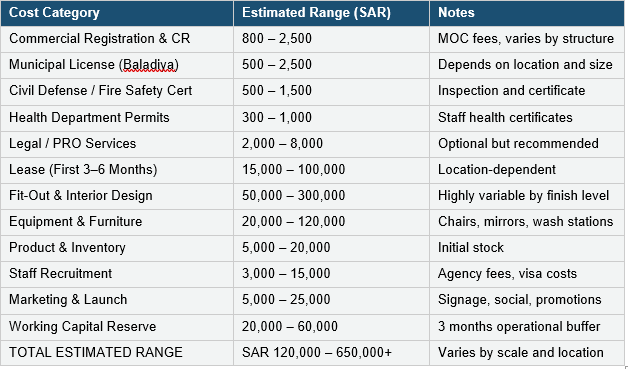
Market observations suggest that undercapitalization is among the leading causes of salon failure in the Kingdom. Operators should budget conservatively and maintain working capital reserves sufficient to cover at least 90 days of operational costs before anticipated break-even.
5. Interior Setup Requirements & Equipment Checklist
Interior Design Considerations
• Minimum recommended floor area: 40–60 sqm for barbershop; 80–150+ sqm for full-service salon
• Adequate ventilation is a regulatory requirement, HVAC systems should meet municipal standards
• Hygiene zones: separate areas for chemical treatments, hair washing, and waiting
• Gender-segregation considerations for mixed services (if applicable)
• Accessible entrance and emergency exit in compliance with Civil Defense requirements
Core Equipment Checklist
1. Styling chairs (barber chairs or salon chairs)
2. Hair wash basins / shampoo stations
3. Styling stations with mirrors and storage
4. Hair dryers, curling tools, straighteners
5. Clippers, trimmers (for barbershop formats)
6. Sterilization equipment (UV sterilizers, autoclave for tools)
7. Reception desk and POS system
8. Waiting area seating
9. Product retail display shelving
10. CCTV system (recommended for safety and compliance)
6. Hiring Strategy for Saudi Salon Operations
Human capital is the operational backbone of any salon. Staff quality directly correlates with client retention, revenue per visit, and brand reputation.
Recommended Staffing Structure (Mid-Size Salon)
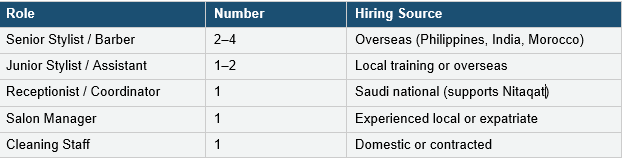
Recruitment for skilled overseas staff typically involves coordination with approved recruitment agencies and a 60–90 day process for visa issuance and onboarding. On average, a complete stylist or barber work visa package (agency fee, visa, medical, Iqama) costs SAR 8,000–20,000 per hire.
7. Health & Safety Compliance Requirements
• All staff must hold valid health certificates renewed annually
• Tools must be sterilized between each client using approved methods
• Single-use disposable items (razors, gloves) must be standard practice
• Chemical products must be stored safely and labeled clearly
• Fire extinguishers and first aid kits must be on premises
• Regular hygiene inspections may be conducted by the municipality without notice
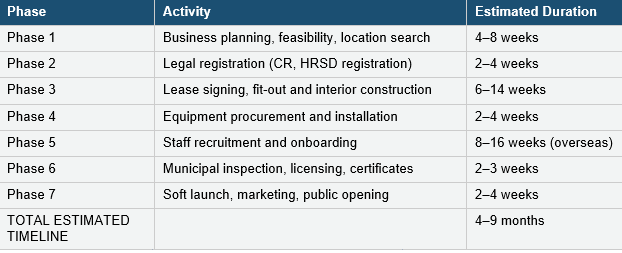
8. Expected Setup Timeline
9. Common Failure Points to Avoid
Industry observations identify the following as recurring causes of salon failure in Saudi Arabia:
• Choosing a location based on low rent rather than foot traffic or demographic alignment
• Underestimating regulatory complexity and ignoring Saudization requirements until audit
• Launching with insufficient working capital and requiring emergency funding within 60 days
• Hiring unqualified staff due to cost pressure, resulting in client dissatisfaction
• Setting service prices below market without a clear promotional strategy
• Failing to build a client retention infrastructure, relying entirely on walk-ins
• Operating without appointment management systems, leading to scheduling chaos and lost revenue
10. Marketing & Customer Acquisition Strategy
Google Maps & Local SEO
Registering on Google Business Profile is non-negotiable. Salons ranking in the top 3 of Google Maps results for local searches ('barbershop near me', 'salon Riyadh') capture a disproportionate share of discovery traffic. Key actions include: optimizing your business name, category, and description; consistently uploading high-quality interior and service photos; accumulating 4.5+ star ratings; and publishing regular Google Posts.
Instagram & Visual Marketing
Instagram remains the dominant discovery channel for salon businesses in Saudi Arabia. A consistent feed showcasing before/after transformations, styling process content, and client testimonials builds credibility and organic follower growth. Hashtag strategies targeting salon business Saudi Arabia, beauty salon Riyadh, and city-specific beauty communities extend reach significantly.
TikTok Marketing
TikTok adoption among Saudi consumers has grown substantially, particularly among the 18–34 demographic. Short-form transformation videos, behind-the-scenes content, and styling tutorials demonstrate expertise while building brand personality at low production cost.
WhatsApp Communication
WhatsApp Business is the primary direct communication channel between salons and clients in Saudi Arabia. Appointment confirmations, promotions, and rebooking reminders sent via WhatsApp achieve significantly higher open rates than email or SMS.
Opening Launch Strategy
• Offer a 20–30% launch discount for the first 30 days
• Partner with 2–3 local micro-influencers (10K–100K followers) for pre-opening coverage
• Run a Google Maps review incentive for first clients
• Distribute flyers in surrounding residential compounds and commercial buildings
11. Operational Reality: The Hidden Challenges of Running a Salon
Many salon owners who navigate setup successfully encounter operational breakdowns within the first 6–12 months of trading. These challenges are rarely caused by lack of talent or ambition. They stem from systems gaps that compound over time.
• Booking chaos: double bookings, missed appointments, and no-show management without a structured system
• Staff scheduling conflicts that result in under-staffing during peak hours and over-staffing during slow periods
• Inventory leakage: product theft and untracked usage eroding gross margins silently
• Customer no-shows representing 10–20% of booked revenue that cannot be recovered without a policy
• Inconsistent service delivery when staff are overloaded or procedures are not standardized
• Reporting gaps: not knowing which services, staff members, or time slots are most profitable
• Growth bottlenecks: manually managed salons struggle to scale to multiple branches or increase throughput
12. The Digital Transformation of Saudi Salons
Salons in Saudi Arabia are rapidly digitizing their operations. Consumer expectations have shifted clients in major cities now expect to book online, receive automated reminders, and manage their preferences through digital channels. Industry observations indicate that salons with integrated digital operations report higher client retention, fewer no-shows, and greater revenue visibility compared to manually operated counterparts.
Data-driven management is becoming a competitive differentiator. Operators who can track revenue per staff member, identify peak booking windows, and monitor product consumption patterns are better positioned to make informed pricing, staffing, and inventory decisions.
13. Selecting a Salon Management System: A Strategic Consideration
As the Saudi salon industry matures, the choice of management software has evolved from a convenience into a strategic operational decision. The right system provides revenue visibility across services and staff, reduces administrative overhead, manages scheduling efficiently, and improves customer retention through structured follow-up workflows.
Platforms such as WAJ (waj.ai) represent the category of modern, all-in-one salon management solutions designed for the operational realities of GCC salon businesses. WAJ enables salon operators to manage appointments, staff schedules, customer records, and daily operations within a unified system reducing the friction points that cause many technically capable salons to underperform financially.
Selecting a management platform should be done during the setup phase, not as an afterthought. Integrating a system from day one establishes the operational discipline and data infrastructure that supports long-term growth and eventual multi-branch expansion.
Frequently Asked Questions (FAQ)
Q: What is the minimum investment to open a barbershop in Saudi Arabia?
On average, a small barbershop setup in a neighborhood location requires a minimum investment of SAR 120,000–180,000, covering registration, fit-out, equipment, and working capital. Premium locations and larger formats require SAR 400,000+.
Q: Can a foreigner own a salon in Saudi Arabia?
Foreign investors can own salons in Saudi Arabia through an LLC structure with a local partner or under 100% foreign ownership frameworks in certain sectors under MISA (Ministry of Investment of Saudi Arabia) licensing. Legal counsel is recommended for foreign ownership structures.
Q: How long does the salon licensing process take in Saudi Arabia?
The full registration and licensing process typically takes 2–6 weeks for documentation, plus the time required for premises fit-out and inspection. Total timeline from decision to opening averages 4–9 months.
Q: What are the Saudization requirements for salons?
Salon businesses are subject to Nitaqat requirements. The exact percentage varies by company size and classification. Operators should consult the current HRSD Nitaqat guidelines or work with a PRO services provider to ensure compliance.
Q: Is VAT applicable to salon services in Saudi Arabia?
Yes. VAT at 15% applies to salon services for businesses registered for VAT. Registration is mandatory for businesses with annual revenues exceeding SAR 375,000.
Q: What are the best cities for a salon business in Saudi Arabia?
Riyadh, Jeddah, and Dammam are the primary markets with the highest revenue potential. Salon setup in Riyadh offers the largest population base; salon setup in Jeddah benefits from higher tourism and lifestyle spending; salon setup in Dammam serves a substantial expatriate community.
Saudi Arabia Salon Setup Checklist
□ Business plan and feasibility analysis completed
□ Legal structure decided (Sole Proprietorship / LLC)
□ Commercial Registration (CR) obtained from Ministry of Commerce
□ HRSD registration and Saudization compliance plan in place
□ VAT registration completed (if applicable)
□ Location secured: lease agreement signed
□ Municipality license (Baladiya) applied for
□ Civil Defense fire safety certificate obtained
□ Health department inspection passed
□ Interior fit-out completed and equipment installed
□ Staff recruited, health certificates obtained
□ Google Business Profile created and optimized
□ Instagram and WhatsApp Business channels set up
□ Salon management system implemented
□ Soft launch and opening promotion planned
Final Thoughts: Building a Salon Business That Lasts in Saudi Arabia
Saudi Arabia's salon and barbershop industry stands at a compelling inflection point. The convergence of Vision 2030 social reforms, rising consumer spending, a youthful population, and an increasingly sophisticated grooming culture has created a market window that rewards prepared, well-capitalized operators. The entrepreneurs who succeed long-term in this environment are not simply those who open the most aesthetically impressive salon they are those who combine strong location intelligence, regulatory compliance, skilled talent, and operational discipline from day one.
The checklist above is not a formality it represents the minimum viable foundation for a sustainable salon business in the Kingdom. Each unchecked item is a risk that compounds over time: a missing license becomes a shutdown notice, an underfunded launch becomes a liquidity crisis, an unmanaged booking system becomes a reputation problem. The Saudi salon market is growing, but it is also becoming more competitive. The operators gaining ground are those who treat their salon as a managed business, not a managed craft.
Operational excellence backed by the right systems, the right team, and the right data is what separates the salons that dominate their neighborhoods from those that struggle to survive past year one. Platforms like WAJ (waj.ai) exist precisely to bridge that gap: giving salon owners in Saudi Arabia the visibility, control, and automation infrastructure to compete at a higher level without scaling the complexity of their day-to-day operations. The market opportunity is real. The path is clear. What remains is execution.
Follow WAJ on Google
Add WAJ as a preferred source to see more of our articles in your Google Search results, marked with a "preferred" badge.