Salon Software with WhatsApp for MENA
WAJ Team
August 5, 2025
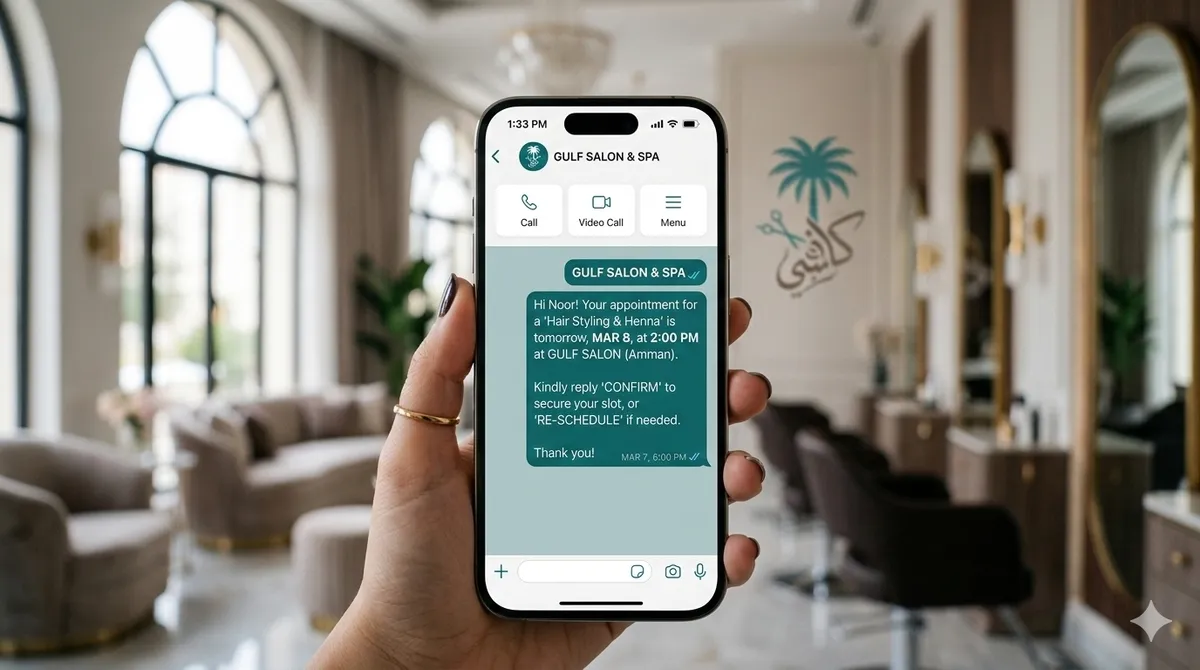
In the MENA region, when clients want to book a salon appointment, they reach for WhatsApp first.
Not email. Not a website booking form. Not even a phone call. They open WhatsApp and send a message — because that is how people in the Gulf communicate about everything, from family dinners to business deals. WhatsApp's penetration in the UAE exceeds 90% of smartphone users, and in Saudi Arabia, it is the most-used app across all age groups.
Yet most salon software platforms were designed for markets where email and SMS are the primary communication channels. They bolt on WhatsApp as an afterthought, if they support it at all. This creates a frustrating disconnect: your clients want to communicate on WhatsApp, but your software pushes them toward channels they rarely check.
The salons that solve this disconnect gain a massive competitive advantage. This guide shows you how.
Why WhatsApp Dominates Client Communication in the Gulf
Understanding why WhatsApp is so important requires understanding how communication works in the MENA region.
Cultural preference for personal communication. In Arab culture, business relationships are personal. Sending a WhatsApp message feels like a personal conversation, while an email feels transactional. This cultural nuance matters — clients who feel personally connected to your salon are more loyal and more likely to rebook.
Immediate response expectation. WhatsApp messages create an expectation of quick response. Unlike email, which can sit unread for hours or days, a WhatsApp message demands attention. This immediacy works in your favor when sending booking confirmations and reminders.
Rich media capabilities. Clients can share reference photos (the haircut they want, the nail art they admire, the color they are considering), and you can share your portfolio, before-and-after transformations, and promotional content — all within the same conversation thread.
Group and broadcast functionality. WhatsApp broadcast lists let you send promotional messages to hundreds of clients simultaneously without them seeing each other's responses. This is more personal than email marketing and more effective than SMS for engagement.
Trust and familiarity. Clients already have WhatsApp on their phones and use it constantly. There is no app to download, no account to create, and no new interface to learn. The barrier to engagement is zero.
WhatsApp Business vs. WhatsApp Business API: A Critical Distinction
Many salon owners use WhatsApp Business — the free app designed for small businesses. It offers basic features like a business profile, quick replies, labels for organizing chats, and a product catalog. For very small salons handling a handful of bookings per day, this might suffice.
But WhatsApp Business has significant limitations for growing salons:
Single device limitation. Only one phone can be logged into a WhatsApp Business account at a time. If your receptionist is using it and your salon manager needs to respond to a client, they cannot both access the same account simultaneously.
Manual operations. Every message must be sent manually. There is no way to automate booking confirmations, reminders, or marketing campaigns. As your salon grows, the manual workload becomes unsustainable.
No integration with salon software. WhatsApp Business operates as a standalone app. It does not connect to your booking system, client database, or POS. This means your team has to manually cross-reference conversations with your salon software — a recipe for errors and missed bookings.
Limited analytics. You cannot track which messages drive bookings, which clients are most engaged, or which campaigns generate the best return.
The WhatsApp Business API solves all of these problems. It is designed for medium and large businesses that need to communicate with clients at scale. When integrated with your salon software, it enables:
Automated booking confirmations. When a client books an appointment, an instant WhatsApp confirmation is sent automatically, including the date, time, service, stylist, and location.
Interactive reminders. Reminder messages can include buttons that let clients confirm, reschedule, or cancel with a single tap — no need to type a response.
Automated marketing campaigns. Send targeted promotional messages based on client segments: birthday offers to clients celebrating this month, rebooking reminders to clients who have not visited in 60 days, or new service announcements to clients who typically book related services.
Multi-agent support. Multiple team members can respond to client messages from the same business number, with conversation routing and assignment capabilities.
Detailed analytics. Track message delivery rates, read rates, response rates, and conversion to bookings. This data helps you optimize your messaging strategy over time.
Five WhatsApp Strategies That Drive Salon Bookings
Strategy 1: The Seamless Booking Flow
The ideal client journey looks like this:
1. Client clicks your WhatsApp booking link (from your Instagram bio, Google listing, or website)
2. An automated greeting message welcomes them and offers a direct link to your online booking page
3. Client selects their service, stylist, date, and time
4. An instant WhatsApp confirmation is sent with all appointment details and an "Add to Calendar" option
5. Automated reminders follow at 48 hours and 2 hours before the appointment
This flow combines the personal feel of WhatsApp with the efficiency of automated booking. The client feels like they are having a conversation, but the entire process is automated and tracked in your salon software.
Strategy 2: Post-Visit Follow-Up
Within 24 hours of every appointment, send an automated WhatsApp message:
"Thank you for visiting us today, [Name]. We hope you love your new look. If you would like to rebook, here is a quick link: [booking URL]. We would also appreciate a Google review if you have a moment: [review link]."
This message accomplishes three things: it strengthens the client relationship, encourages rebooking, and generates reviews (which are critical for Google ranking in the UAE market).
Strategy 3: The "We Miss You" Campaign
Set up an automated trigger for clients who have not visited in a period that exceeds their typical booking interval. If a client usually visits every six weeks and has not booked in eight weeks, send:
"Hi [Name], it has been a while since your last visit with [Stylist]. We have reserved some availability this week if you would like to book: [booking URL]."
This is not a discount offer — it is a personal reminder that feels like a friend checking in. The conversion rate on these messages is significantly higher than generic email campaigns.
Strategy 4: Visual Service Menus and Portfolios
Use WhatsApp's media capabilities to send rich content:
- Share a visual service menu with prices when clients inquire about services - Send before-and-after photos of the specific service a client is considering - Share your stylist's portfolio when clients ask for recommendations - Send short video clips of techniques or trending styles
Visual content on WhatsApp has much higher engagement than the same content sent via email. Clients are more likely to view, respond to, and share visually appealing WhatsApp messages.
Strategy 5: Broadcast Campaign Calendar
Create a monthly WhatsApp marketing calendar:
Week 1: New service or product announcement Week 2: Client spotlight or transformation story (with client permission) Week 3: Educational content (styling tips, product care advice) Week 4: Promotional offer or seasonal campaign
Keep broadcast messages to four per month maximum. More frequent messages lead to clients blocking or muting your number. Quality and relevance always beat quantity.
Choosing Salon Software with WhatsApp Integration
Not all salon software handles WhatsApp equally. Here is what to look for:
Native WhatsApp Business API integration vs. third-party add-ons. Native integration means the WhatsApp functionality is built directly into the salon software. Third-party integrations (through services like Twilio, MessageBird, or 360dialog) add complexity and cost.
Automated message triggers. Can you set up automatic messages based on events like new booking, cancellation, reminder due, post-visit follow-up, birthday, and inactivity? The more triggers available, the more you can automate.
Template management. WhatsApp Business API requires pre-approved message templates for automated messages. Your software should make it easy to create, submit, and manage these templates.
Interactive message support. Can the software send messages with interactive buttons (confirm, cancel, reschedule) or quick reply options? These dramatically increase engagement compared to plain text messages.
Multi-language templates. For salons in the UAE serving multilingual clients, the ability to send automated messages in the client's preferred language (Arabic or English) is essential.
Analytics dashboard. Track delivery rates, read rates, response rates, and booking conversions from WhatsApp messages. This data justifies your investment and helps optimize your strategy.
Compliance with WhatsApp policies. WhatsApp has strict policies about business messaging, including opt-in requirements and content restrictions. Your software should handle compliance automatically, ensuring you do not accidentally violate policies and risk having your number banned.
The ROI of WhatsApp Integration
Let us quantify the impact for a mid-sized Dubai salon:
Reduced no-shows. WhatsApp reminders with interactive confirmation buttons can reduce no-shows by 25-40% compared to SMS-only reminders. For a salon losing 30,000 AED monthly to no-shows, that is 7,500 to 12,000 AED recovered per month.
Increased rebooking rate. Post-visit WhatsApp follow-ups increase rebooking rates by 15-20%. If your average client spends 300 AED per visit and you rebook 20 additional clients per month, that is 6,000 AED in incremental revenue.
Higher marketing engagement. WhatsApp broadcast campaigns see 70-80% open rates compared to 20-30% for email. Higher engagement means more bookings per campaign, more product sales, and more referrals.
Reduced front desk workload. Automated WhatsApp booking flows reduce the number of phone calls and manual messages your receptionist handles, freeing them to focus on in-salon client experience.
The combined impact easily justifies the cost of a WhatsApp-integrated salon platform — typically paying for the entire software subscription several times over.
Getting Started
If your current salon software does not offer WhatsApp Business API integration, you have two options:
Switch to a platform with native WhatsApp integration. This is the cleanest solution. Look for platforms built for the MENA market that include WhatsApp as a core feature rather than an afterthought.
Add WhatsApp through a third-party integration. Services like Twilio, MessageBird, or 360dialog can connect WhatsApp to various salon platforms through APIs or middleware like Zapier. This works but adds complexity, cost, and potential points of failure.
Whichever path you choose, start simple. Set up automated booking confirmations and appointment reminders first. Once those are running smoothly, layer in post-visit follow-ups, marketing campaigns, and interactive booking flows.
WhatsApp is not just a messaging app in the MENA region — it is the primary communication infrastructure. Salons that integrate it deeply into their operations will out-communicate, out-engage, and ultimately out-earn those that do not.
Sources and References
1. Mindbody. "Wellness Insights." mindbodyonline.com — Client communication preferences and booking behavior data across wellness businesses.
2. GlossGenius Blog. "Salon Booking Software: 9 Apps for Booking and Payments." glossgenius.com — Communication feature comparisons and booking channel analysis.
3. The Salon Business. "9 Best Salon Software in 2026: The Ultimate Guide." thesalonbusiness.com — Software feature comparisons including messaging capabilities.
4. WAJ Blog. "WAJ vs CloudMeSoft 2025." waj.ai — WhatsApp Business API integration features for MENA salon software.
5. Mordor Intelligence. "Salon & Spa Software Market - Report & Analysis." mordorintelligence.com — Regional technology adoption data for MENA salon businesses.
6. Vagaro. "The Best Salon Software of 2026." vagaro.com — Client communication features and marketing automation capabilities.
7. Koalendar. "8 Best Salon Booking Software for Beauty Professionals." koalendar.com — Booking channel effectiveness comparisons.
8. Meevo Inspo Blog. "How to Choose the Right Salon Management Software in 2026." meevo.com — Marketing and communication feature evaluation criteria.
Follow WAJ on Google
Add WAJ as a preferred source to see more of our articles in your Google Search results, marked with a "preferred" badge.