
How to Open a Salon or Barbershop in the UAE (2026 Complete Legal + Business Guide)
WAJ Team
May 12, 2026
How to Open a Salon or Barbershop in the UAE (2026 Complete Legal + Business Guide)
The UAE Grooming Industry: A High-Growth, High-Demand Market
The personal care and grooming sector in the UAE is one of the most resilient and high-margin retail categories in the region. With a population exceeding 9.5 million — approximately 88% of whom are expatriates — demand for professional salon and barbershop services is not seasonal; it is structural and continuous.
On average, UAE consumers spend significantly more on personal grooming than their global counterparts. Industry estimates place the UAE beauty and personal care market value at over USD 3.5 billion, with consistent year-over-year growth driven by urbanization, a young demographic profile, and a culture where personal presentation is closely tied to social and professional identity.
For entrepreneurs, this creates a compelling opportunity: the salon industry in the UAE is both recession-resilient and highly scalable — provided the business is set up correctly, legally, and with operational precision from day one.
This guide covers everything a founder, investor, or aspiring salon owner needs to know: legal structure, licensing, cost forecasting, staffing, and long-term operational planning.
Market Overview: Why the UAE Salon Industry Continues to Expand
Structural Demand Drivers
- Expat-dominant population: The UAE's workforce composition creates permanent, year-round demand for grooming services across every price segment — from budget barbershops to luxury blowout salons.
- Tourism and hospitality: Dubai and Abu Dhabi host tens of millions of tourists annually. Hotel salon services and walk-in barbershops in tourist districts consistently outperform location averages.
- Corporate culture: Business dress standards in the UAE are high. Haircuts, beard grooming, and styling are regular expenditures for both employed residents and business owners.
- Female grooming segment: The women's salon market is particularly strong, with regular services including hair treatments, threading, waxing, nail care, and bridal packages generating high per-visit revenue.
Revenue Benchmarks
On average, a well-positioned mid-range salon in Dubai or Abu Dhabi generates between AED 30,000 to AED 80,000 per month in revenue. Premium salons in high-footfall locations can exceed AED 150,000 monthly. Barbershops — lower setup cost, faster service cycles — typically operate at margins of 40–55% once staff costs are controlled.
These numbers are not guarantees; they are industry-observed ranges used by business consultants and investors for feasibility modeling.
Step-by-Step: How to Open a Salon or Barbershop in the UAE
Step 1: Choose Your Legal Structure and Jurisdiction
The UAE offers multiple licensing jurisdictions, and the choice significantly impacts your cost, operational flexibility, and ownership structure.
Mainland (DED-licensed)
- Allows you to operate anywhere in the UAE
- Previously required a UAE national sponsor (51% ownership); this rule has been reformed in most business activities, allowing 100% foreign ownership in many categories including beauty services
- Regulated by the Department of Economic Development (DED) in each emirate
- Salon and beauty services generally fall under "Personal Services" or "Beauty Care Activities"
Free Zone
- 100% foreign ownership with no requirement for a UAE national partner
- Typically restricted to operating within the free zone or in designated areas
- Less common for salons due to footfall limitations
- Some free zones (e.g., Dubai CommerCity, IFZA) do offer retail/service licenses
Recommended for most salon operators: DED Mainland license, as it provides maximum location flexibility and access to the widest customer base.
Step 2: Obtain the Correct Salon License in UAE
Licensing for salons and barbershops in the UAE involves multiple layers. Below is a breakdown by emirate and authority:
Dubai
- Primary License: Dubai Department of Economy and Tourism (DET/DED)
- Health Permit: Dubai Health Authority (DHA) — mandatory for salons offering any skin, nail, or cosmetic services
- Trade Name Registration: Must comply with UAE naming regulations
- Activity Code: "Ladies' Beauty Salon" or "Gents' Barbershop" — these are distinct activities requiring separate licenses if both services are offered
Abu Dhabi
- Primary License: Department of Economic Development Abu Dhabi (ADDED)
- Health Permit: Health Authority Abu Dhabi (HAAD) or DoH (Department of Health)
- Municipality Approval: Abu Dhabi City Municipality approval for premises
Sharjah, Ajman, and Other Emirates
- Regulated by respective DED branches and emirate-level health authorities
- Often lower license costs than Dubai/Abu Dhabi
- Strong secondary markets for budget-positioned salons
Key Note: Operating without a valid DHA/DoH health permit in a salon setting can result in immediate closure and fines. This is non-negotiable.
Step 3: Register Your Business Name and Activity
- Submit 3 trade name options (in order of preference) to the relevant DED
- Name must not violate Islamic values, UAE laws, or duplicate existing registrations
- For Arabic-medium operations targeting Emirati clientele, Arabic business names often perform better on Google Maps and WhatsApp referrals
- Activity registration must be precise: "Ladies' Beauty Salon," "Gents' Hairdresser," or "Unisex Salon" — each carries different regulatory requirements
Step 4: Select Your Location Strategically
Location is the single most impactful decision in a salon business. It affects not only foot traffic but also rent-to-revenue ratios, client demographics, and competitive intensity.
Decision Framework for UAE Salon Location:
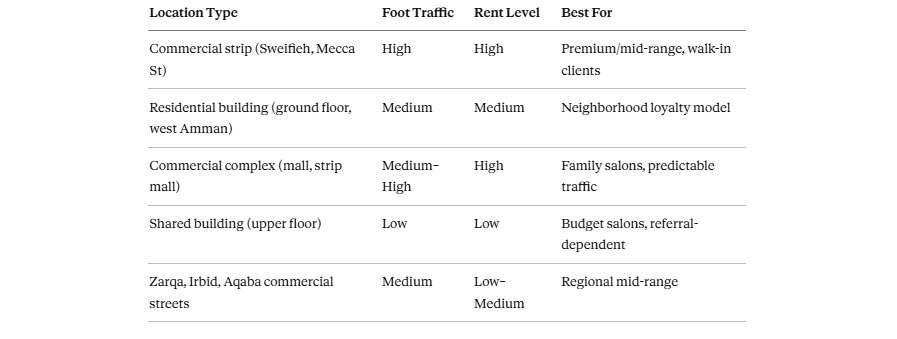
Practical guidance:
- Target locations with 1,000+ apartments or 500+ daily commuters within 500m
- Avoid ground-floor units below parking structures (ventilation + signage issues)
- Negotiating rent-free periods (2–4 months fit-out period) is standard practice and should be secured before signing
Step 5: Secure Premises and Obtain No-Objection Certificates (NOC)
- Sign tenancy contract (Ejari registration required in Dubai)
- Obtain NOC from building owner/management
- Municipality inspection and approval of fit-out plans
- Ensure premises meet minimum area requirements (DHA mandates specific area requirements for treatment rooms, sanitation stations, and ventilation)
Step 6: Fit-Out, Equipment, and Interior Setup
The salon interior is both a regulatory requirement and a brand statement. UAE customers — particularly in Dubai and Abu Dhabi — have high aesthetic expectations.
Equipment Checklist (Standard Salon):
- Styling chairs (hydraulic, professional grade) — AED 800–2,500 each
- Wash basins with reclining chairs — AED 1,200–3,000 each
- Trolleys and tool stations — AED 300–600 each
- Reception desk and waiting area furniture
- Hair dryers, steamers, and processing equipment
- Sterilization equipment (UV cabinets, autoclave) — mandatory per DHA
- Storage for chemicals and retail products (locked, ventilated)
- POS system and booking management setup
- Mirrors and lighting (critical for client experience and photo quality)
For barbershops specifically:
- Barber chairs (reclinable) — AED 1,000–3,000 each
- Hot towel warmers, straight razor stations
- Shaving bowls, strop holders, neck strips dispensers
Step 7: Staff Hiring and Visa Processing
UAE labor law applies to all salon employees. Key requirements:
- All foreign staff require employment visas (Ministry of Human Resources and Emiratisation — MOHRE)
- Employment contracts must be registered with MOHRE
- Labor cards and Emirates ID must be processed before staff begin work
- DHA requires that staff performing certain cosmetic/skin services hold relevant qualifications (certificates from accredited institutions are reviewed during DHA permit application)
Staffing model for a standard 4-chair salon:
- 1 salon manager / senior stylist
- 2–3 stylists or barbers
- 1 receptionist (often multifunctional: booking, product sales, cleaning oversight)
- Cleaning staff (may be outsourced)
Hiring channels in UAE: Recruitment agencies specializing in beauty staff, Facebook groups for salon professionals, Instagram outreach, and direct hire from home countries (Philippines, India, Lebanon, and Morocco are common source markets).
Step 8: Health, Safety, and Compliance Setup
DHA and equivalent authorities conduct unannounced inspections. Non-compliance leads to fines or closure. Mandatory compliance areas:
- Sterilization logs for all tools
- Single-use razors and disposable items protocol
- Chemical storage and MSDS (Material Safety Data Sheet) binder on premises
- Staff vaccination records
- First aid kit and fire extinguisher
- No-smoking signage
- Separate male/female entrances if operating a mixed-gender salon (for modesty compliance in some emirates)
Step 9: Launch Timeline (Realistic)
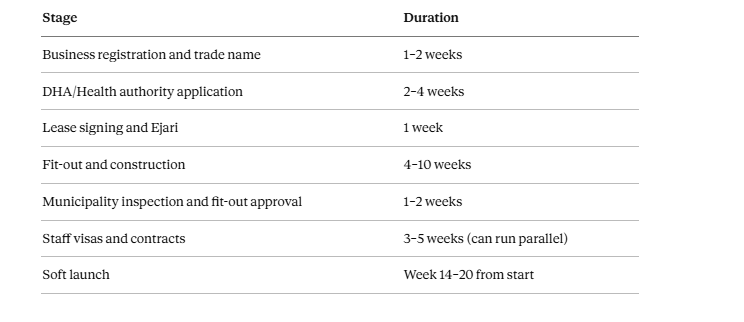
Total realistic timeline: 3–5 months from initial registration to operating day.
Detailed Cost Breakdown: Opening a Salon in UAE
The following estimates apply to a standard 4–6 chair salon in Dubai (mid-range positioning). Costs in Abu Dhabi are broadly comparable; Sharjah and other northern emirates are typically 20–35% lower.
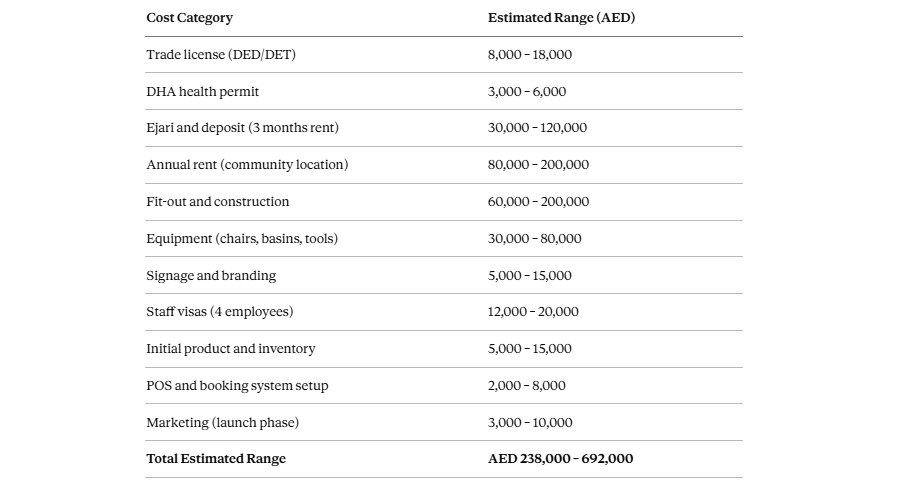
Working capital recommendation: Maintain 3 months of operating expenses (rent + salaries) as cash reserve at launch.
Common Failure Points: Why UAE Salons Struggle
Understanding where salons fail is as important as knowing how to launch them.
1. Wrong Location Selection
The most common and most expensive mistake. Salons that select a location based on low rent alone — without assessing foot traffic, demographic fit, or competitive density — consistently underperform. A AED 40,000/year location with 50 walk-ins per day outperforms a AED 20,000/year location with 10 walk-ins per day every time.
2. Regulatory Non-Compliance at Launch
Attempting to open without full DHA permits or operating under a temporary license while "waiting for approvals" exposes the business to immediate closure risk. Inspections in Dubai are routine and enforcement is real.
3. Undercapitalization
A significant portion of salon failures in the UAE occur within the first 18 months due to insufficient working capital. Fit-out costs routinely exceed initial estimates by 20–30%. Budget accordingly.
4. Hiring Unqualified Staff
The UAE beauty market is quality-sensitive. A single viral complaint on Google Maps or social media can inflict lasting brand damage. Invest in verifying certifications and conducting skill assessments before hiring.
5. Manual Operations at Scale
Salons attempting to manage bookings via WhatsApp, track inventory on paper, and coordinate staff schedules manually encounter compounding inefficiency as client volume grows. No-shows go unmanaged, revenue per slot decreases, and staff utilization drops — all invisible on paper until it's reflected in declining monthly revenue.
Marketing and Customer Acquisition: Building a Salon Brand in UAE
Google Maps SEO (Critical)
The majority of walk-in and first-time salon visits in the UAE are driven by Google Maps searches ("barber near me," "ladies salon Dubai Marina," etc.). Optimizing your Google Business Profile is not optional — it is a primary revenue lever.
- Complete all fields: hours, services, photos, description
- Collect consistent Google reviews (10+ reviews within first month)
- Post regularly on Google Business (updates, offers, new services)
- Ensure NAP (Name, Address, Phone) consistency across all listings
Instagram and TikTok Strategy
Visual before-and-after content is the highest-performing organic content type for salons. A consistent posting schedule of 4–5 Instagram posts per week, combined with 2–3 TikTok videos showing techniques or transformations, builds a compound follower base that converts to bookings.
- Use geotags (Dubai, Abu Dhabi, specific neighborhoods)
- Run Instagram story polls and Q&A for engagement
- Partner with micro-influencers (10K–50K followers) in beauty/lifestyle niches; their audiences are more conversion-ready than mega-influencers
Opening Promotions That Work
- "First visit 30% off" for bookings made online
- Referral cards for first clients (refer 2 friends, get a free service)
- WhatsApp broadcast list built from day one — valuable long-term CRM channel
Review Generation Strategy
- Ask satisfied clients directly at checkout: "Would you mind leaving us a quick Google review?"
- QR code on reception desk linking directly to Google review page
- Follow-up WhatsApp message 24 hours after appointment
Operational Reality: Why Setup Is Not the Hard Part
Opening a salon in the UAE is achievable. Sustaining it profitably is where most operators face their real challenge.
The daily operational reality of a busy salon includes:
- Booking conflicts: Double bookings, walk-ins competing with appointments, no-show gaps
- Staff scheduling: Ensuring peak hours are covered without over-staffing off-peak periods
- Inventory management: Product consumption tracking, theft prevention, reorder management
- Revenue leakage: Services delivered but not properly recorded, discounts applied inconsistently
- Client retention: No systematic follow-up with lapsed clients, no loyalty mechanism
Salons that operate manually — even with one or two talented stylists — consistently leave 20–30% of potential revenue on the table through scheduling inefficiencies alone.
The Digital Transformation of UAE Salons
The UAE's salon market is shifting decisively toward digital operations. Customers increasingly expect to book appointments online, receive confirmation messages, and pay digitally. Salons that cannot offer this experience lose clients to competitors who can — often before the first visit.
Industry-wide, the adoption of salon management technology in the UAE has accelerated significantly post-2022, driven by:
- UAE consumers' high smartphone penetration and digital comfort
- The normalization of contactless and cashless transactions
- Competitive pressure from branded franchise salons with sophisticated systems
The days of the appointment book and the WhatsApp group for staff scheduling represent not a viable operational model — but a competitive liability.
Selecting a Salon Management System: A Competitive Advantage
For modern salon operations in the UAE, the choice of a management platform has moved from a "nice to have" to an operational necessity. The right system directly impacts revenue capture, customer retention, and staff productivity.
Key capabilities to evaluate in any salon management platform include:
- Online booking (accessible from any device, anytime)
- Staff scheduling and shift management
- Customer profiles and visit history
- Automated appointment reminders (reducing no-shows by an average of 30–40%)
- Inventory and product tracking
- Revenue reporting and analytics
WAJ (waj.ai) is a regional salon management platform built specifically for salons and barbershops operating in the UAE and broader Middle East market. It covers the full operational stack — from customer booking through staff scheduling, customer management, and business analytics — in a single integrated interface.
For founders planning a new salon or operators looking to systematize an existing one, evaluating a purpose-built regional platform like WAJ alongside any other options is a logical step in the operational planning process.
Frequently Asked Questions (FAQ)
Q: How much does a salon license cost in Dubai? A: A standard beauty salon trade license through Dubai DET typically costs between AED 8,000 and AED 18,000 annually. A separate DHA health permit adds AED 3,000–6,000. Total regulatory licensing cost for a Dubai salon ranges from AED 11,000 to AED 24,000 per year.
Q: Can a foreigner open a salon in UAE without a local sponsor? A: Yes. Following UAE's 2021 Companies Law amendments, most business activities in the personal services sector — including beauty salons — are eligible for 100% foreign ownership on the mainland, without requiring a UAE national partner. Verification with the relevant DED is recommended as activity-specific rules can apply.
Q: What is the minimum area required for a salon in Dubai? A: DHA guidelines specify minimum space requirements that vary by service type. In general, beauty salons require adequate separation between treatment areas, wash stations, and reception. An area of 500–800 sq ft is considered a workable minimum for a 3–4 chair salon, though DHA will assess layout compliance during inspection.
Q: How long does it take to open a salon in UAE? A: From initial registration to first day of operations, a realistic timeline is 3–5 months. This includes trade license approval, DHA health permit, fit-out, municipality inspection, and staff visa processing.
Q: Do salon staff in UAE need special certifications? A: Yes. DHA requires that staff performing cosmetic, skin, or hair chemical services hold recognized professional qualifications. Certificates from accredited beauty academies or internationally recognized institutions (NVQ, CIDESCO, ITEC) are typically accepted.
Q: What are the most profitable salon services in UAE? A: Hair coloring, keratin treatments, balayage, bridal packages, and eyelash extensions typically generate the highest revenue per hour. For barbershops, beard sculpting, head shave treatments, and grooming packages (haircut + beard + face) offer strong upsell value.
Q: Is a ladies' salon and gents' barbershop the same license? A: No. In the UAE, these are separate licensed activities. A ladies' beauty salon and a gents' barbershop require separate trade license activities and in some emirates, separate DHA permits. A unisex or mixed-gender salon requires specific approval and may face additional compliance requirements depending on emirate.
This guide was prepared for informational purposes. Regulatory requirements may change. Always verify current requirements with the relevant UAE authority (DED, DHA, DET, HAAD) before initiating the licensing process.
Follow WAJ on Google
Add WAJ as a preferred source to see more of our articles in your Google Search results, marked with a "preferred" badge.