
Salon Staff: Scheduling, Commissions & Retention
WAJ Team
August 15, 2025
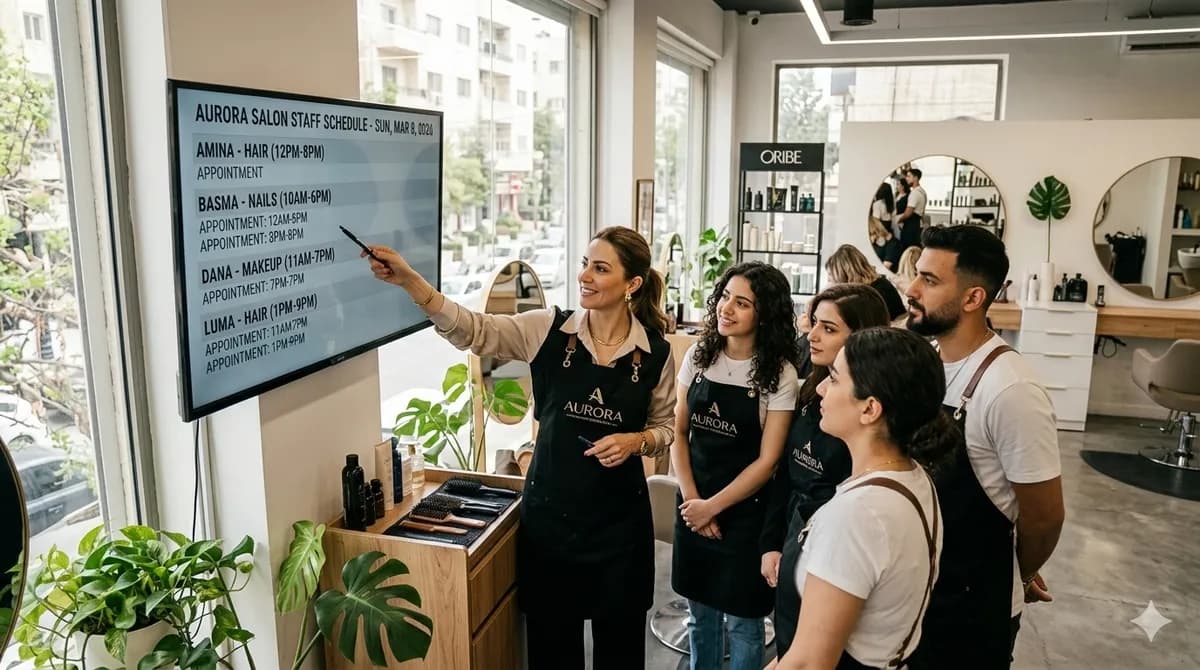
In the salon business, your team is your product. The chairs, the lighting, the products, the software — these are all supporting elements. What clients actually pay for is the skill, attention, and personality of the person behind the chair.
This means staff management is not just an HR function. It is the core of your business strategy. Get it right, and you build a loyal team that delivers consistent experiences, retains clients, and grows your revenue. Get it wrong, and you enter the expensive cycle of constant hiring, training, losing talent to competitors, and watching clients follow their stylists out the door.
In the Gulf region, salon staff management comes with unique challenges: a multinational workforce with varying cultural expectations, visa sponsorship obligations, high living costs that drive salary negotiations, and fierce competition for top talent. This guide addresses all of it.
The True Cost of Staff Turnover
Before diving into management strategies, understand what turnover actually costs your business. When a stylist leaves, you lose:
Direct recruitment costs. Advertising the position, interviewing candidates, processing visa applications (5,000-8,000 AED per person in the UAE), and onboarding expenses.
Training investment. The time and money spent training the departing stylist on your systems, standards, products, and client preferences — all lost.
Lost productivity. A new stylist takes three to six months to reach the productivity level of the person they replaced. During the ramp-up period, you are paying full salary for reduced output.
Client attrition. This is the big one. When a popular stylist leaves, they take clients with them. Industry research suggests that 25% to 40% of a stylist's clients will follow them to their new salon if given the opportunity. For a stylist generating 25,000 AED per month, that is 6,250 to 10,000 AED in monthly revenue at risk.
The total cost of replacing a single mid-level stylist can easily exceed 30,000 to 50,000 AED when you account for all these factors. For a salon losing two or three stylists per year, turnover becomes one of the largest hidden expenses in the business.
Designing a Fair and Motivating Commission Structure
Commission structure is the most common source of conflict between salon owners and their teams. Get it right, and it becomes your strongest retention tool. Get it wrong, and it becomes the reason your best people leave.
The Three Main Commission Models
Percentage of service revenue. The stylist earns a percentage of every service they perform. Typical ranges are 30% to 50% of the service price. Simple and transparent, but it can discourage teamwork if stylists compete for high-value bookings.
Tiered commission. The percentage increases as the stylist hits revenue thresholds. For example, 35% on the first 15,000 AED in monthly services, 40% on the next 10,000 AED, and 45% on everything above 25,000 AED. This motivates higher performance and rewards top producers.
Base salary plus commission. A guaranteed monthly salary supplemented by a lower commission rate on services. This provides income stability for the stylist (important for visa and housing requirements in the UAE) while still incentivizing productivity. Common structures are 3,000-5,000 AED base salary plus 15% to 25% commission.
Product Sales Commission
Product retail is a significant revenue stream that many salons underutilize. Offering stylists a commission on product sales (typically 10% to 15% of the sale price) incentivizes them to recommend products during services. This increases your revenue without adding service time.
Train your team to make recommendations that genuinely benefit the client. Hard-sell product pushing damages the client relationship and the salon's reputation. But an expert recommendation — "This serum would help maintain your color between visits" — is valued by clients and drives sales naturally.
Transparency Is Non-Negotiable
Whatever structure you choose, it must be completely transparent. Every stylist should be able to calculate their expected earnings before the end of the month. Your salon software should provide real-time commission tracking so that team members can see their accrued commissions at any point.
Disputes over commission calculations are one of the top reasons stylists leave salons. Eliminate this by using software that calculates commissions automatically based on pre-defined rules, generating detailed commission reports that the stylist can review and verify.
Optimizing Staff Scheduling
Effective scheduling balances three competing priorities: meeting client demand, respecting staff preferences, and controlling labor costs.
Data-Driven Scheduling
Your salon software should provide data on booking patterns by day of week, time of day, service type, and stylist. Use this data to build schedules that match staffing levels to demand:
Peak periods (typically Thursday evenings through Saturday, and the days before major holidays) require maximum staffing. Schedule your full team and consider extending hours.
Shoulder periods (Sunday through Wednesday mornings) are typically slower. Schedule fewer staff and use this time for training, team meetings, and administrative tasks.
Consistent quiet periods may indicate an opportunity to adjust hours rather than paying staff to stand idle. If Tuesday mornings are consistently empty, consider opening later on Tuesdays.
Shift Management Best Practices
Publish schedules two weeks in advance. Staff need time to plan their personal lives around their work schedules. Last-minute changes breed resentment and increase the likelihood of call-outs.
Distribute desirable shifts fairly. Friday and Saturday shifts generate the most tips and commissions but also require working when most people are off. Rotate these shifts equitably unless specific stylists have standing agreements.
Build in buffer time. Do not schedule stylists back-to-back for the entire day. Allow 15 to 30 minutes of buffer between appointments for cleanup, preparation, and rest. Exhausted stylists deliver worse service and burn out faster.
Cross-train your team. When staff can cover multiple roles (a stylist who can also do basic nail services, a receptionist who can assist with blowouts), you gain scheduling flexibility and reduce the impact of absences.
Managing Time-Off and Absences
In the UAE, employees are entitled to annual leave, sick leave, and various other leave types under labor law. Your scheduling system must account for these:
Annual leave (30 calendar days per year for most employees). Plan for leave requests in advance. Establish a policy for how far ahead leave must be requested and how conflicts are resolved.
Sick leave. Employees are entitled to 90 days of sick leave per year under UAE labor law, with full pay for the first 15 days and half pay for the next 30 days. While excessive sick leave should be addressed, a punitive approach damages morale.
Public holidays. The UAE has approximately 10-13 public holidays per year. Salons typically remain open during holidays (demand increases for Eid and National Day), so plan for holiday staffing well in advance with appropriate overtime compensation.
Building a Culture That Retains Talent
Compensation matters, but it is not the only reason people stay. Culture, growth opportunities, and feeling valued play equally important roles.
Career Development Paths
Create clear career progression paths within your salon:
Junior Stylist → Senior Stylist → Master Stylist → Salon Manager/Artistic Director
Each level should come with specific skill requirements, revenue targets, and compensation increases. When stylists can see a future within your salon, they are less likely to look elsewhere.
Invest in ongoing education. Send team members to workshops, brand training sessions, and industry events like Professional Beauty Dubai or Beautyworld Middle East. The knowledge they bring back improves your salon's service quality, and the investment demonstrates that you are committed to their growth.
Recognition and Feedback
Monthly performance reviews. Not annual — monthly. Brief, constructive conversations about what is going well, what could improve, and what support the stylist needs. Use your salon software's performance data to make these conversations specific and evidence-based.
Public recognition. Celebrate achievements — highest revenue, best client retention, most positive reviews, most improved — in team meetings and on social media (with the team member's permission). Recognition costs nothing but has enormous impact on morale.
Listen and act. Create channels for staff to share concerns, suggestions, and feedback. More importantly, act on that feedback. A team that feels heard is more engaged and more loyal.
Practical Retention Perks
Beyond salary and commission, consider:
Housing allowance or accommodation. In the UAE's expensive housing market, helping with accommodation is highly valued, especially by junior staff.
Annual flight ticket. Many salon employees in the UAE are expatriates who travel home annually. Contributing to their airfare is a meaningful benefit.
Flexible scheduling. Where possible, accommodate preferences for specific days off, shift times, or reduced hours during personal circumstances.
Product allowance. Allow team members to purchase salon products at cost or with a significant discount. This also makes them more knowledgeable about the products they recommend to clients.
Performance bonuses. Quarterly bonuses for hitting team or individual targets add excitement and motivation beyond the regular commission structure.
Using Software to Simplify Staff Management
Modern salon software should handle the operational complexity of staff management so you can focus on the human side. Look for these capabilities:
Automated commission calculation. The software should automatically calculate commissions based on your defined rules — whether that is a flat percentage, tiered structure, or a hybrid model. Commissions should be calculated in real-time and visible to staff on their dashboard.
Digital scheduling with shift swaps. Staff should be able to view their schedules on their phones, request time off digitally, and swap shifts with colleagues (pending manager approval).
Performance dashboards. Each team member should have access to their own performance metrics: services performed, revenue generated, average ticket value, client retention rate, and product sales. Transparency motivates self-improvement.
Utilization tracking. Monitor how much of each stylist's available time is actually booked. A stylist with a 60% utilization rate has significant room for growth — through better scheduling, marketing, or client retention.
Goal setting and tracking. Set individual and team targets and track progress in real-time. Gamification elements (leaderboards, progress bars, milestone celebrations) can add motivation without creating toxic competition.
The Bottom Line
Your salon team is simultaneously your greatest asset and your largest expense. The salons that thrive are those that treat staff management not as an administrative burden but as a strategic priority.
Design fair compensation that rewards performance. Schedule intelligently using data. Build a culture that makes people want to stay. Invest in growth and development. Use technology to handle the complexity while you focus on the relationships.
A stable, motivated, skilled team is the ultimate competitive advantage in the salon industry. It is the one thing that a competitor cannot easily replicate.
Sources and References
1. The Salon Business. "9 Best Salon Software in 2026." thesalonbusiness.com — Staff management features and commission tracking capabilities in leading platforms.
2. Mindbody. "Wellness Insights." mindbodyonline.com — Staff retention data and employee satisfaction benchmarks in the wellness industry.
3. GlossGenius Blog. "Salon Booking Software: 9 Apps for Booking and Payments." glossgenius.com — Team management tools and performance tracking features.
4. Meevo Inspo Blog. "How to Choose the Right Salon Management Software." meevo.com — Staff scheduling and commission calculation software features.
5. Vagaro. "The Best Salon Software of 2026." vagaro.com — Employee management, payroll, and commission tracking capabilities.
6. Linktly. "Zenoti Salon/SPA Review 2025." linktly.com — Enterprise staff management features and performance analytics.
7. Mordor Intelligence. "Salon & Spa Software Market." mordorintelligence.com — Industry labor data and workforce management trends.
8. U.S. Chamber of Commerce. "The 4 Best Salon Software Options." uschamber.com — Small business employee management best practices.
Follow WAJ on Google
Add WAJ as a preferred source to see more of our articles in your Google Search results, marked with a "preferred" badge.