
Salon Inventory: Stop Waste, Save Thousands
WAJ Team
July 15, 2025
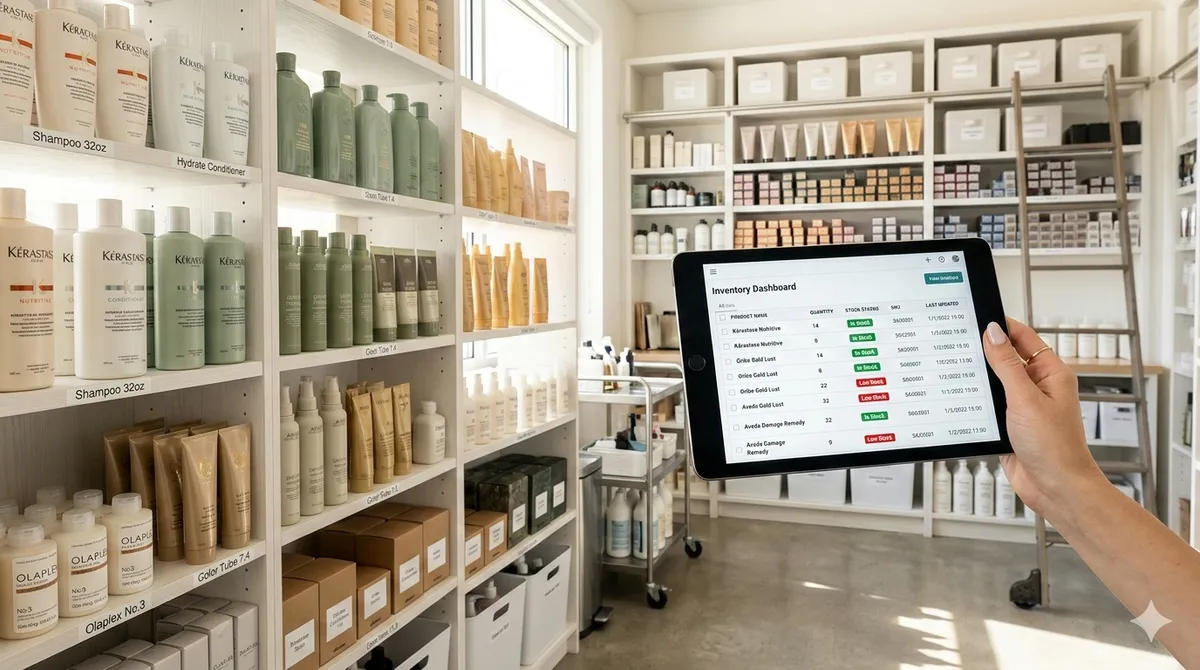
Ask any salon owner what their biggest expense is, and they will say rent or salaries. Ask what their most wasteful expense is, and most will not have a clear answer — because they are not tracking it.
Product waste is the silent profit killer in the salon industry. It is the color tubes that expire before they are used, the shampoo bottles that disappear without generating revenue, the over-ordered supplies that sit on shelves for months, and the retail products that pass their sell-by dates unnoticed.
For a salon spending 8,000 to 15,000 AED per month on professional products and retail inventory, even a 15% waste rate represents 14,400 to 27,000 AED in annual losses. That is money that goes directly from your bottom line into the bin.
The fix is not complicated. It requires a system — not perfection, just a system. And modern salon software makes implementing that system easier than ever.
Understanding Where Inventory Losses Happen
Before you can fix the problem, you need to understand where products are leaking out of your business.
Professional Product Overuse
Stylists often use more product than necessary. An extra pump of conditioner here, an overly generous application of color there. Individually, these seem trivial. Cumulatively, they are significant.
Consider hair color: a standard tube costs 25 to 45 AED and should be sufficient for a single full-head application. If stylists consistently use one and a half tubes per application because they mix too much or apply too generously, you are paying 50% more for every color service. Across hundreds of color services per month, the waste adds up to thousands of dirhams.
Retail Shrinkage
Products disappear from retail shelves without being sold. This happens through internal theft (uncomfortable to discuss, but real), products used for back-bar services instead of being tracked as professional-use, client samples given without recording, and simple miscounting during stock takes.
Expiration and Obsolescence
Beauty products have shelf lives. Professional color lines, organic products, and treatments with active ingredients can expire within 12 to 24 months. If you over-order or stock slow-moving items, they expire before they are used or sold. Every expired product is money thrown away.
Over-Ordering
Without data on actual usage rates, salon owners tend to order based on intuition rather than numbers. This leads to excessive stock of popular items (tying up cash unnecessarily) and insufficient stock of others (leading to service disruptions or lost retail sales).
Building an Inventory Management System
An effective inventory management system does not need to be complex. It needs to be consistent. Here is how to build one from scratch:
Step 1: Categorize Your Inventory
Divide your inventory into three main categories:
Professional-use products. These are consumed during services: color, developer, bleach, treatment products, waxing supplies, nail polish, and so on. They generate revenue indirectly through the services that use them.
Retail products. These are sold to clients: shampoos, conditioners, styling products, skincare items, and tools. They generate direct revenue with their own profit margin.
Consumables. These are operational supplies: towels, capes, foils, gloves, cotton, and cleaning products. They do not generate revenue directly but are necessary for operations.
Each category requires a different management approach. Professional products need usage tracking per service. Retail products need sales tracking and margin analysis. Consumables need reorder threshold management.
Step 2: Establish Baseline Quantities
For every product you stock, establish three numbers:
Par level. The ideal quantity to have on hand at any given time. This should cover your expected usage until the next delivery, plus a safety buffer.
Reorder point. The quantity at which you should place a new order. This accounts for the lead time between ordering and receiving the delivery.
Maximum stock level. The highest quantity you should ever hold. Exceeding this means you are over-investing in inventory and increasing the risk of expiration.
Your salon software should track these levels automatically and alert you when items reach their reorder point.
Step 3: Track Usage Systematically
For professional products, the most effective tracking method is to link product usage to services. When your system knows that a standard balayage uses 60 grams of bleach and 90 ml of developer, it can automatically deduct the expected quantities from inventory when that service is completed.
This is not about policing your stylists — it is about having accurate data. If actual usage consistently exceeds expected usage for a particular service or stylist, it indicates an opportunity for training or a need to update your usage estimates.
For retail products, track every sale through your POS system. Regular stock counts (at minimum, monthly) reconcile actual quantities with system records and reveal any shrinkage.
Step 4: Analyze and Optimize
With consistent data, you can answer critical questions:
What is your cost of goods sold (COGS) as a percentage of revenue? For professional products, a healthy COGS ratio is 8% to 12% of service revenue. For retail, a healthy gross margin is 40% to 60%. If your numbers deviate significantly, investigate.
Which products move fastest? Ensure you never run out of your top 20% of products (which likely generate 80% of your usage and sales).
Which products are slow movers? Products that have not moved in 60 to 90 days should be reviewed. Consider promotions, bundling, or discontinuation.
What is your shrinkage rate? Compare system quantities to actual physical counts. A shrinkage rate above 3% warrants investigation.
Are you ordering efficiently? Consolidating orders with fewer suppliers can reduce shipping costs and qualify for volume discounts. But spreading across multiple suppliers reduces risk if one has supply chain issues.
Practical Tips That Make an Immediate Difference
Standardize Portions
Create standard mixing charts for every service. Post them in the color mixing area. Specify exact quantities of color, developer, bleach, and any additives for each service type and hair length.
This is not about restricting creativity — senior stylists may need more product for complex techniques. It is about establishing a baseline so that deviations are intentional rather than habitual.
First In, First Out (FIFO)
When new stock arrives, place it behind existing stock. Use the older products first. This simple habit prevents items from aging out on the back of the shelf while newer inventory is used up front.
Monthly Physical Counts
Technology is helpful, but nothing replaces a physical inventory count. Once per month, count every product in your salon and compare it to your system's records. This is the only way to identify shrinkage, counting errors, and system inaccuracies.
Schedule counts during quiet periods — early morning before opening or after closing. Assign specific sections to specific team members to ensure thoroughness.
Negotiate With Suppliers
Armed with usage data, you are in a much stronger negotiating position with suppliers. You can provide accurate volume projections, negotiate volume discounts, request consignment arrangements for new products (you only pay for what sells), and compare pricing across suppliers with confidence.
Even a 5% improvement in supplier pricing, applied across your entire inventory spend, can save 4,800 to 9,000 AED annually for a mid-sized salon.
Retail Strategy: Turn Shelves into Revenue
Many salons treat their retail area as an afterthought. With the right approach, retail can contribute 15% to 25% of total revenue with margins of 40% to 60%.
Display strategically. Place retail products near the checkout area and in areas where clients wait. The best retail displays are at eye level and feature products related to the most popular services.
Train your team to recommend. Stylists should recommend one to two products per client visit, based on the service performed. "I used this thermal protector during your blowout — it would really help maintain the smoothness at home" is a natural, helpful recommendation, not a hard sell.
Bundle products with services. Create packages that include a service plus a take-home product at a bundled price. This introduces clients to products they might not otherwise try.
Track retail performance by stylist. Your salon software should show which team members are driving the most retail sales. Recognize and reward top performers, and provide additional training for those who are not recommending products.
Leveraging Technology for Inventory Control
Modern salon software platforms offer inventory management features that automate much of the work described above. When evaluating a platform's inventory capabilities, look for:
Automatic deduction on service completion. The system deducts expected product usage when a service is marked as complete, keeping your inventory counts current without manual entry.
Low-stock alerts. Configurable notifications when products reach their reorder point, sent to the salon manager's phone or email.
Supplier management. The ability to store supplier information, pricing, and order history within the system, making reordering quick and accurate.
Barcode scanning. For retail products, barcode scanning at the POS speeds up checkout and ensures accurate inventory tracking.
Expiration tracking. Alerts for products approaching their expiration date, giving you time to use them in services, promote them for retail sale, or return them to the supplier if applicable.
Reporting dashboards. Visual reports showing inventory value, COGS ratios, top products, slow movers, shrinkage rates, and reorder recommendations.
The Financial Impact
Let us quantify what good inventory management is worth to a mid-sized salon:
Reduced product waste (15% to 5%): Saving approximately 800 to 1,500 AED per month on a 10,000 AED monthly product spend.
Improved retail sales (10% to 20% increase): If retail currently contributes 10,000 AED monthly with a 50% margin, a 20% increase adds 1,000 AED in monthly profit.
Better supplier terms (5% cost reduction): Saving approximately 500 AED monthly on a 10,000 AED product spend.
Total estimated annual benefit: 27,600 to 36,000 AED — for a system that requires perhaps two to three hours of setup and 30 minutes of monthly maintenance.
Inventory management is not glamorous. It will never trend on Instagram or impress clients with its sophistication. But it is one of the highest-ROI operational improvements available to any salon owner. And it starts with simply deciding to track what you have, use what you track, and improve what you measure.
Sources and References
1. The Salon Business. "9 Best Salon Software in 2026." thesalonbusiness.com — Inventory management features and product tracking capabilities.
2. GlossGenius Blog. "Salon Booking Software: 9 Apps for Booking and Payments." glossgenius.com — POS and inventory integration features.
3. Meevo Inspo Blog. "How to Choose the Right Salon Management Software." meevo.com — Inventory management module evaluation criteria.
4. Vagaro. "The Best Salon Software of 2026." vagaro.com — Inventory tracking, supplier management, and retail analytics.
5. Mindbody. "Wellness Insights." mindbodyonline.com — Product retail benchmarks and inventory management best practices.
6. Linktly. "Zenoti Salon/SPA Review 2025." linktly.com — Enterprise inventory management and multi-location stock control.
7. U.S. Chamber of Commerce. "The 4 Best Salon Software Options." uschamber.com — Small business inventory management recommendations.
8. Mordor Intelligence. "Salon & Spa Software Market." mordorintelligence.com — Technology adoption data for salon operations management.
Follow WAJ on Google
Add WAJ as a preferred source to see more of our articles in your Google Search results, marked with a "preferred" badge.