
GCC VAT-Compliant Salon Software Guide
WAJ Team
November 25, 2025
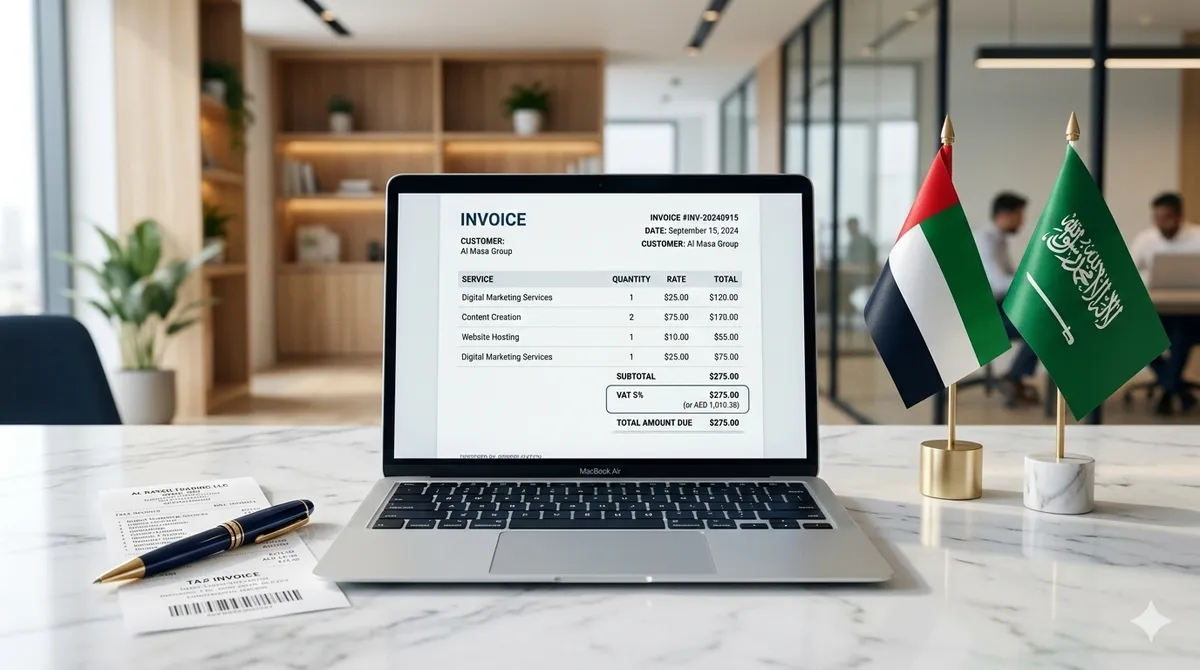
When the UAE introduced Value Added Tax at 5% on January 1, 2018, it fundamentally changed how every salon in the Emirates handles payments. Saudi Arabia followed with its own VAT implementation at 5%, later increasing it to 15% in 2020. Bahrain, Oman, and other GCC states have since implemented their own VAT regimes.
For salon owners, VAT compliance is not a one-time setup. It is an ongoing operational requirement that affects every transaction, every invoice, and every financial report your business produces. Getting it wrong can result in penalties, audits, and reputational damage.
The good news: the right salon software handles most of the compliance burden automatically. The challenge: many popular salon platforms were not designed for the GCC market and lack the specific compliance features you need.
This guide explains what GCC tax compliance requires from your salon operations and how to ensure your software meets those requirements.
Understanding VAT in the GCC Salon Context
What Is Taxable?
In the UAE, all salon services are subject to standard-rate VAT at 5%. This includes haircuts, coloring, treatments, nail services, makeup, waxing, and any other beauty or grooming service. Retail product sales are also taxable at the standard rate.
There are no VAT exemptions specific to the beauty industry in the UAE. Every service and product you sell must include VAT in the price or have VAT clearly added at the point of sale.
How VAT Affects Your Pricing
You have two options for displaying prices:
VAT-inclusive pricing. The displayed price includes VAT. A haircut listed at 105 AED means the service price is 100 AED plus 5 AED VAT. This is the most common approach in the UAE salon market because it simplifies the client experience.
VAT-exclusive pricing. The displayed price is the base price, and VAT is added at checkout. A haircut listed at 100 AED becomes 105 AED at the register. This is less common in consumer-facing businesses but may be used in some B2B contexts.
Whichever approach you choose, your POS system must clearly show the VAT amount on every invoice.
What Your Invoice Must Include
UAE tax regulations require that every VAT invoice issued by a registered business includes specific information. For simplified tax invoices (applicable to most salon transactions under 10,000 AED), the requirements include your business name and address, your Tax Registration Number (TRN), the invoice date, a description of the goods or services provided, the total amount inclusive of VAT, and a clear statement of the VAT amount.
For full tax invoices (transactions above 10,000 AED or when requested by a VAT-registered customer), additional details are required including the customer's name, address, and TRN.
Your salon software must be able to generate invoices that meet these requirements automatically, without manual intervention for each transaction.
Saudi Arabia's ZATCA E-Invoicing Requirements
If your salon operates in Saudi Arabia or you plan to expand there, you need to understand ZATCA's e-invoicing system, known as FATOORAH.
ZATCA has implemented e-invoicing in phases:
Phase 1 (Generation Phase) required all VAT-registered businesses to generate e-invoices using compliant electronic systems. Handwritten invoices and basic PDFs are no longer acceptable.
Phase 2 (Integration Phase) requires businesses to integrate their invoicing systems directly with ZATCA's platform, enabling real-time or near-real-time reporting of invoices to the tax authority.
For salon owners in Saudi Arabia, this means your software must generate e-invoices in the specific format required by ZATCA, include the required fields and QR codes, connect to ZATCA's platform for invoice validation, and archive invoices in compliance with retention requirements.
Not all salon software platforms support ZATCA integration. If you operate in Saudi Arabia, this is a non-negotiable requirement when selecting your software.
VAT Return Preparation
Every VAT-registered business in the UAE must file VAT returns with the Federal Tax Authority (FTA), typically on a quarterly basis. The return summarizes all taxable sales, purchases, and the net VAT payable or refundable.
Your salon software should simplify this process by generating detailed VAT reports covering total output VAT collected on sales, total input VAT paid on purchases, net VAT payable, and transaction-by-transaction details for audit purposes.
The ability to export these reports in formats compatible with FTA filing requirements saves significant time and reduces the risk of errors in your returns.
Choosing VAT-Compliant Salon Software
When evaluating salon software for GCC tax compliance, verify the following capabilities:
Invoice Generation
Can the system automatically generate VAT-compliant invoices for every transaction? Does it support both simplified and full tax invoices? Can it display prices as VAT-inclusive or VAT-exclusive based on your preference? Does it include your TRN on every invoice?
Tax Calculation
Does the system correctly calculate VAT at the applicable rate? Can it handle different VAT rates for different countries if you operate across multiple GCC states? Does it apply the correct rounding rules? Can it handle VAT on promotional discounts, packages, and bundled services correctly?
Reporting
Does the system generate VAT return reports in the required format? Can it produce detailed transaction logs for audit purposes? Does it support data export for your accountant or tax advisor?
E-Invoicing (Saudi Arabia)
If you operate in Saudi Arabia, does the system support ZATCA's FATOORAH e-invoicing format? Can it integrate with ZATCA's platform for Phase 2 compliance? Does it generate the required QR codes on invoices?
Multi-Currency and Multi-Country
If you operate across multiple GCC countries, does the system support different currencies (AED, SAR, QAR, OMR, BHD)? Can it handle different VAT rates by country? Can it generate reports by country for separate tax filings?
Common VAT Mistakes Salon Owners Make
Not registering for VAT when required. In the UAE, businesses with taxable supplies exceeding 375,000 AED annually must register for VAT. Voluntary registration is available for businesses exceeding 187,500 AED. If your salon meets the threshold and is not registered, you are non-compliant.
Using non-compliant software. Some salon platforms, particularly those designed for US or European markets, do not support UAE VAT requirements. Using a non-compliant system puts the burden of compliance on manual processes, which is error-prone and unsustainable.
Failing to keep proper records. UAE tax law requires businesses to retain records (invoices, receipts, financial records) for at least five years. Your salon software should handle record retention automatically, with secure cloud storage and data export capabilities.
Incorrect treatment of tips. Tips are generally not subject to VAT in the UAE if they are voluntary and not part of the service price. However, mandatory service charges added to invoices are taxable. Make sure your POS system distinguishes between voluntary tips and mandatory charges.
Not claiming input VAT. You can recover VAT paid on business purchases — products, equipment, rent (if VAT-registered landlord), and business services. Many salon owners overlook input VAT recovery, effectively overpaying their tax obligation.
The Compliance Advantage
VAT compliance is not just about avoiding penalties. Salons with clean, automated tax processes gain several advantages:
Credibility with clients and suppliers. Proper invoicing signals professionalism. Corporate clients and B2B customers often require VAT invoices for their own tax compliance.
Easier financial management. When your tax data is accurate and automated, your financial reporting is more reliable. This helps with business planning, bank relationships, and investor confidence.
Reduced accounting costs. Accountants and tax advisors charge less when your data is clean and organized. A salon that delivers complete, accurate VAT reports to its accountant will pay significantly less in professional fees than one that delivers a shoebox of receipts.
Preparation for audits. FTA audits do happen, and they are much less stressful when your records are complete, organized, and automatically generated by your software.
Tax compliance is not the most exciting topic in salon management. But it is one of the most consequential. The penalties for non-compliance are real, the requirements are clear, and the tools to comply automatically are available. Choosing VAT-compliant salon software is not a luxury — it is a business essential.
Sources and References
1. Alpha EBM. "Salon and Spa Software Dubai." alphaebm.com — GCC VAT compliance features and tax-compliant invoicing for salon software.
2. Mordor Intelligence. "Salon & Spa Software Market." mordorintelligence.com — Regional regulatory landscape and compliance requirements for salon businesses.
3. WAJ Blog. "WAJ vs CloudMeSoft 2025." waj.ai — VAT compliance capabilities and multi-country tax support for MENA salon software.
4. Zolmi. "Best Salon Software Dubai." zolmi.ae — UAE VAT invoicing and local tax compliance features.
5. The Salon Business. "9 Best Salon Software in 2026." thesalonbusiness.com — Financial reporting and tax compliance feature comparisons.
6. Linktly. "Zenoti Salon/SPA Review 2025." linktly.com — Enterprise tax compliance and multi-country regulatory support.
7. Meevo Inspo Blog. "How to Choose the Right Salon Management Software." meevo.com — Financial management and reporting capabilities evaluation.
8. GlossGenius Blog. "Salon Booking Software: 9 Apps for Booking and Payments." glossgenius.com — Payment processing and invoicing feature analysis.
Follow WAJ on Google
Add WAJ as a preferred source to see more of our articles in your Google Search results, marked with a "preferred" badge.