
Salon Management Software Guide for 2026
WAJ Team
January 15, 2026
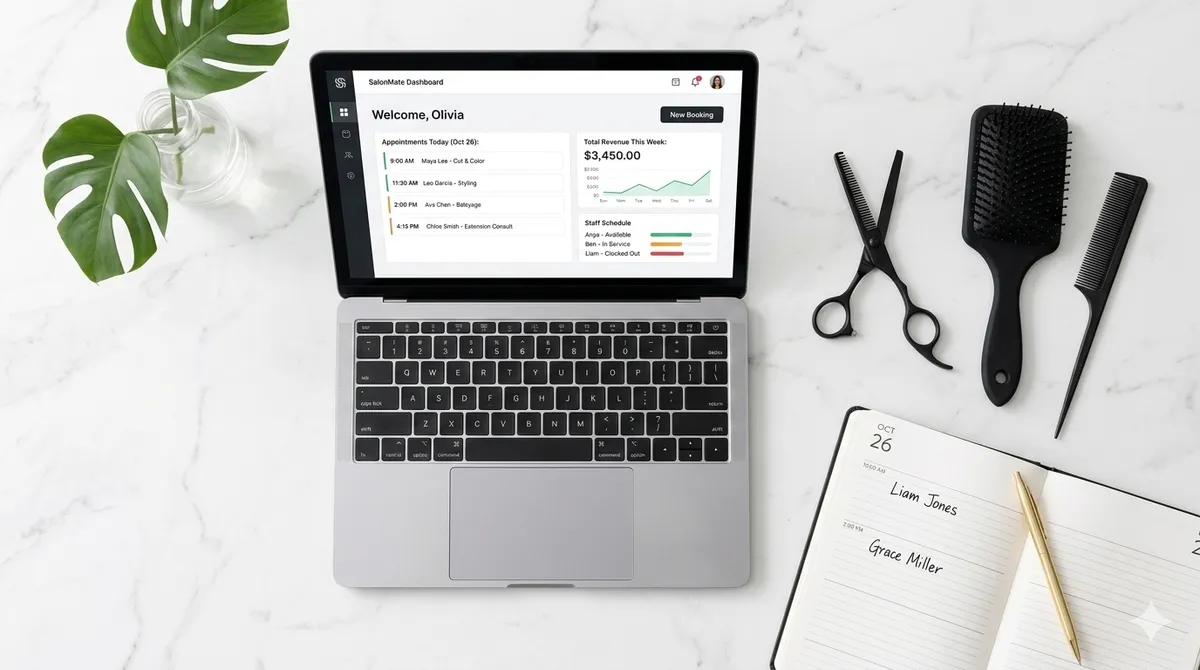
Running a salon in 2026 without management software is like running a restaurant without a kitchen. Technically possible, maybe, but you will lose clients, waste money, and burn out your team faster than you can say "double booking."
The salon software market has grown into a $1.01 billion global industry, with analysts projecting it to reach $1.97 billion by 2032. That growth has brought a flood of options — over 150 platforms now compete for your attention and your subscription fees. Some are brilliant. Some are bloated. And some will quietly charge you commissions that eat into your profit margins without you even noticing.
This guide cuts through the noise. Whether you are running a single-chair barbershop in Deira or a multi-location spa chain across the Gulf, you will find everything you need to make an informed decision.
What Salon Management Software Actually Does
At its core, salon management software replaces the scattered tools most salon owners currently juggle: a paper appointment book (or a basic calendar app), a separate payment terminal, a WhatsApp group for staff scheduling, an Excel sheet for tracking inventory, and maybe a shoebox full of client cards.
Good salon software combines all of these into a single platform. But the best platforms go further — they turn your data into insights that help you grow.
Here is what a modern salon management system should handle:
Appointment Scheduling and Online Booking
This is the foundation. Your software should allow clients to book appointments 24/7 through a website widget, a dedicated booking page, or a mobile app. According to industry data, nearly half of all salon bookings now happen outside of business hours. If you are not offering online booking, you are leaving revenue on the table every single night.
Look for features like real-time availability display, automatic buffer times between appointments, recurring booking options, and the ability to book multiple services in a single session. The system should also handle walk-ins gracefully — not every client plans ahead, especially in high-traffic areas.
Client Management (CRM)
Every interaction with a client generates valuable data. What services they book, how often they visit, which stylist they prefer, their product allergies, their birthday, and their preferred communication channel. A good CRM stores all of this and makes it actionable.
The real power comes from segmentation. You should be able to group clients by visit frequency, spending level, service preferences, or last visit date. This allows you to create targeted campaigns: a "we miss you" message to clients who have not visited in 60 days, a birthday discount, or an upsell recommendation based on their history.
Point of Sale (POS) and Payment Processing
Your POS system should handle split payments, tips, product sales, service packages, gift cards, and membership fees. In the GCC region, VAT compliance is non-negotiable — your system must generate tax-compliant invoices automatically.
Payment processing fees vary dramatically between providers. Some platforms include processing at a flat rate (typically 2.5% to 3.5% per transaction), while others let you integrate with your existing payment terminal. The commission model is where you need to be especially careful: some platforms charge transaction fees on top of subscription costs, which can add up to thousands of dirhams per month for busy salons.
Staff Management
Managing a salon team involves more than just scheduling shifts. You need to track individual performance, calculate commissions (which often vary by service type and stylist seniority), manage time-off requests, and ensure you have the right coverage during peak hours.
Advanced platforms offer performance dashboards showing each team member's utilization rate, average ticket value, rebooking rate, and client retention. These metrics help you identify top performers, coach underperformers, and make data-driven decisions about hiring.
Inventory Management
Product waste is one of the most overlooked profit killers in the salon industry. Without proper tracking, it is common to discover expired products on shelves, run out of popular colors during peak season, or over-order supplies that sit unused for months.
Your software should track stock levels in real-time, alert you when items reach reorder thresholds, and provide usage analytics that show which products generate the most revenue versus which ones just collect dust.
Marketing and Communication
Automated marketing is where salon software starts paying for itself. Look for platforms that offer email campaigns, SMS reminders, WhatsApp integration (critical in the MENA region), loyalty programs, referral tracking, and review management.
The most impactful automated message is the simple appointment reminder. Industry data suggests that automated reminders can reduce no-shows by 29% or more. For a busy salon with 50 appointments per day and an average ticket of 200 AED, cutting no-shows even by half could save you over 15,000 AED per month.
Reporting and Analytics
You cannot improve what you do not measure. At minimum, your software should provide reports on daily revenue, service category breakdown, staff performance, client retention rates, average ticket value, and peak booking times. The best platforms offer customizable dashboards and the ability to export data for deeper analysis.
The Four Pricing Models You Will Encounter
Understanding pricing models is critical because the advertised price is rarely the full cost of ownership.
Model 1: Pure Subscription (Flat Monthly Fee)
You pay a fixed monthly or annual fee regardless of how many bookings or transactions you process. This is the most transparent model and the easiest to budget for. Examples include platforms like WAJ, Vagaro, and Mangomint.
The advantage is predictability. Your software cost does not increase as your business grows. A salon processing 100 bookings per month and one processing 1,000 bookings per month pay the same fee. This model rewards growth rather than penalizing it.
Model 2: Freemium with Paid Upgrades
Some platforms offer a basic free tier with limited features, then charge for essential upgrades like SMS reminders, online payments, or marketing tools. Examples include Square Appointments (free for one user) and SimplyBook.me.
The free tier sounds appealing, but most salons quickly outgrow it. The real question is what the platform costs once you add the features you actually need. Calculate the total cost of all the add-ons you would use, and compare that to flat-subscription alternatives.
Model 3: Commission-Based or Hybrid
This is where it gets expensive. Some platforms charge a percentage of every transaction processed through their system, or take a commission on new clients acquired through their marketplace. Fresha, for example, charges 20% on new clients booked through its marketplace. Treatwell takes up to 35% on first bookings.
At first glance, this seems fair — you only pay when you earn. But the math gets brutal at scale. If your salon generates 50,000 AED per month and 30% of your clients come through the marketplace, you could be paying 3,000 AED or more in commissions monthly — far more than any subscription fee.
Model 4: Custom Enterprise Pricing
Larger chains and multi-location businesses often negotiate custom pricing based on the number of locations, users, and required integrations. Zenoti, Boulevard, and Meevo typically operate in this model, with monthly costs ranging from 300 to 600 USD or more per location.
Seven Questions to Ask Before You Choose
Before you sign any contract or start any free trial, get clear answers to these questions:
1. What is the total cost of ownership? Include the subscription fee, payment processing fees, SMS costs, any per-user charges, setup fees, and hardware requirements. Ask for a quote based on your actual business size and volume.
2. Is there a commission on any transactions? This is the question many platforms hope you will not ask. Get it in writing: are there commissions on new clients, marketplace bookings, payment processing, or any other transactions?
3. What happens to my data if I leave? Can you export your full client database, appointment history, and financial records? Some platforms make data export difficult or impossible, effectively holding your business hostage.
4. Does the platform support my language and currency? For businesses in the MENA region, Arabic language support is not just a nice-to-have — it determines whether your staff will actually use the system. Similarly, make sure the platform handles AED, SAR, QAR, and other local currencies natively.
5. How does onboarding work? Switching software is disruptive. Ask about data migration from your current system, staff training timelines, and whether you get a dedicated onboarding specialist or just a link to a help center.
6. What integrations are available? If you use a specific payment gateway, accounting software, or marketing tool, make sure the platform integrates with it. WhatsApp Business API integration is essential for salons in the Gulf region.
7. What does customer support look like? Is support available in your timezone? Can you reach a real person, or only a chatbot? For salons in the Gulf, having local support in your working hours is a significant advantage over platforms headquartered in the US or Europe.
The Features That Separate Good Software from Great Software
Every platform on the market will check the basic boxes: scheduling, payments, and client records. The differentiators are in the details.
Smart scheduling with conflict prevention. Great software does not just allow bookings — it prevents impossible ones. It accounts for processing time between color services, ensures that a stylist is not double-booked for a balayage and a blowout simultaneously, and automatically adjusts availability when a team member calls in sick.
Automated lifecycle marketing. Instead of manually texting clients, the best platforms trigger personalized messages at key moments: a thank-you after their first visit, a reminder when they are due for their next appointment, a special offer on their birthday, and a "we miss you" message when they have been absent too long.
Real-time business health dashboards. Rather than making you dig through reports, the best platforms show you the metrics that matter the moment you log in: today's revenue versus target, this week's booking rate versus last week, your top-performing services, and any staff gaps that need attention.
Multi-location management. If you operate or plan to operate more than one location, look for centralized reporting, inter-branch client recognition, staff transfers between locations, and unified inventory management.
WhatsApp and social media integration. In the MENA region, WhatsApp is the dominant communication channel. Platforms that offer native WhatsApp Business API integration for booking confirmations, reminders, and marketing messages have a significant advantage over those relying solely on email and SMS.
Common Mistakes Salon Owners Make When Choosing Software
Choosing based on price alone. The cheapest option is not always the most cost-effective. A free platform that charges commissions will cost you more than a premium subscription once you start growing. Calculate the three-year total cost of ownership, not just the monthly sticker price.
Ignoring staff adoption. The most feature-rich software in the world is worthless if your team refuses to use it. Involve your senior stylists and reception staff in the evaluation process. Let them test the interface during free trials. If the software is not available in their preferred language, adoption will be a constant struggle.
Overlooking mobile experience. Both your staff and your clients will interact with the software primarily on mobile devices. If the mobile app is sluggish, unintuitive, or missing key features, the overall experience suffers regardless of how good the desktop version looks.
Signing long-term contracts without testing. Some platforms require 12-month commitments. Always complete a full free trial before signing anything, and negotiate month-to-month options when possible. Your business needs will evolve, and being locked into a suboptimal platform for a year is expensive.
Failing to plan for growth. Choose software that can scale with you. If you are a single-location salon today but plan to expand, make sure the platform supports multi-location management, centralized reporting, and flexible user additions without dramatic price increases.
The Bottom Line
The right salon management software will save you time, reduce errors, improve client retention, and give you the data you need to grow your business intentionally. The wrong choice will create frustration, hidden costs, and months of wasted effort.
Take your time with the decision. Run the numbers on total cost of ownership. Involve your team in the evaluation. And remember: the best software is not the one with the most features — it is the one your team will actually use, every single day.
Sources and References
1. Mordor Intelligence. "Salon & Spa Software Market - Report & Analysis." mordorintelligence.com — Market size data ($1.01B valuation, 10.9% CAGR growth projection to $1.97B by 2032).
2. Meevo Inspo Blog. "How to Choose the Right Salon Management Software in 2026." meevo.com — Software selection criteria and feature analysis.
3. The Salon Business. "9 Best Salon Software in 2026: The Ultimate Guide." thesalonbusiness.com — Comprehensive software comparison and pricing data.
4. Vagaro. "The Best Salon Software of 2026." vagaro.com — Feature comparisons and pricing model breakdowns.
5. GlossGenius Blog. "Salon Booking Software: 9 Apps for Booking and Payments." glossgenius.com — Appointment scheduling features and booking statistics.
6. Koalendar. "8 Best Salon Booking Software for Beauty Professionals." koalendar.com — Industry booking trends and after-hours data.
7. Software Advice. "Booksy Biz vs Fresha - 2026 Comparison." softwareadvice.com — Pricing model comparisons and commission structure analysis.
8. The Salon Business. "The Ultimate Fresha Review 2026." thesalonbusiness.com — Commission model details and marketplace analysis.
9. YouCanBookMe. "Best Fresha Alternatives for Salons and Spas." youcanbook.me — Alternative platform comparisons.
10. U.S. Chamber of Commerce. "The 4 Best Salon Software Options." uschamber.com — Small business software evaluation criteria.
Follow WAJ on Google
Add WAJ as a preferred source to see more of our articles in your Google Search results, marked with a "preferred" badge.