
How to Cut Salon No-Shows by 72%
WAJ Team
December 10, 2025
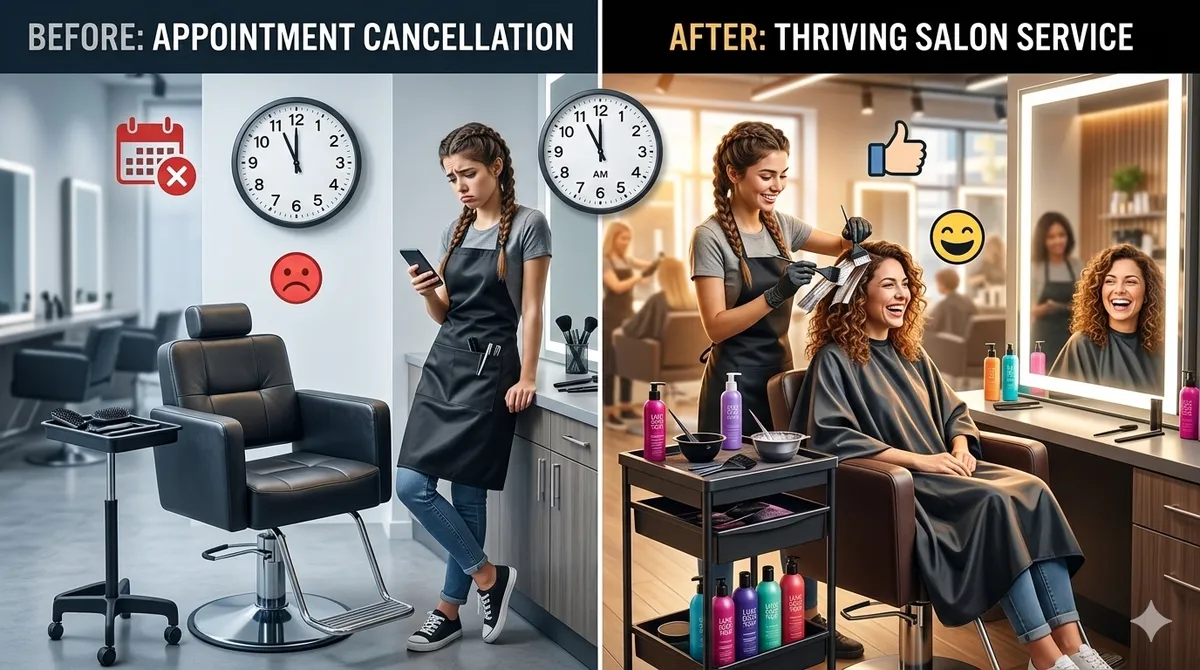
An empty chair in a salon is not just an inconvenience. It is lost revenue that can never be recovered.
Unlike a retail store where unsold inventory can wait until tomorrow, a salon's product is time. When a 2 PM appointment does not show up, that slot is gone forever. The stylist's time was wasted, the opportunity cost of turning away another client is real, and the rent, utilities, and salaries keep running regardless.
Industry estimates put the average salon no-show rate at 15% to 20%. For a busy salon running 40 appointments per day with an average ticket of 250 AED, a 15% no-show rate translates to approximately 45,000 AED in lost revenue every single month. Over a year, that is 540,000 AED — enough to fund a second location, hire additional staff, or simply take home as profit.
But some salons have cracked the code. By implementing a combination of technology, policy, and communication strategies, top-performing salons have reduced their no-show rates to below 5%. This guide shows you exactly how.
Understanding Why Clients No-Show
Before you can solve the problem, you need to understand it. Clients miss appointments for predictable reasons, and each reason requires a different solution.
They simply forgot. This is the most common reason by far. Life gets busy, and a salon appointment booked two weeks ago can easily slip from memory. The solution is straightforward: automated reminders at the right intervals.
Something came up, and they did not bother to cancel. Many clients intend to cancel but put it off until it feels too late or too awkward. Making cancellation easy and judgment-free actually reduces no-shows because it converts potential no-shows into cancellations — which are much better because you can rebook the slot.
They booked impulsively and lost interest. This happens frequently with promotional offers and marketplace bookings. The client was intrigued by a deal, booked on impulse, and then decided they did not actually want the service. A deposit or prepayment requirement filters out non-serious bookings.
They had a bad experience and are avoiding the salon. Sometimes a no-show is feedback. If a client had a disappointing service or an uncomfortable interaction, they may ghost rather than confront. Post-visit feedback surveys can catch these issues before they result in a lost client.
The appointment was too far in advance. Bookings made more than three weeks out have significantly higher no-show rates. Life changes, priorities shift, and a commitment made a month ago feels less binding.
Strategy 1: Automated Multi-Channel Reminders
This is the single most impactful change you can make. Research consistently shows that automated reminders reduce no-shows by 29% or more. But the channel, timing, and frequency matter enormously.
The Optimal Reminder Sequence
The most effective approach uses three touchpoints:
First reminder: 48 hours before the appointment. This gives the client enough time to reschedule if needed, and gives you enough time to fill a cancelled slot. Send this via WhatsApp or SMS — channels with near-instant open rates.
Second reminder: 24 hours before. This is the critical reminder. Include the appointment date, time, service, and stylist name. Add a one-tap confirmation button and an easy cancellation or rescheduling link. Make it as frictionless as possible for them to confirm or cancel.
Third reminder: 2 hours before. A brief final nudge, especially effective for afternoon and evening appointments. This catches the clients who saw the earlier reminders but did not act on them.
Channel Selection Matters
In the MENA region, WhatsApp is the undisputed champion for client communication. Open rates for WhatsApp messages exceed 90%, compared to 20-30% for email and 85-90% for SMS. Platforms that offer native WhatsApp Business API integration give you a significant advantage.
That said, a multi-channel approach works best. Some clients prefer SMS, others check WhatsApp more frequently, and email works well for sending detailed booking confirmations with calendar attachments. The key is to match the channel to the client's preference — which your CRM should track automatically.
What to Include in Reminder Messages
Effective reminders are short, clear, and actionable. Include:
- Client's first name (personalization increases engagement) - Date and time of the appointment - Service booked and estimated duration - Stylist or therapist name - Salon location (especially for multi-location businesses) - A confirm button or link - A reschedule or cancel link - Your salon's cancellation policy (briefly)
Avoid generic messages. "You have an appointment tomorrow" is far less effective than "Hi Fatima, your balayage appointment with Sara is tomorrow at 3 PM at our Dubai Marina location. Tap to confirm or reschedule."
Strategy 2: Smart Deposit and Prepayment Policies
Requiring a deposit or full prepayment at the time of booking is the most effective way to filter out non-serious bookings. When a client has money on the line, their commitment to the appointment increases dramatically.
How to Implement Deposits Without Alienating Clients
The concern most salon owners have is that requiring deposits will reduce bookings. This is a valid concern, but the data tells a nuanced story. While you may see a slight decrease in total bookings initially, the quality of those bookings improves significantly. You end up with fewer appointments but far more clients who actually show up — which is better for your revenue and your team's morale.
Here is how to implement it smoothly:
Start with high-value services only. Require deposits for services above a certain threshold (for example, any service over 300 AED). This protects your most valuable time slots without creating friction for quick services like a basic haircut.
Keep the deposit reasonable. A 20% to 30% deposit is standard. It is enough to discourage no-shows but not so much that it feels like a barrier. For a 500 AED service, a 100 to 150 AED deposit is appropriate.
Offer flexible cancellation. Allow free cancellation up to 24 hours before the appointment. This feels fair to clients and still gives you time to rebook. Deposits for cancellations within 24 hours are retained or converted to credit.
Frame it positively. Do not present the deposit as a punishment for potential no-shows. Frame it as a reservation guarantee. "To secure your appointment, a small deposit is required. This ensures your preferred time with your stylist is reserved just for you."
Make the payment process seamless. If paying the deposit requires calling the salon, visiting a separate payment page, or any other friction, bookings will drop. The deposit should be collected as part of the online booking flow — one tap, done.
Strategy 3: A Clear, Enforced Cancellation Policy
Many salons have a cancellation policy on paper but never enforce it. This sends a message to clients that the policy is negotiable, which undermines its purpose.
Your cancellation policy should be:
Visible everywhere. Display it on your booking page, in your confirmation emails, and in your reminder messages. Clients should never be able to say they did not know about it.
Simple and fair. Complexity breeds confusion and resentment. A straightforward policy works best: "Cancel or reschedule for free up to 24 hours before your appointment. Late cancellations and no-shows will be charged 50% of the service price."
Consistently enforced. This is the hard part. It is tempting to waive the policy for loyal clients or sympathetic excuses. While occasional exceptions are fine (life genuinely does throw curveballs), habitual no-shows must face consequences or they will continue the behavior.
Applied gradually for repeat offenders. Consider a three-strike approach. First no-show: a friendly reminder about the policy. Second no-show: the policy is enforced, and future bookings require a deposit. Third no-show: the client is required to prepay in full for all future appointments.
Strategy 4: Waitlist Management
No-shows are less painful when you can fill the empty slot. A well-managed waitlist turns cancellations from losses into opportunities.
When a cancellation occurs, your software should automatically notify waitlisted clients who match the available time slot, service type, and preferred stylist. The first client to confirm gets the slot. This requires software that supports automated waitlist notifications — not all platforms offer this.
Encourage clients to join the waitlist when their preferred time is unavailable. Many clients are flexible about timing and happy to receive a last-minute opening notification. The waitlist also provides valuable data about demand patterns, helping you optimize your schedule.
Strategy 5: Optimize Your Booking Window
The length of time between booking and the appointment date strongly correlates with no-show rates. Appointments booked more than three weeks in advance have significantly higher no-show rates than those booked within a few days.
Consider these adjustments:
Limit the advance booking window. Instead of allowing bookings six months out, limit it to four to six weeks for most services. Exceptions can be made for high-demand periods like holidays and wedding seasons.
Send a confirmation request for far-out bookings. For appointments booked more than two weeks in advance, send a "still planning to visit?" message one week before. This re-engages the client and catches potential no-shows early.
Optimize same-day and next-day availability. Make it easy for clients to book last-minute. Same-day bookings have the lowest no-show rates because the intent is immediate. Highlight available slots for today and tomorrow on your booking page.
Strategy 6: Build Personal Relationships
Technology handles the mechanics, but personal connection drives loyalty. Clients who feel a genuine connection to their stylist and salon are far less likely to no-show — not because of policies, but because they do not want to let someone down.
Use names. Train your front desk to greet clients by name. Personalize automated messages. A client who is addressed as "Dear Client" feels like a transaction; one addressed by name feels like a relationship.
Follow up after visits. A brief "thank you for visiting" message (not a sales pitch) after each appointment reinforces the relationship and opens a channel for feedback.
Remember preferences. When a client's preferred drink is ready when they arrive, or their stylist remembers the details of their last conversation, the experience transcends a transaction. This is where a good CRM earns its value.
Strategy 7: Track, Analyze, and Adapt
You cannot improve what you do not measure. Set up your salon software to track these metrics monthly:
Overall no-show rate. This is your headline number. Track it monthly and set a target for improvement.
No-show rate by stylist. Are certain stylists experiencing higher no-show rates? This could indicate a client relationship issue or a scheduling pattern problem.
No-show rate by service type. Some services may have inherently higher no-show rates. Long, expensive services may need deposit requirements while quick services may not.
No-show rate by booking channel. Compare no-show rates between marketplace bookings, direct online bookings, and phone bookings. This data helps you prioritize channels that attract committed clients.
No-show rate by day and time. If Monday mornings consistently see high no-shows, you might reduce staffing on those shifts or require deposits for those time slots.
Revenue recovered from cancellation fees. Track how much revenue your cancellation policy is actually recovering. This demonstrates the direct financial impact of enforcement.
Bringing It All Together
No single strategy eliminates no-shows entirely. But the combination of automated reminders, smart deposit policies, clear cancellation terms, waitlist management, optimized booking windows, personal relationships, and data-driven analysis can reduce your no-show rate from the industry average of 15-20% down to 3-5%.
For a salon generating 150,000 AED monthly, that improvement is worth approximately 15,000 to 25,000 AED per month — or 180,000 to 300,000 AED annually. That is not a minor optimization. That is a transformation of your bottom line.
Start with the highest-impact, lowest-effort strategy first: set up automated reminders. Then layer in the other strategies over the following weeks. Within three months, you should see a dramatic improvement in both your no-show rate and your revenue.
Sources and References
1. GlossGenius Blog. "Salon Booking Software: 9 Apps for Booking and Payments." glossgenius.com — After-hours booking statistics and reminder effectiveness data.
2. The Salon Business. "9 Best Salon Software in 2026: The Ultimate Guide." thesalonbusiness.com — Automated reminder features and no-show reduction capabilities.
3. Mindbody. "Wellness Insights." mindbodyonline.com — Consumer booking behavior data and appointment attendance statistics.
4. Meevo Inspo Blog. "How to Choose the Right Salon Management Software in 2026." meevo.com — No-show management features and policy implementation guidance.
5. Vagaro. "The Best Salon Software of 2026." vagaro.com — Automated reminder systems and client communication features.
6. Koalendar. "8 Best Salon Booking Software for Beauty Professionals." koalendar.com — Booking window optimization and scheduling best practices.
7. Mordor Intelligence. "Salon & Spa Software Market - Report & Analysis." mordorintelligence.com — Industry-wide data on salon operations and technology adoption.
8. YouCanBookMe. "Best Fresha Alternatives for Salons and Spas." youcanbook.me — Reminder and cancellation policy feature comparisons.
Follow WAJ on Google
Add WAJ as a preferred source to see more of our articles in your Google Search results, marked with a "preferred" badge.