
Best Salon Software in Dubai & UAE (2026)
WAJ Team
January 28, 2026
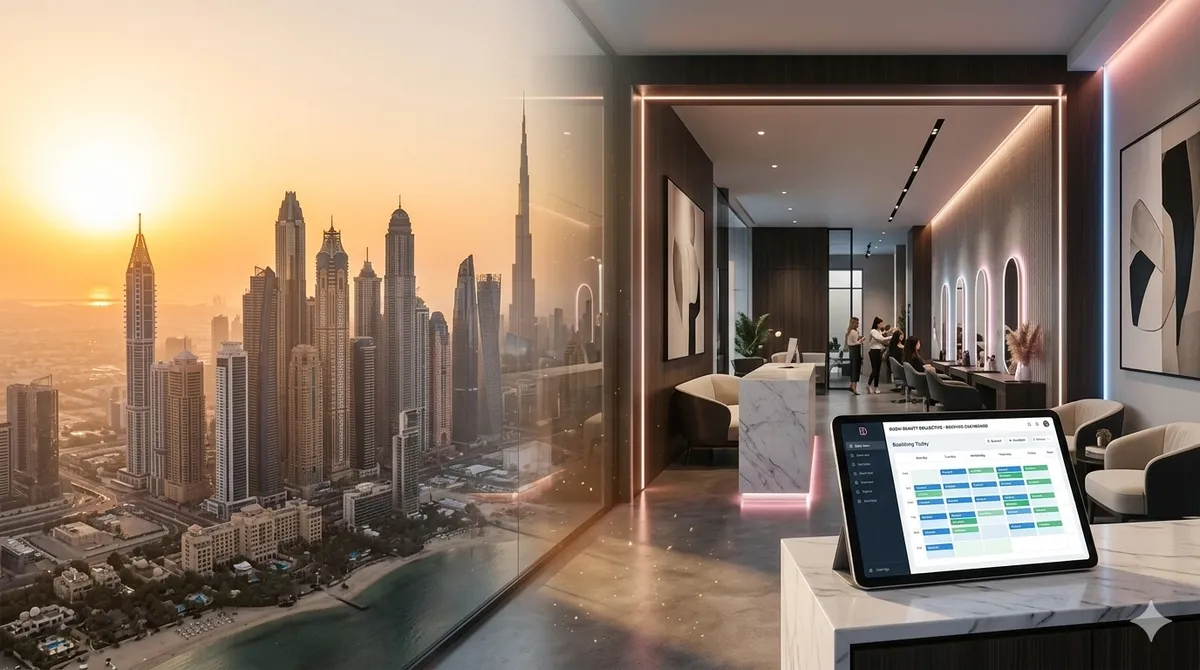
Dubai is one of the most competitive beauty markets on the planet. With over 5,000 salons and beauty centers operating across the Emirates, standing out requires more than great stylists and premium products. It requires operational excellence — and that starts with the right software.
But here is the challenge: most salon software reviews and comparison guides are written for the American or European market. They recommend platforms that do not support Arabic, cannot process AED payments natively, have never heard of ZATCA or UAE Federal Tax Authority requirements, and offer customer support only during US business hours — which means midnight in Dubai.
This guide is different. It evaluates salon software specifically through the lens of a UAE-based business owner, addressing the unique requirements that make or break a platform in this market.
What Makes the UAE Market Different
Before comparing specific platforms, it is important to understand why a salon in Dubai has fundamentally different software needs than one in New York or London.
Multilingual Operations Are Non-Negotiable
The UAE's population is approximately 88% expatriate. Your salon team likely includes Arabic speakers, South Asian staff, Filipino professionals, and European specialists. Your clients are equally diverse. Software that only operates in English creates friction for Arabic-speaking staff and clients. Software that only operates in Arabic alienates the significant English-speaking and other-language client base.
The ideal platform offers a fully bilingual Arabic-English interface — not just translated menu labels, but proper right-to-left (RTL) text support, Arabic search functionality, and bilingual booking pages that clients can switch between.
VAT Compliance Is a Legal Requirement
Since the UAE introduced Value Added Tax at 5% in 2018, every salon must issue VAT-compliant invoices. This means your POS system needs to automatically calculate VAT, generate invoices with your Tax Registration Number (TRN), and produce VAT return reports.
For salons also operating in Saudi Arabia, compliance becomes more complex. ZATCA (the Saudi Zakat, Tax and Customs Authority) has implemented mandatory e-invoicing requirements, and the regulations continue to evolve. Your software must stay current with these changes.
WhatsApp Is the Primary Communication Channel
In the UAE, WhatsApp is the dominant communication app. Most clients prefer to receive booking confirmations, reminders, and promotional messages via WhatsApp rather than email or SMS. Platforms with native WhatsApp Business API integration have a significant advantage over those relying on email-based communication.
The distinction between basic WhatsApp messaging and WhatsApp Business API integration is important. Basic integration simply sends text messages. Full API integration allows for interactive booking confirmations (with confirm, cancel, and reschedule buttons), automated conversation flows, rich media messages, and detailed delivery analytics.
Local Payment Methods Matter
While credit and debit cards are widely used, many UAE clients also use Apple Pay, Samsung Pay, and regional payment methods. Some salons still handle a significant volume of cash transactions. Your POS system should support all of these methods and handle AED pricing natively — not convert from USD or EUR.
Weekend and Holiday Schedules Are Unique
The UAE business week runs Sunday through Thursday for many companies, though the government sector shifted to a Monday-to-Friday, 4.5-day week in 2022. Salons operate seven days a week, but peak times differ from Western markets. Friday afternoons and Saturdays are peak salon days. Ramadan shifts operating hours significantly. Your scheduling software needs to accommodate these patterns flexibly.
The Landscape: Who Is Operating in the UAE Market
The UAE salon software market includes three categories of providers:
Global platforms with UAE presence. These are large international platforms like Fresha, Zenoti, and Booksy that serve the UAE as part of their global operations. They offer mature, feature-rich products but may lack local customizations.
MENA-focused platforms. These are companies built specifically for the Middle Eastern market. They typically offer Arabic-first interfaces, local compliance features, and regional customer support. Examples include WAJ, Salonist, Zylu, and Glamera.
Local Dubai-based providers. These are smaller companies serving primarily the UAE market with localized solutions, often bundling hardware with software. Examples include Zolmi, Bizmodo, Alpha EBM, Mass Technologies, and KeynesPOS.
Evaluating Platforms for the UAE Market
Here is a framework for assessing any salon software for UAE operations, organized by priority.
Priority 1: Core Operations
Appointment scheduling. Does the platform handle online booking with a client-facing booking page? Does it support Arabic and English? Can it manage complex service durations, multiple staff members, and room or equipment dependencies?
Client management. Does the CRM store comprehensive client profiles including service history, preferences, allergies, and communication preferences? Can you segment clients for targeted marketing?
POS and payments. Does the system support AED pricing, generate VAT-compliant invoices with TRN, handle split payments and tips, and integrate with local payment processors?
Priority 2: Communication and Marketing
WhatsApp integration. Does the platform offer native WhatsApp Business API integration or only basic messaging? Can you send automated booking confirmations, reminders, and marketing campaigns through WhatsApp?
Multilingual support. Is the entire interface available in Arabic with proper RTL support? Can booking pages be displayed in both Arabic and English? Are automated messages customizable in multiple languages?
Marketing automation. Can you set up automated campaigns triggered by client behavior — such as birthday messages, post-visit follow-ups, or re-engagement campaigns for inactive clients?
Priority 3: Compliance and Reporting
VAT compliance. Does the system automatically calculate and apply 5% VAT? Does it generate compliant invoices and VAT return reports? For multi-country operations, can it handle different tax rates and regulatory requirements?
Financial reporting. Does the platform provide detailed revenue reports, staff commission calculations, product sales tracking, and cash flow summaries? Can you export data for your accountant?
Data security. Where is client data stored? Does the platform comply with UAE data protection regulations? Is data encrypted in transit and at rest?
Priority 4: Scalability and Support
Multi-location management. If you operate or plan to operate multiple branches, does the platform support centralized management with per-location customization?
Local customer support. Is support available during UAE business hours? Can you reach support in Arabic? Is there a local office or representative for in-person assistance when needed?
Onboarding and training. Does the platform offer guided onboarding, data migration assistance, and staff training — ideally in Arabic?
The Fresha Question
Fresha deserves special attention because it is the most widely used salon platform in the UAE. Its marketplace has strong consumer adoption, and many Dubai salons rely on it for client acquisition.
However, Fresha's pricing model raises important questions for UAE salon owners. The platform charges 20% on new clients acquired through its marketplace. In a market as competitive as Dubai, where a significant portion of new clients discover salons through the Fresha marketplace, this commission can represent a substantial cost.
Additionally, Fresha transitioned from a free model to paid tiers in late 2024, which caused significant frustration among existing users who had built their operations around the platform's free offering. The lesson here is clear: relying heavily on a platform whose pricing model can change overnight carries risk.
UAE salon owners should evaluate whether Fresha's marketplace delivers enough incremental business to justify the commission, or whether investing in direct client acquisition (through Google, Instagram, and WhatsApp) combined with a zero-commission booking platform would be more cost-effective long-term.
Building Your Direct Booking Strategy in the UAE
Regardless of which software you choose, reducing dependence on third-party marketplaces should be a priority. Here is how:
Optimize your Google Business Profile. Most clients in the UAE search for salons on Google and Google Maps. A complete, well-maintained Google Business Profile with current photos, accurate hours, and a direct booking link is your most valuable free marketing asset.
Leverage Instagram effectively. Instagram is the social platform of choice for beauty in the UAE. Your booking link should be in your bio, in your stories, and referenced in every post. The visual nature of salon services makes Instagram a natural fit.
Use WhatsApp as a booking channel. Many UAE clients prefer to book via WhatsApp message. Having a software platform that can handle WhatsApp bookings — or at least provide a seamless link from WhatsApp to an online booking page — captures this behavior.
Encourage direct rebooking. After every appointment, prompt clients to rebook their next visit — either at the front desk or through an automated follow-up message. A client who rebooks before leaving has a near-zero no-show rate and never needs to rediscover your salon through a marketplace.
Making Your Decision
The right salon software for your UAE business depends on your specific situation:
If you are a single-location salon with 1-5 staff, prioritize ease of use, Arabic/English support, WhatsApp integration, and affordability. Avoid platforms that require long-term contracts or charge commissions.
If you are a growing salon with 6-20 staff, add staff management, commission tracking, detailed reporting, and marketing automation to your requirements. The ability to scale to multiple locations without switching platforms is a significant advantage.
If you are a multi-location chain, centralized management, inter-branch reporting, franchise support, and enterprise-level analytics become critical. Local customer support and compliance features are also more important at scale.
If you operate across multiple GCC countries, multi-currency support, country-specific tax compliance, and the ability to manage different regulatory environments from a single dashboard are essential.
Take the time to trial at least two or three platforms. Involve your front desk staff and your most tech-savvy stylist in the evaluation. And calculate the total cost of ownership — including commissions, payment processing fees, and add-on charges — not just the headline subscription price.
Sources and References
1. Zolmi. "Best Salon Software Dubai | Zolmi Salon Management System UAE." zolmi.ae — Local UAE salon software features and pricing.
2. Alpha EBM. "Salon and Spa Software Dubai | Salon Software UAE." alphaebm.com — GCC VAT compliance and local software solutions.
3. WAJ Blog. "WAJ vs CloudMeSoft 2025." waj.ai — UAE market feature comparisons and zero-commission model analysis.
4. The Salon Business. "The Ultimate Fresha Review 2026." thesalonbusiness.com — Fresha commission structure and marketplace model analysis.
5. Mordor Intelligence. "Salon & Spa Software Market - Report & Analysis." mordorintelligence.com — Regional market growth data and UAE salon industry statistics.
6. Software Advice. "Booksy Biz vs Fresha - 2026 Comparison." softwareadvice.com — Feature and pricing comparisons for UAE-relevant platforms.
7. Linktly. "Zenoti Salon/SPA Review 2025." linktly.com — Enterprise platform capabilities and Dubai office presence.
8. GlossGenius Blog. "Salon Booking Software: 9 Apps for Booking and Payments." glossgenius.com — Booking system features and payment processing comparisons.
9. Koalendar. "8 Best Salon Booking Software for Beauty Professionals." koalendar.com — Platform comparison criteria and feature analysis.
10. YouCanBookMe. "Best Fresha Alternatives for Salons and Spas." youcanbook.me — Alternative platform evaluations for markets beyond the US.
Follow WAJ on Google
Add WAJ as a preferred source to see more of our articles in your Google Search results, marked with a "preferred" badge.